

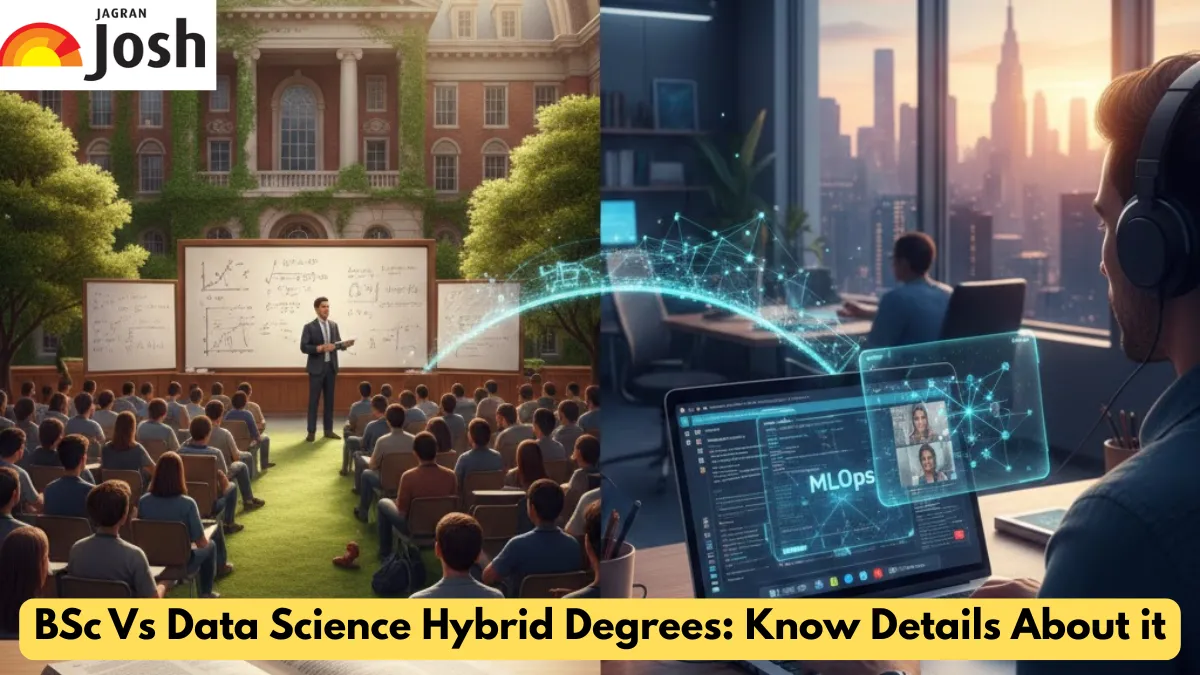
BSc Vs Data Science Hybrid Degrees: The landscape of data science education in 2026 is characterized by a deliberate division between hybrid (blended) degree models and traditional bachelor's degree programs, each of which serves different job paths. Students who want a foundation that is heavily reliant on research and academic depth continue to choose the Traditional BSc.
These on-campus programs, which emphasize the rigorous mathematical theories like linear algebra and computational statistics necessary to construct next-generation AI architectures from the ground up, provide immersive laboratory environments and one-on-one mentoring.
The Hybrid Degree, on the other hand, has become the "industry-first" path due to its radical flexibility. These programs reserve campus time for intense "sprint weekends" and group hackathons, while using asynchronous online modules for theoretical instruction. For working professionals and 2026 "digital nomad" learners who must study the newest production tools, such as MLOps, LLM fine-tuning, and Agentic AI, without taking a break from their professions, this methodology works especially well.
While a traditional degree provides a steady, 16-week semester pace that fosters deep peer networks, the hybrid model leverages real-time industry projects and virtual networking, often reducing tuition costs by 20–30%. Ultimately, the 2026 market values "hybrid technical fluency" professionals who can blend the statistical rigor of a traditional education with the rapid, tool-based agility of a blended learner to solve complex, real-world business challenges.
The Core Difference: Traditional vs. Hybrid
-
Model of Academic Delivery and Learning: Conventional degrees provide in-person laboratory sessions and lectures that are entirely on campus. On the other hand, hybrid models offer a well-rounded educational experience by combining adaptable online modules with sporadic, intense in-person immersions.
-
Program Length and Flexibility in Time: Traditional bachelor's degree programs have a set academic pace and last three or four years. With hybrid degrees, students can select accelerated or part-time routes, giving them a great deal of flexibility.
-
Networking Dynamics and Peer Interaction: Students on campus gain from regular in-person interactions and physical social networks. The main method of engagement for hybrid learners is virtual groups, which are augmented by planned monthly campus visits to foster business connections.
-
Curriculum Emphasis and Industry Preparedness: The conventional approach places a strong emphasis on mathematical underpinnings and in-depth academic theory. Practical industrial readiness is given top priority in hybrid programs, which concentrate on building extensive portfolios with cutting-edge technologies like MLOps and AI.
-
The cost of tuition and financial investment: Because university facilities and infrastructure expenses are required, traditional degrees are more expensive. Elite data science education is now financially accessible worldwide because to hybrid degrees, which are usually 20–30% less expensive.
Top Institutions Offering Hybrid/Modern DS Degrees (2026)
With top universities providing programs that blend the flexibility of online learning with the prestige of a traditional degree, the market for hybrid and modern data science degrees has grown by 2026. These programs are designed especially for working professionals and "career-switchers" who require a curriculum that is in line with industry standards without requiring full-time college residency.
| Institution | Degree Name | Model Type | Key Industry Focus |
| BS in Data Science & Applications | Hybrid / Multi-Exit | Full-Stack DS, Application Dev, Programming. | |
| B.Sc./M.Sc. in AI & Data Science | Hybrid (Digital) | AI Engineering, MLOps, Business Strategy. | |
| Georgia Tech | MS in Analytics (Hybrid Track) | Interdisciplinary | Business Intelligence, Operations Research. |
| eMasters in Data Science & BA | Executive Hybrid | Advanced Predictive Modeling, Business Analytics. | |
| M.Sc. in Data Science (Online/Hybrid) | Blended | Big Data Analytics, Data Visualization. | |
| HEC Paris / École Poly. | MSc Data Science & AI for Business | Elite Hybrid | AI Leadership, Ethics, Fintech & Management. |
| Executive PG Cert in Data Science | Executive Hybrid | Machine Learning, Big Data Infrastructure. |
Related Searches:
-
Which Institute Is Best For Marine Engineering In The World?
-
Which Government Engineering Colleges in Maharashtra Have High Placements?
To stay updated on current trends, join the Jagran Josh Telegram Community!