

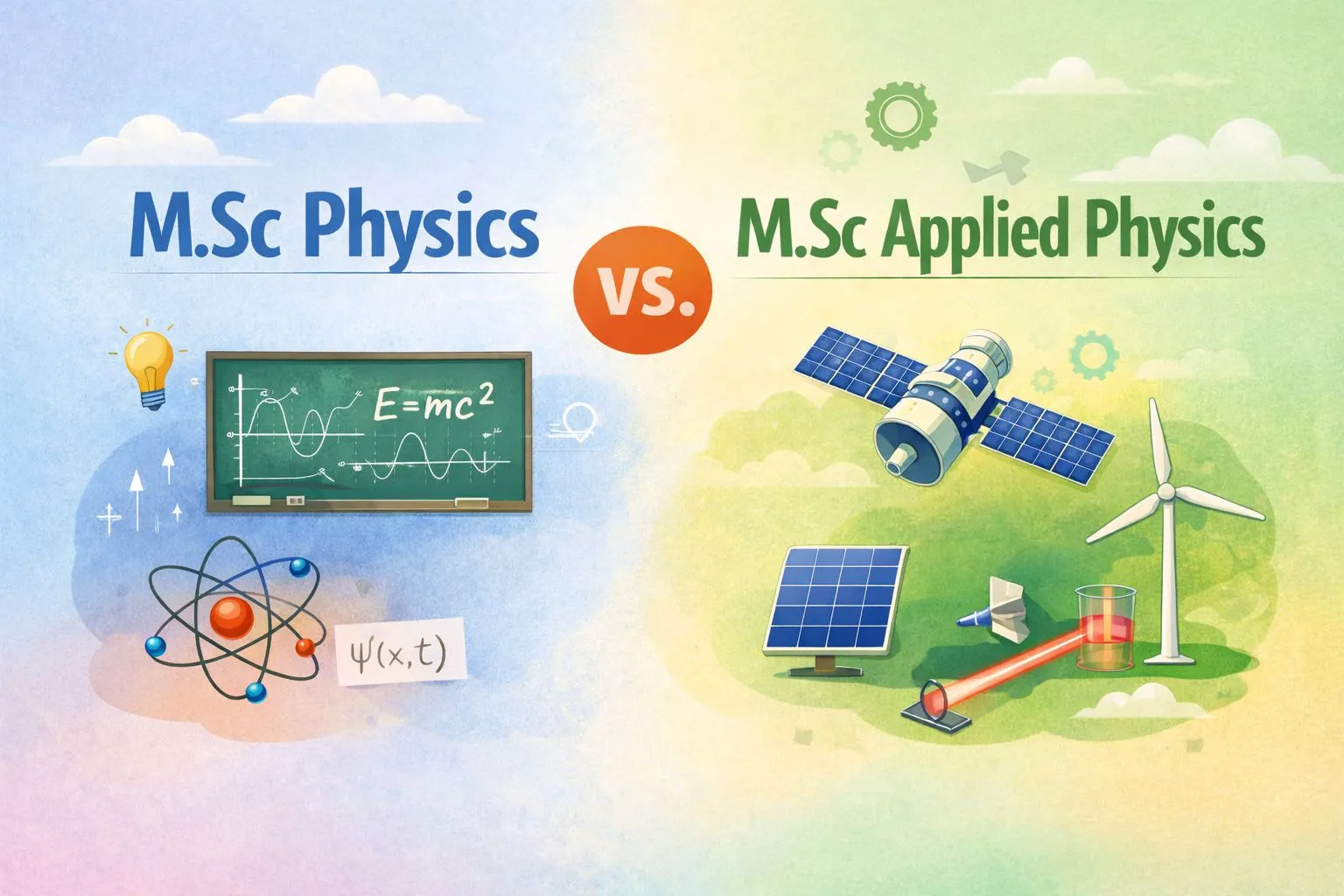
When looking for a Master's degree in science, you will usually find two options: Physics and Applied Physics. Both study how our world works, but they take you on different paths. One is about understanding big ideas, and the other is about creating new inventions.
Also check: M.Sc Data Science vs. M.Sc Data Analytics: Which One to Choose?
What is M.Sc Physics?
Think of M.Sc Physics as a way to learn the big secrets of the universe. It looks at the basic rules of nature to explain why everything happens, from tiny particles to giant stars in space.
-
What you study: You spend time studying math and big ideas. You learn about how things fall to the ground, how the tiniest pieces of the world move, and how the whole universe started.
-
The Goal: To understand the rules of nature.
-
Best for: People who love reading, solving hard math problems, and want to work in teaching or research.
What is M.Sc Applied Physics?
Think of M.Sc Applied Physics as the bridge between science and engineering. It takes those deep laws of nature and asks, "How can we use this to build something useful?"
-
What you study: You still learn physics, but focus more on hands-on tools and technology. You might study lasers, medical imaging (like X-rays), or how to make faster computer chips.
-
The Goal: To use science to solve real-world problems and create new technology.
-
Best for: People who like to build things, work in labs, and want a job in industry or technology companies.
Comparison

Which One Should You Choose?
The right choice depends on your dream job:
-
Choose M.Sc Physics if you want to become a professor, spend your life researching the mysteries of space or atoms, or eventually get a Ph.D. in science.
-
Choose M.Sc Applied Physics if you want to start working in a high-tech company right away, enjoy making gadgets, or want to work in fields like medicine, energy, or electronics.
Both choices are great and lead to good careers. Just think about what you like more: finding new answers in a book or building new tools in a lab!
Also check: B.E. vs. B.Tech: What’s the Difference?