

Scribe of Species: Zoology is the science degree referred to as "The Scribe of Species" since it is concentrated on the two pillars of taxonomy and systematics. The field's fundamental duty to record, characterize, and preserve the "biographies" of all living things on Earth is reflected in this honorific.
A zoologist is the scribe who physically catalogs the enormous diversity of the animal kingdom, whereas a geneticist may be thought of as the Cryptographer of Codons, deciphering the internal digital script of life. They guarantee that every species is accurately recognized, given a name, and positioned within the worldwide "Tree of Life."
The fundamental duty of the field to record, characterize, and preserve the "biographies" of all living things on Earth is reflected in this honorific. A zoologist is the scribe who physically catalogs the enormous diversity of the animal kingdom, whereas a geneticist may be thought of as the Cryptographer of Codons, deciphering the internal digital script of life. They guarantee the accurate identification, naming, and placement of every species within the worldwide "Tree of Life."
The "Scribe" has developed into a very accurate digital curator in the scientific scene of 2026. In order to resolve "cryptic species" creatures that appear identical but are genetically different modern zoologists use Integrative Taxonomy, which combines traditional morphological "biopsies" (physical descriptions) with DNA barcoding and nanoCT scanning. By upholding the International Code of Zoological Nomenclature (ICZN), they offer the universal Latin "script" that enables researchers in Tokyo and London to perfectly converse about the same organism.
Why Zoology is Known as the "Scribe of Species"?
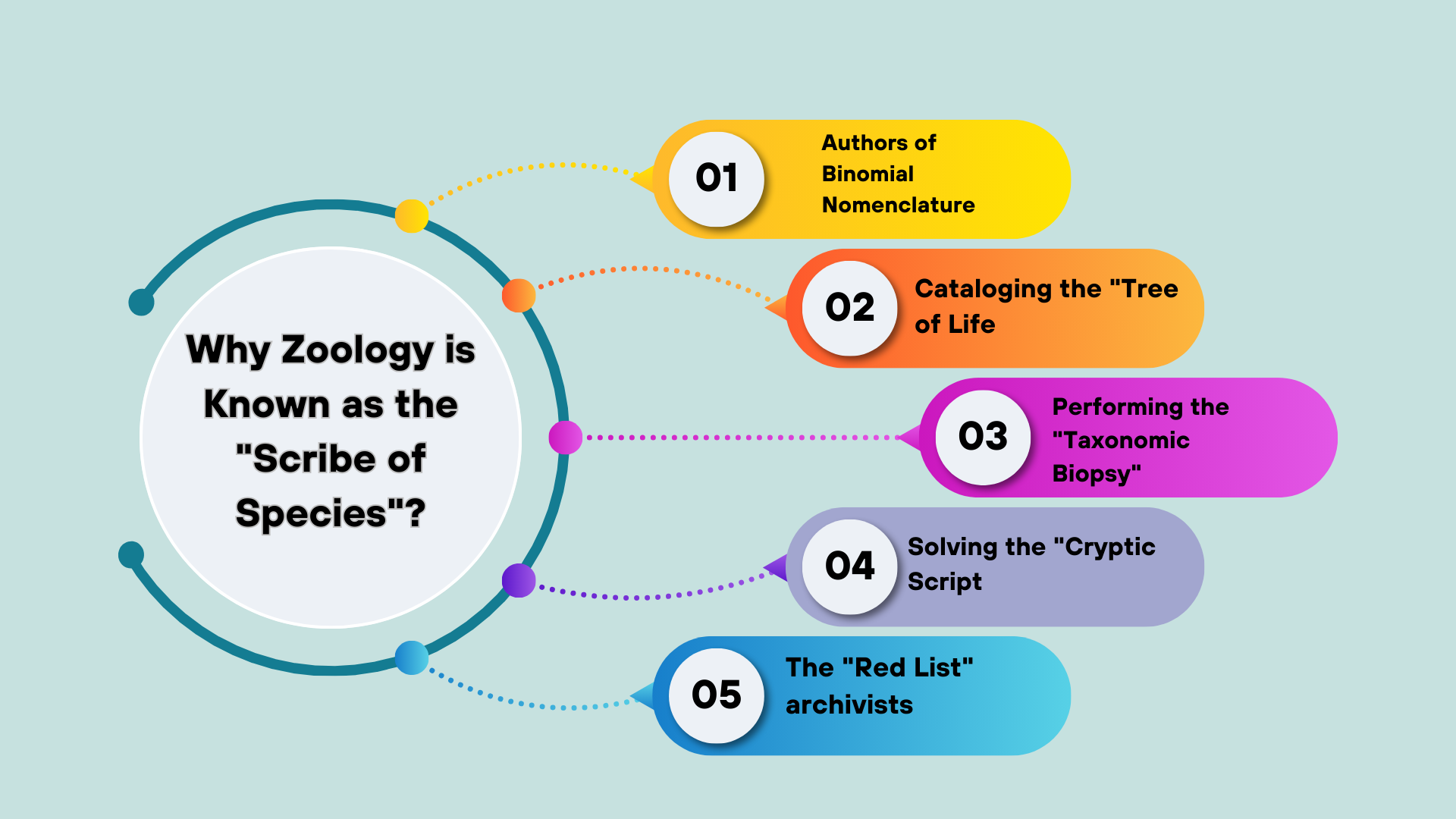
Since zoology is the official record-keeper of the animal kingdom, it is often referred to as the "Scribe of Species." Zoology concentrates on the precise documenting of life itself, whereas other sciences may change or utilize biological systems. Here are six reasons why the title "Surgical" is fitting:
-
Authors of Binomial Nomenclature: Zoologists give each animal a distinct, two-part Latin name (such as Panthera tigris) using the Linnaean method. This serves as a universal "scientific script," guaranteeing clarity in a variety of languages and cultural contexts.
-
Cataloging the "Tree of Life": Zoologists physically arrange species into a methodical hierarchy using taxonomy. As "Librarians of Life," they assign each organism to its proper Phylum, Class, and Genus based on both genetic and observable characteristics.
-
Performing the "Taxonomic Biopsy": The "Scribe" conducts a thorough characterization upon the discovery of a new species. By recording morphological, anatomical, and behavioral "vital signs," they guarantee that a permanent, peer-reviewed record is kept in the world's biological archives.
-
Solving the "Cryptic Script": Zoologists utilize DNA barcoding to differentiate between "Cryptic Species" animals that share the same appearance but differ genetically. They rewrite the data in their capacity as "Microscopic Detectives," ensuring that hidden biodiversity is correctly identified.
-
The "Red List" archivists: Zoologists offer the information for the IUCN Red List by tracking population trends. They record which animal kingdom "chapters" are flourishing and which are getting close to the "Final Page" of extinction.
-
Maintaining the "Museum of Existence": In museums, zoologists keep extensive physical specimen archives. These "Biological Repositories" preserve the "original manuscripts" of Earth's varied animal life, acting as the final tangible evidence of a species' existence.
Career Roles for the "Scribe of Species"
In 2026, the "Scribe of Species" made the switch from conventional paper-and-ink cataloging to a cutting-edge "Bio-Digital Architect." In order to monitor the planet's changing biodiversity, career possibilities for Zoology graduates especially those with a focus on Taxonomy and Systematics now incorporate AI-driven species identification, DNA barcoding, and Geographic Information Systems (GIS).
| Professional Title | Metaphorical Avatar | Key "Surgical" Focus | Average Salary (India) |
| Taxonomist | The Curator of Classification | Using DNA Barcoding to resolve cryptic species and update the "Tree of Life." | ₹6L – ₹12L |
| Wildlife Biologist | The Chronicler of Conduct | Tracking population "Vital Signs" using AI-driven camera traps and telemetry. | ₹4.5L – ₹9L |
| Research Scientist | The Cryptographer of Codons | Conducting genomic research for drug discovery and evolutionary "biopsies." | ₹6L – ₹15L |
| Museum Curator | The Librarian of Life | Digitizing physical specimen archives into Global Biodiversity Databases. | ₹5L – ₹10L |
| Ecological Consultant | The Sentinel of Species | Performing Environmental Impact Assessments (EIA) for green infrastructure projects. | ₹5L – ₹8L |
| Conservation Officer | The Warden of the Wild | Enforcing "Biological Sovereignty" and managing protected habitat networks. | ₹4L – ₹8.5L |
| Science Communicator | The Herald of Heritage | Translating complex "Species Scripts" for National Geographic, Discovery, or NGOs. | ₹4L – ₹7L |
Related Searches:
-
Top IITs in QS Asia Rankings 2026 - Indian Engineering Institutes Ranking
-
Guide to FMS Delhi Application: Course Fees and Other Details
Also Read:
Top IIT Colleges That Offer Data Science Courses to Learn Online in 2025
Best Free AI Courses for Beginners in 2025
Best Pharmacy Colleges in India 2025 After 12th Offering High Job Placement
To stay updated on current trends, join the Jagran Josh Telegram Community!