

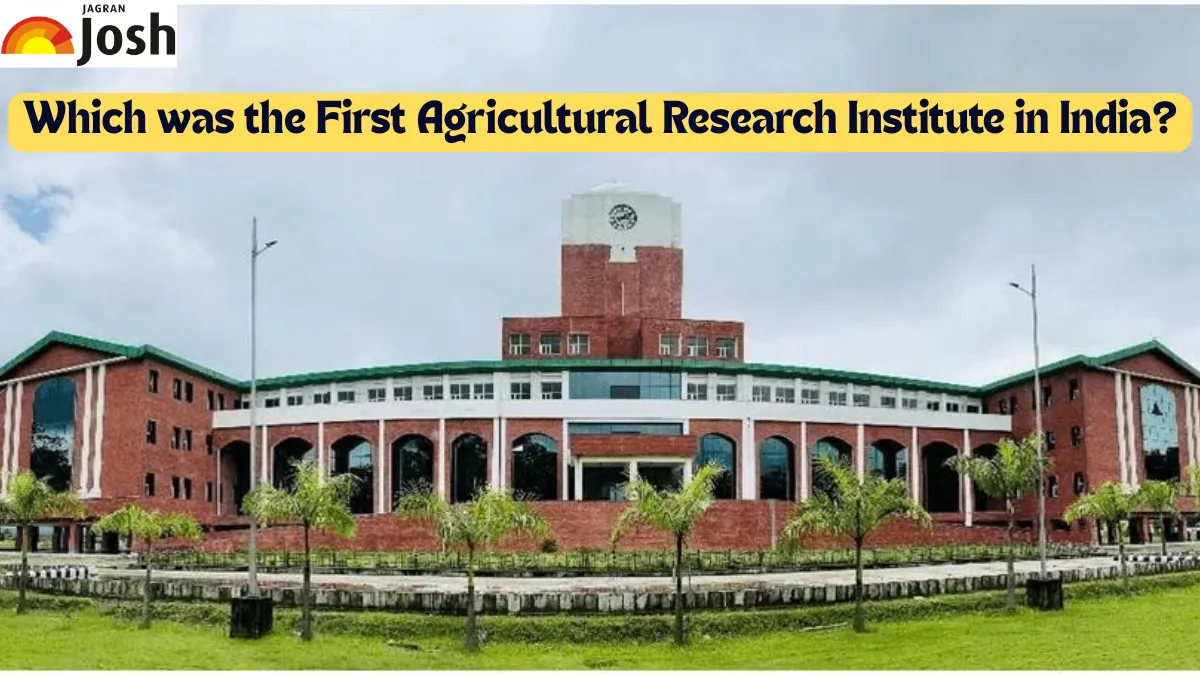
Key Points
- IARI, founded April 1, 1905, in Pusa, Bihar, was initially named Agricultural Research Institute.
- Relocated to New Delhi in 1936 after a major earthquake destroyed the original campus.
- IARI drove India's Green Revolution (1960s-70s) with high-yielding wheat varieties.
Agricultural Research Institute in India: The foundation of organized agricultural research in India is the Indian Agricultural Research Institute (IARI), also referred to as the Pusa Institute. It was established on April 1, 1905, at Pusa, Bihar, thanks to a kind donation of £30,000 from Lady Curzon's close friend and American philanthropist Henry Phipps Jr. Agriculture, Cattle Breeding, Chemistry, Economic Botany, and Mycology were its five main departments when it was first established as the Agricultural Research Institute (ARI). It changed its name multiple times during the ensuing decades, becoming the Imperial Agricultural Research Institute in 1919 and the Imperial Institute of Agricultural Research in 1911.
The history of the institute changed drastically on January 15, 1934, when the famous Phipps Laboratory and other campus buildings in Bihar were seriously destroyed by a terrible earthquake. The decision to move the institute to a more stable and central location was spurred by this natural tragedy. As a result, the IARI moved to its present 500-hectare campus in New Delhi in 1936, which Lord Linlithgow, the Viceroy at the time, officially opened. It was formally titled the Indian Agricultural Research Institute when India gained independence in 1947.
As the main catalyst for the Green Revolution, the IARI had its greatest influence in the 1960s and 1970s. The institute contributed to India's transformation from a food-scarce country to a self-sufficient exporter by creating high-yielding, rust-resistant wheat varieties including Sonalika and Kalyan Sona. Acknowledged as a Deemed University in 1958, it remains the "Mother of ICAR institutions," spearheading 21st-century advancements in biotechnology, sustainable agriculture, and food security.
Courses Offered By Indian Agricultural Research Institute (IARI)
As a prestigious "Deemed to be University," the Indian Agricultural Research Institute (IARI) provides a variety of academic programs aimed at upgrading Indian agriculture. These programs are extremely competitive, and entrance exams at the national level are the main method of admission.
| Course Level | Degrees Offered | Eligibility Criteria | Entrance Exam |
| Undergraduate | B.Sc. (Hons) Agriculture, B.Sc. (Community Science), B.Tech (Agri. Engg), B.Tech (Biotech) | 10+2 with Physics, Chemistry, and Biology/Maths | CUET (UG) |
| Postgraduate | M.Sc., M.Tech., MCA | Bachelor’s degree in Agriculture or allied sciences | ICAR AIEEA (PG) |
| Doctoral | Ph.D. | Master’s degree in relevant agricultural discipline | ICAR AICE-JRF/SRF (Ph.D) |
List of Specializations (PG & Ph.D.)
IARI provides chances for advanced research in 28 different fields. These can be divided into different schools of thought:
| School | Key Specializations |
| Crop Improvement | Genetics & Plant Breeding, Seed Science & Technology, Plant Genetic Resources |
| Plant Protection | Entomology, Plant Pathology, Nematology, Agricultural Chemicals |
| Basic Sciences | Biochemistry, Plant Physiology, Molecular Biology & Biotechnology, Microbiology |
| Natural Resource Management | Agronomy, Soil Science, Environmental Science, Water Science & Technology |
| Social Sciences | Agricultural Economics, Agricultural Extension, Agricultural Statistics |
| Horticultural Science | Fruit Science, Vegetable Science, Floriculture & Landscaping, Post-Harvest Management |
| Engineering & IT | Agricultural Engineering, Computer Applications, Bioinformatics |
Evolution of the Institute And Fee Structure
-
Pusa Era (1905–1934): The first of its sort in India, it was established in Pusa, Bihar. The Agricultural Research Institute (ARI) was its original name.
-
The Great Shift (1936): The institute was relocated to New Delhi after a devastating earthquake struck Bihar in 1934. This move was crucial because it put the institute at the forefront of national policy-making.
-
Green Revolution (1960s–1970s): By creating high-yielding "Pusa" rice and wheat cultivars, IARI became the scientific driving force behind India's food self-sufficiency.
-
Modern Expansion (2015–Present): The institute added two new mega-campuses, IARI-Jharkhand (Barhi) and IARI-Assam (Gogamukh), to solve local agricultural issues. In order to close the gap between research and practical farming, these campuses will continue to host significant "Kisan Melas" and industry gatherings in 2026.
Fee Structure (Academic Session 2026-27)
IARI is known for providing world-class education at highly subsidized rates. Below is the approximate total fee structure for the entire duration of the programs.
| Course Level | Degrees Offered | Total Course Fee (Approx.) | First Year Fee (Indicative) |
| Undergraduate | B.Sc. (Hons) Agriculture, B.Tech | ₹51,850 | ₹15,000 – ₹18,000 |
| Postgraduate | M.Sc., M.Tech. | ₹52,600 | ₹27,250 |
| Doctoral | Ph.D. | ₹65,050 – ₹75,200 | ₹29,250 |
Related Searches