

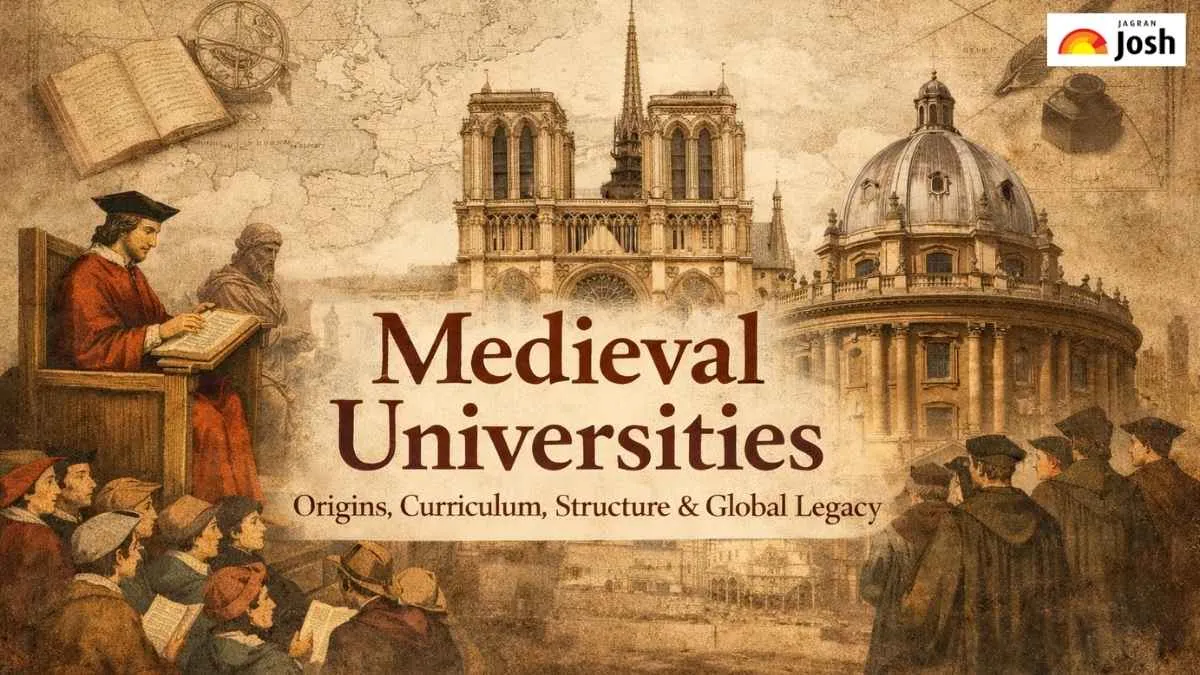
The emergence of the medieval universities marked one of the most significant institutional developments in European intellectual history. Unlike monasteries or cathedral schools that preceded them, universities were legally recognised corporations of masters and students, possessing defined privileges, charters, and administrative autonomy. Institutions such as the following became foundational models for higher learning:-
-
University of Oxford
-
University of Paris
-
University of Bologna
For a college student today, understanding medieval universities is not merely about history; it is about understanding where modern degree systems, faculties, examinations, and titles originated. This institutional continuity explains why contemporary universities still use structures first formalised between the 11th and 13th centuries.
What was the Academic Origin of the Medieval Universities?
The medieval universities did not emerge overnight. It evolved from cathedral schools that offered theological instruction under supervision.
-
During the Late Middle Ages and Early Modern period, universities hosted a significant amount of natural philosophy, mathematics, and medicine activity.
-
Universities of Bologna, Paris and Oxford were the first three foundations, but dozens more followed over the next few centuries.
-
Almost all universities became self-governing organisations with funding from both the church and the state.
-
The primary function of these universities was to train individuals to be lawyers, physicians, and theologians, but they were also increasingly utilised by the gentry to teach their sons the cultural skills which was required for courtly life.
(Source of information:- University of Cambridge)
What was the Curriculum of the Medieval Universities?
Universities played an important role in developing scientific inquiry during the Middle Ages. The medieval university, like the present-day higher education institutions, prepared young students for a future job, but, unlike today’s schools, students’ final career path after graduation was with the church. This fact had a tremendous impact on the curriculum at the medieval university. The major curriculum is centred on seven academic areas that would offer a young student a ‘liberal arts’ education while also preparing him for a career as a Catholic Chruch cleric.
Given below is the division of the seven liberal arts, which was divided into two categories and included in the curriculum of the medieval universities:-
|
(Source of Information:- https://sites.udel.edu/britlitwiki/the-medieval-university)
Medieval universities were more than just educational organisations; they were organised enterprises with formal governance, degrees, and intellectual methodologies. Their institutional designs continue to serve as the cornerstone for modern higher education around the world.
Related Searches:-