

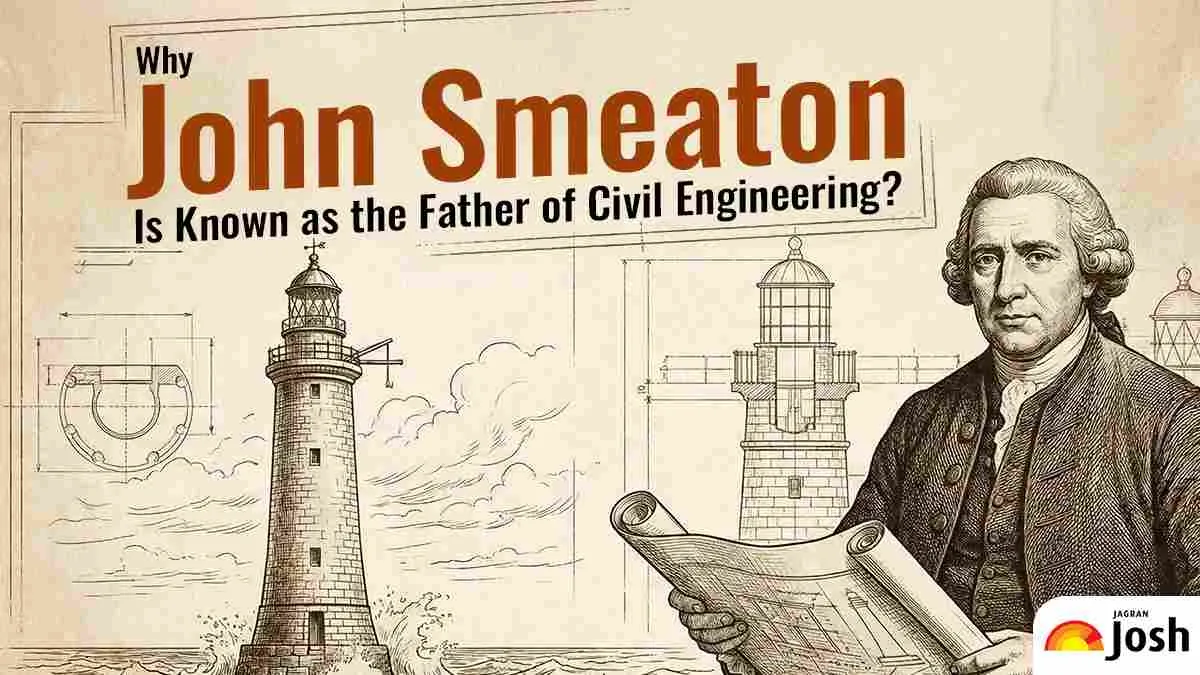
As an engineering aspirant, understanding the origins of the discipline is as important as mastering and learning its principles and formulas and software tools. Civil Engineering in the present day is a structured profession which is governed by scientific methods, ethics, and standards. However, this is not always the case. Long before, most of the large-scale construction projects were either executed by military engineers or skilled craftsmen, without being awarded a distinct professional identity.
There might be this one question, which might have been discussed often in academic discussions, introductory engineering courses or entrance examinations, ‘why is John Smeaton known as the father of civil engineering?’ Let’s explore!
Who was John Smeaton?
Before we explore why John Smeaton was known as the ‘father of civil engineering,’ it is important to understand who he was and how he gained this title.
John Smeaton was born on June 8, 1724, in Leeds, Yorkshire. He was originally trained as a carpenter, but his enthusiasm and ability for engineering drove him to pursue independent studies in subjects like mechanics and mathematics. Although his official engineering education is very unusual, his independent research served as the basis for his subsequent innovations. His contributions to hydraulic engineering, especially his advancements in pumping engines and watermills, were among his greatest accomplishments.
John Smeaton coined the term civil engineering to differentiate it from military engineering and elevate its previously considered status as a craft-based occupation to a scientific profession.
| Civil Engineering as defined by John Smeaton:- He defined civil engineering as the work that benefits the public. His designs and plans were unparalleled in clarity and logic, and his revolutionary approach to engineering practice continues to influence civil engineering today. |
John Smeaton also became one of the most in-demand consulting civil engineers in the second half of the 18th century. Joh Smeaton is also credited for establishing the world’s first engineering society, known as the Society of Civil Engineers, in 1771. This society has now evolved into the Smeatonian Society of Civil Engineers after him.
List of Top 5 Achievements of John Smeaton
Unlike any builders of his period, John Smeaton had a unique approach to various engineering problems, like approaching any problem through testing, measurement, and observation. He was among the first to apply scientific principles systematically to design various infrastructure, such as:-
-
Bridges
-
Canals
-
Harbours
Most importantly, he described himself as a civil engineer, and this self-identification marked a significant turning point in the professional history of engineering.
Given below is the list of the top five achievements of John Smeaton, the father of civil engineering:-
| Achivements | About | Pictures |
| Eddystone Lighthouse |
|
|
| Coldstream Bridge, River Tweed |
|
|
| Aire and Calder Navigation Canal |
|
|
| Royal Harbour, Ramsgate |
|
|
| Wheal Busy, Cornwall |
|
|


(Source:- The information and pictures have been taken from the History England blog and the Institution of Civil Engineers.)
John Smeaton is known as the father of civil engineering because he defined this profession, established the first civil engineering society, and applied scientific methods to infrastructure design. His work transformed engineering from a craft-based activity into a structured, professional discipline.
Related Searches:-