

Engineering Mathematics: Even though engineering is more varied than ever in 2026, some mathematical principles are still applicable. Calculus (including Differential Equations) and Linear Algebra are generally regarded as the most important in practically all engineering specialties, though the "most used" branch may change depending on specialization.
The major language used to model physical systems is still calculus. Rates of change, such as a vehicle's velocity, the stress on a bridge under load, or the fluid dynamics across a wing, are described by it in mechanical, civil, and aerospace engineering. The "bread and butter" of engineering is differential equations, which are a direct extension of calculus and enable experts to forecast how dynamic systems will behave over time.
The importance of linear algebra has increased dramatically at the same time. The framework for managing large datasets and multi-variable systems is provided by linear algebra, as engineering activities depend more and more on computer simulations and artificial intelligence.
Robotics (Kinematics), Signal Processing, and Structural Analysis (Finite Element Method) all require matrices and vectors. When an engineer uses software to solve an issue in 2026, "secret" linear algebra is very likely being used behind the scenes.
Why Calculus And Linear Algebra Is Most Widely Used in Engineering?
These fields are known as the "twin engines" of engineering because they enable experts to explain structure and change in both the real and virtual worlds.The table below outlines why these specific branches are non-negotiable for modern engineers.
| Feature | Calculus (The Math of Change) | Linear Algebra (The Math of Structure) |
| Primary Goal | To model how a system behaves or changes over time and space. | To manage and solve systems with thousands of variables simultaneously. |
| Core Concept | Derivatives (rates) and Integrals (accumulation). | Matrices, Vectors, and Eigenvalues. |
| Common Uses | Fluid dynamics, thermodynamics, and predicting structural stress. | Machine learning, robotics kinematics, and electrical circuit networks. |
| Daily Tool Example | Designing a bridge to withstand wind resistance (using differential equations). | Running a simulation in MATLAB to optimize a drone's flight path (using matrices). |
| 2026 Shift | Essential for optimizing Energy Efficiency in "Green Tech." | Essential for Generative AI and Processing Large Engineering Datasets. |
Impacts Of Calculus And Linear Algebra in Engineering
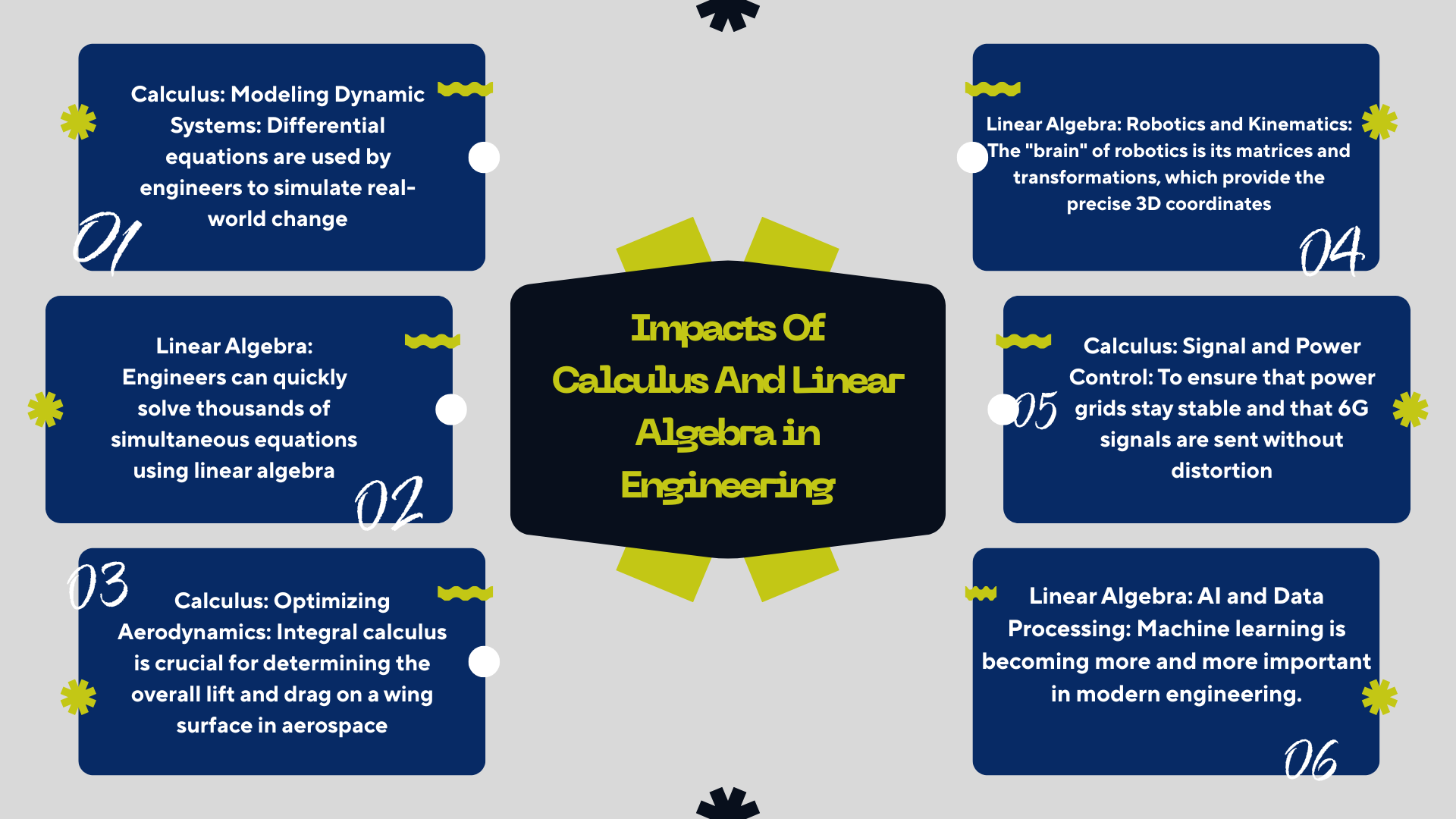
In 2026, the foundation for almost all technological developments—from autonomous robotics and generative AI to sustainable infrastructure is provided by the synergy between calculus and linear algebra.
-
Calculus: Modeling Dynamic Systems: Differential equations are used by engineers to simulate real-world change, such as how heat dissipates in a high-performance EV battery or how a skyscraper sways during an earthquake.
-
Linear Algebra: Engineers can quickly solve thousands of simultaneous equations using linear algebra, which makes it possible for sophisticated simulations like Finite Element Analysis (FEA) to assess structural integrity prior to construction starting.
-
Calculus: Optimizing Aerodynamics: Integral calculus is crucial for determining the overall lift and drag on a wing surface in aerospace, assisting designers in maximizing stability and fuel efficiency in turbulent situations.
-
Linear Algebra: Robotics and Kinematics: The "brain" of robotics is its matrices and transformations, which provide the precise 3D coordinates and joint rotations needed for a robot arm to operate.
-
Calculus: Signal and Power Control: To ensure that power grids stay stable and that 6G signals are sent without distortion, electrical engineers use calculus to evaluate alternating currents and electromagnetic fields.
-
Linear Algebra: AI and Data Processing: Machine learning is becoming more and more important in modern engineering. The fundamental tool for processing large datasets, training neural networks, and carrying out image recognition in autonomous cars is linear algebra.
Related Searches:
-
Top IITs in QS Asia Rankings 2026 - Indian Engineering Institutes Ranking
-
Guide to FMS Delhi Application: Course Fees and Other Details
Also Read:
Top IIT Colleges That Offer Data Science Courses to Learn Online in 2025
Best Free AI Courses for Beginners in 2025
Best Pharmacy Colleges in India 2025 After 12th Offering High Job Placement
To stay updated on current trends, join the Jagran Josh Telegram Community!