

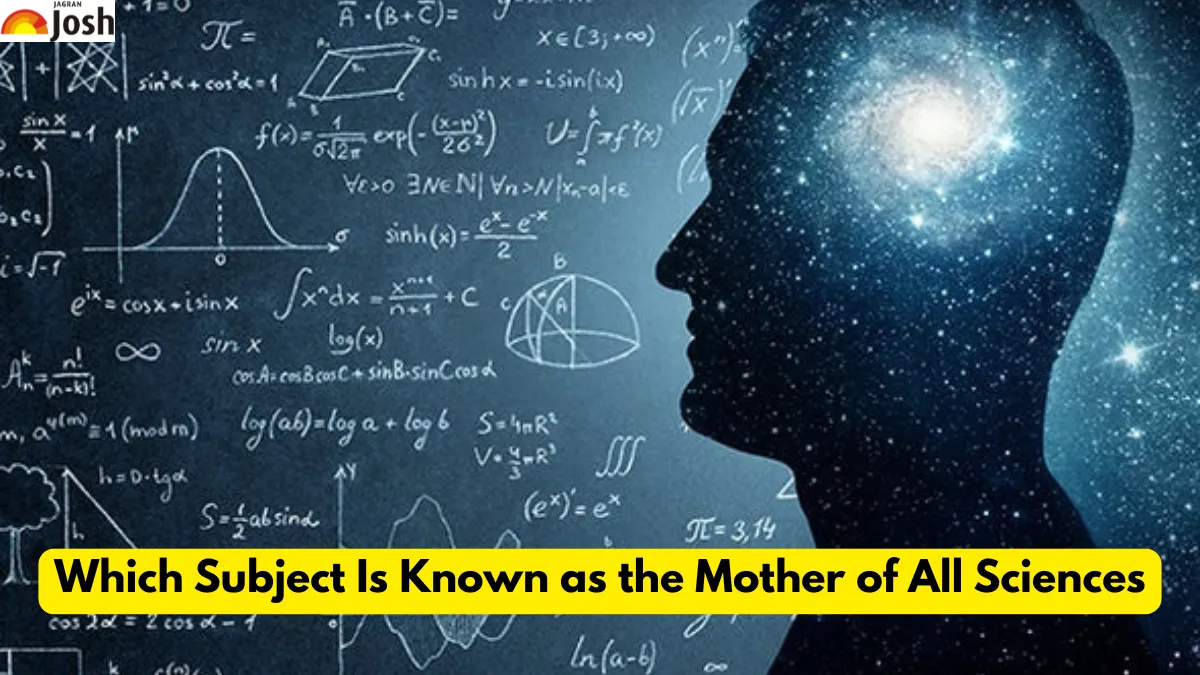
Mathematics: The term "Mother of All Sciences" is most commonly given to mathematics, highlighting its function as the fundamental language and indispensable instrument for all other scientific fields.
While historically philosophy was the progenitor of all knowledge, mathematics earned its maternal title because it provides the structural framework of quantity, structure, and space upon which the "hard sciences" are built.
The universe is a book written in "mathematical language," with triangles, circles, and other geometric shapes serving as the characters, as Galileo Galilei famously said.
The intricacies of chemical reactions or biological systems could never be accurately represented or predicted without this language, and the laws of physics would remain qualitative observations.
With the growth of AI-driven research in 2026, this function has only become more prominent. Mathematics is the ultimate "problem-solving engine," whether it is used to understand the human genome, forecast climate patterns, or design subatomic experiments at CERN.
By converting physical experiences into numerical data, it enables scientists to spot patterns that might otherwise go unnoticed.
The truths of mathematics are obtained from rigorous logical inference and axioms, offering an absolute certainty that other sciences aim to imitate, whereas other sciences rely on empirical data that can be refined or overturned.
Its reputation as the "cradle of creation," where every advancement in technology, engineering, and medicine starts with a calculation, secures its position as the real mother of all sciences.
Why Is Mathematics Known As The Mother of All Sciences?
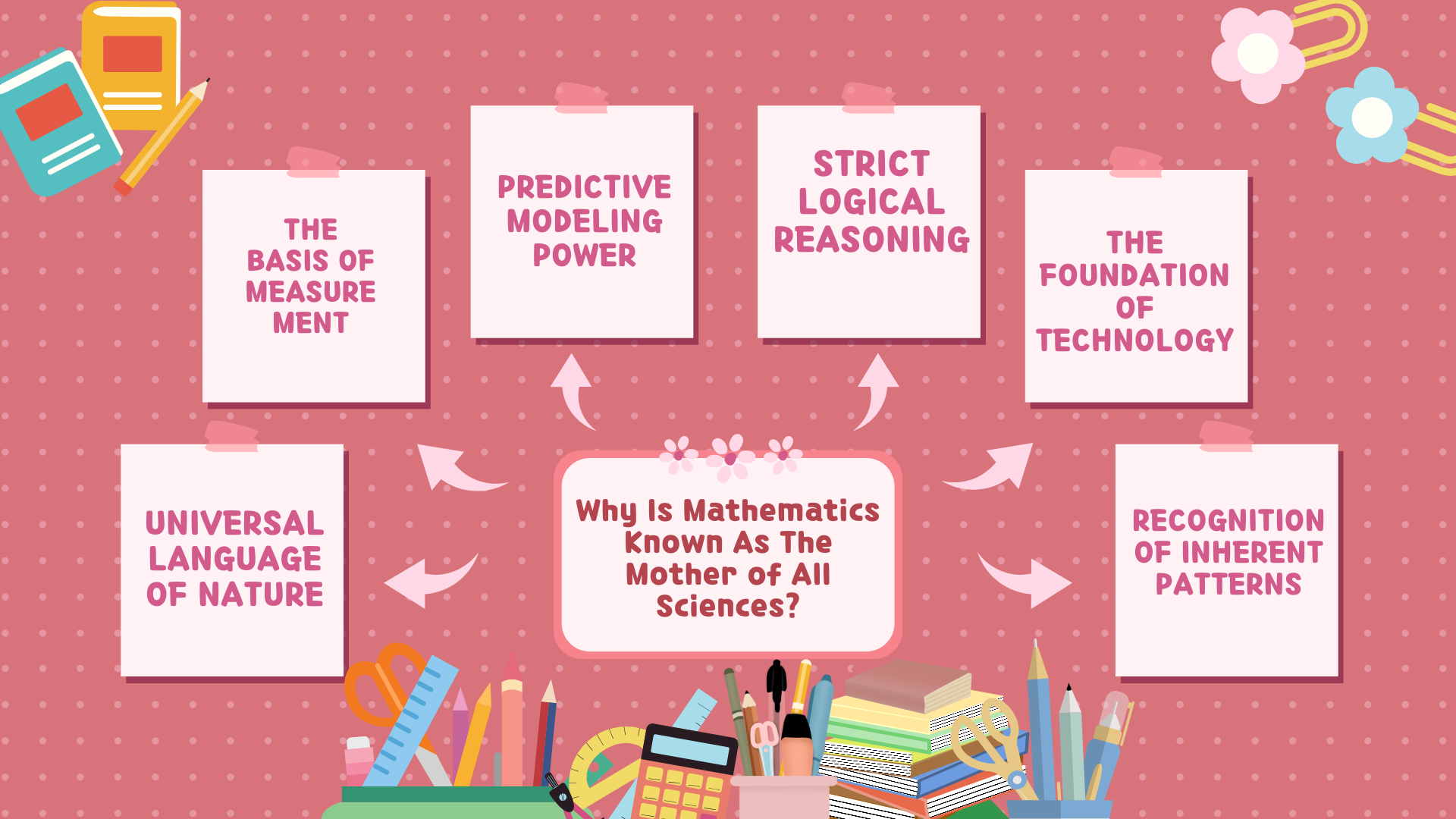
Many refer to mathematics as the "Mother of All Sciences" since it is the fundamental basis and main instrument for all other scientific fields. This term is still more applicable in 2026 as we depend more on sophisticated algorithms and worldwide data.
-
Universal Language of Nature: Scientists from all over the world can convey complicated concepts and natural laws without being hindered by language or cultural differences thanks to mathematics' standardized set of symbols and grammar.
-
The Basis of Measurement: The ability to quantify observations is fundamental to all sciences. By converting physical phenomena such as temperature, mass, or speed into numerical values, mathematics enables accurate comparisons and the discovery of patterns.
-
Predictive Modeling Power: Scientists build models that mimic real-world processes using equations. From a spacecraft's route to the propagation of a virus, these mathematical frameworks enable us to forecast future events.
-
Strict Logical Reasoning: The foundation of the "scientific method" is mathematical reasoning. It teaches researchers how to use deductive reasoning to verify theories with absolute confidence and how to divide complicated issues into manageable chunks.
-
The Foundation of Technology: Mathematics is the "cradle of creation" that transforms theoretical knowledge into useful, life-saving technology, from the 0s and 1s of computer code to the architectural blueprints of smart cities.
-
Recognition of Inherent Patterns: Nature is essentially mathematical. The universe follows a fundamental mathematical order that other sciences merely interpret, as demonstrated by patterns like the elliptical orbits of planets and the Fibonacci sequence in sunflowers.
Career Scope In Mathematics
Graduates in mathematics now have a wide range of job options beyond traditional teaching and research in 2026. As the world grows more "data-centric" and "AI-driven," mathematicians are the creators of the models and algorithms that drive the world economy.
| Industry | Role | Primary Responsibility |
| Artificial Intelligence | Machine Learning Engineer | Developing complex algorithms and neural networks for autonomous systems and LLMs. |
| Finance & Fintech | Quantitative Analyst (Quant) | Designing mathematical models to price securities, manage risk, and automate high-frequency trading. |
| Data Science | Data Scientist / Architect | Extracting actionable insights from "Big Data" using statistical modeling and predictive analytics. |
| Actuarial Science | Actuary | Utilizing probability and statistics to assess risk for insurance companies and pension funds. |
| Cybersecurity | Cryptographer | Creating and breaking encryption codes to secure digital communications and blockchain networks. |
| Aerospace & Defense | Systems Modeler | Calculating trajectories, structural stresses, and fluid dynamics for spacecraft and defense tech. |
| Operations Research | Supply Chain Optimizer | Using mathematical optimization to streamline logistics and global manufacturing efficiency. |
| Healthcare | Biostatistician | Designing clinical trials and analyzing biological data to track disease outbreaks or drug efficacy. |
Related Searches:
-
Top IITs in QS Asia Rankings 2026 - Indian Engineering Institutes Ranking
-
Guide to FMS Delhi Application: Course Fees and Other Details
Also Read:
Top IIT Colleges That Offer Data Science Courses to Learn Online in 2025
Best Free AI Courses for Beginners in 2025
Best Pharmacy Colleges in India 2025 After 12th Offering High Job Placement
To stay updated on current trends, join the Jagran Josh Telegram Community!