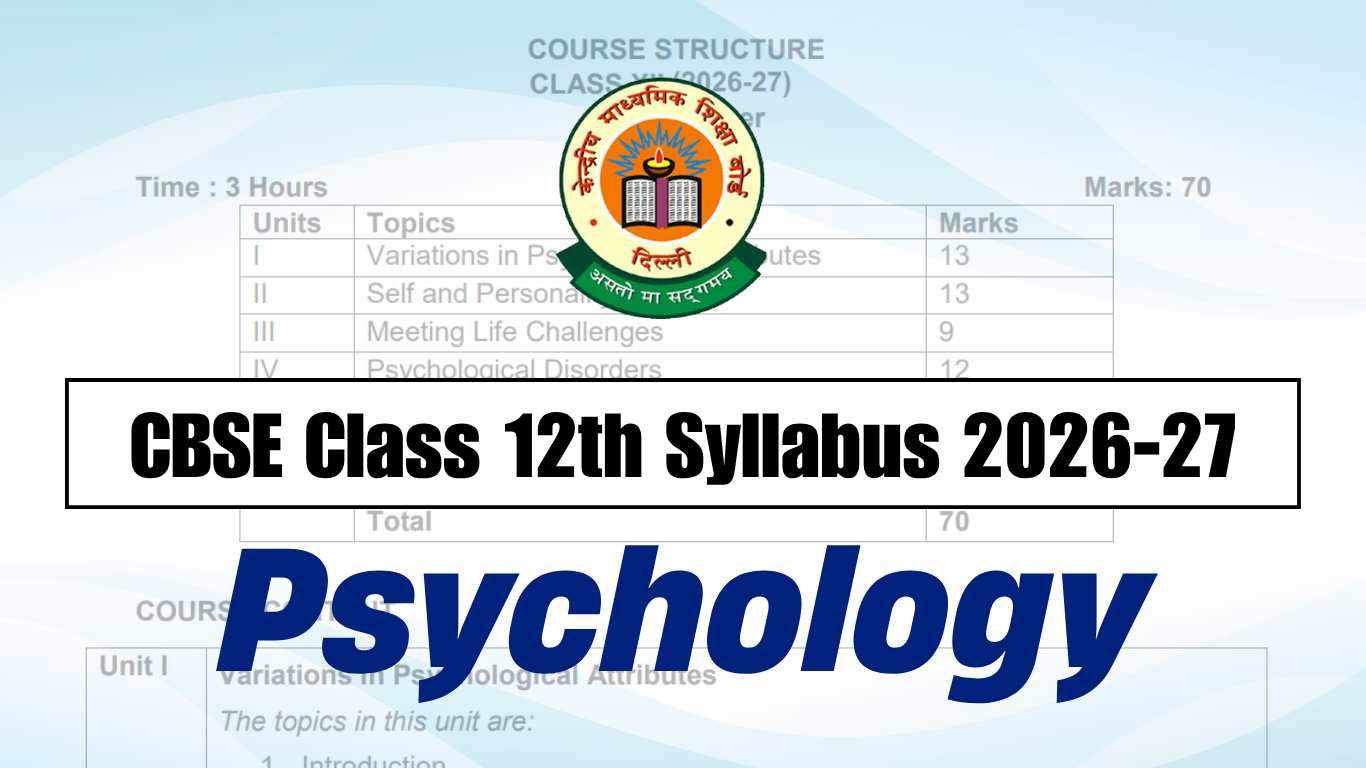
The CBSE class 12 Psychology syllabus 2026-27 is available on the website cbseacademic.nic.in. Students can download the Psychology PDFs from here. It focuses on understanding and manipulating data, developing computer programs, and exploring information systems. Students can get the Psychology syllabus easily here. It also gives various career opportunities. It is updated with the recent syllabus and is important for students to understand the concepts. The syllabus gives the chapters and units which the students have to study for the exam. The class 12 students need to go through it thoroughly. All the details are available on the CBSE website.
CBSE Class 12 Psychology Syllabus 2025-26: Course-Wise Structure
Students can check the course-wise structure here:
|
Units
|
Topics
|
Marks
|
|
I
|
Variations in Psychological Attributes
|
13
|
|
II
|
Self and Personality
|
13
|
|
III
|
Meeting Life Challenges
|
9
|
|
IV
|
Psychological Disorders
|
12
|
|
V
|
Therapeutic Approaches
|
9
|
|
VI
|
Attitude and Social Cognition
|
8
|
|
VII
|
Social Influence and Group Processes
|
6
|
|
Total
|
70
|
CBSE Class 12 Psychology Syllabus 2025-26: Course Content
Students can check the detailed course-wise content here:
|
Unit I
|
Variations in Psychological Attributes
The topics in this unit are:
1. Introduction
2. Individual Differences in Human Functioning
3. Assessment of Psychological Attributes
4. Intelligence
5. Psychometric Theories of Intelligence, Information Processing Theory: Planning, Attention-arousal and Simultaneous Successive Model of Intelligence, Triarchic Theory of Intelligence; Theory of Multiple Intelligences.
6. Individual Differences in Intelligence
7. Culture and Intelligence
8. Emotional Intelligence
9. Special Abilities: Aptitude: Nature and Measurement
10. Creativity
|
|
Unit II
|
Self and Personality
The topics in this unit are:
1. Introduction
2. Self and Personality
3. Concept of Self
4. Cognitive and Behavioural Aspects of Self
5. Culture and Self
6. Concept of Personality
7. Major Approaches to the Study of Personality
|
|
● Type Approaches
● Trait Approaches
● Psychodynamic Approach and Post-Freudian Approaches
● Behavioural Approach
● Cultural Approach
● Humanistic Approach
8. Assessment of Personality
● Self-report Measures
● Projective Techniques
● Behavioural Analysis
|
|
|
Unit III
|
Meeting Life Challenges
The topics in this unit are:
1. Introduction
2. Nature, Types and Sources of Stress
3. Effects of Stress on Psychological Functioning and Health
● Stress and Health
● General Adaptation Syndrome
● Stress and the Immune System
● Lifestyle
4. Coping with Stress
● Stress Management Techniques
5. Promoting Positive Health and Well-being
● Life Skills
● Positive Health
|
|
Unit IV
|
Psychological Disorders
The topics in this unit are:
1. Introduction
2. Concepts of Abnormality and Psychological Disorders
● Historical Background
3. Classification of Psychological Disorders
4. Factors Underlying Abnormal Behaviour
5. Major Psychological Disorders
● Anxiety Disorders
● Obsessive-Compulsive and Related Disorders
● Trauma- and Stressor-Related Disorders
● Somatic Symptom and Related Disorders
● Dissociative Disorders
● Depressive Disorder
● Bipolar and Related Disorders
|
|
● Schizophrenia Spectrum and Other Psychotic Disorders
● Neurodevelopmental Disorders
● Disruptive, Impulse-Control and Conduct Disorders
● Feeding and Eating Disorders
● Substance-Related and Addictive Disorders
|
|
|
Unit V
|
Therapeutic Approaches
The topics in this unit are:
1. Nature and Process of Psychotherapy
● Therapeutic relationship
2. Types of Therapies
● Behaviour Therapy
● Cognitive Therapy
● Humanistic-Existential Therapy
● Alternative Therapies
● Factors contributing to healing in Psychotherapy
● Ethics in Psychotherapy
3. Rehabilitation of the Mentally Ill
|
|
Unit VI
|
Attitude and Social Cognition
The topics in this unit are:
1. Introduction
2. Explaining Social Behaviour
3. Nature and Components of Attitudes
4. Attitude Formation and Change
● Attitude Formation
● Attitude Change
● Attitude-Behaviour Relationship
5. Prejudice and Discrimination
6. Strategies for Handling Prejudice
|
|
Unit VII
|
Social Influence and Group Processes
The topics in this unit are:
1. Introduction
2. Nature and Formation of Groups
3. Type of Groups
4. Influence of Group on Individual Behaviour
● Social Loafing
● Group Polarisation
|
Practical: 30 Marks
- Development of case profile: Using appropriate methods like interviews, observation & psychological tests.
- Test administration: Students are required to administer and interpret five psychological tests related to various psychological attributes like intelligence, aptitude, attitude, personality, etc.
- In the Practical examination, the student will be required to administer and interpret two psychological tests.
Distribution of Marks:
|
● Practical File and Case Profile
|
10 Marks
|
|
● Viva Voce (Case Profile & Two psychological tests)
|
05 Marks
|
|
● Two tests (5 marks for conducting the tests and 10 marks for reporting)
|
15 Marks
|
|
Total
|
30 Marks
|
To download the complete syllabus, CHECK THE DIRECT LINK HERE:
CBSE Class 12 Psychology Syllabus 2025-26: Question Paper Design
Students can check the question paper design below:
|
Time: 3 Hours Maximum Marks: 70
|
|||
|
S. No.
|
Competencies
|
Total
Marks
|
% Weightage
|
|
1
|
Remembering and Understanding: Exhibiting memory of previously learned material by recalling facts, terms, basic concepts, and answers; Demonstrating understanding of facts and ideas by organising, comparing, translating, interpreting, giving descriptions and stating main ideas
|
35
|
50%
|
|
2
|
Applying: Solving problems in new situations by applying acquired knowledge, facts, techniques and rules in a different way
|
25
|
35%
|
|
3
|
Formulating, Analysing, Evaluating and Creating: Examining and breaking information into parts by identifying motives or causes; Making inferences and finding evidence to support generalisations; Presenting and defending opinions
by making judgments about the information validity of ideas, or the quality of work based on a set of criteria; Compiling information together in a different way by
combining elements in a new pattern or proposing alternative solutions
|
10
|
15%
|
|
Total
|
70
|
100%
|
Prescribed Books:
- Psychology, Class XI, Published by NCERT
- Psychology, Class XII, Published by NCERT