


The degree options like the B.Tech (Bachelor of Technology), B.Com (Bachelor of Commerce), B.Sc. (Bachelor of Science), B.A. (Bachelor of Arts), and MBA (Master of Business Administration) would have seemed recognisable and inflexible if you had entered an Indian college campus in 2010. They had clear boundaries and predictable job pathways.
In the present day, degrees like Data Science, Sustainability Studies, Liberal Engineering, Artificial Intelligence, Cognitive Science, and Interdisciplinary Humanities are being offered at the same universities and colleges. The philosophy of higher education itself has evolved, not just the names of the courses. Universities are now structuring degrees around industries, future skills, and issues rather than just academic areas. Many students are unaware that they are enrolling in degrees that were nonexistent ten years ago, since this change has occurred so quietly.
Why are Traditional Degrees No Longer Enough?
For many years, higher education was based on the simple assumption that a single discipline corresponds to a single career path. Computer science led to IT jobs, mechanical engineering led to core engineering vocations, and the humanities led to academia or civil services. However, university curricula were unable to keep up with the rapid changes occurring in the real world.
The limitations of single-discipline degrees were revealed by the rise of data-driven decision-making, automation, climate challenges, and interdisciplinary problem-solving. Hiring managers now seek graduates who can integrate statistics and code, engineering and ethics, or public policy and economics. A shift towards skill-based, learning, portfolios, and micro-credentials to represent real-world capability is required because industries are evolving more quickly than curricula, leaving a large gap between academic theory and the practical, specialised skills employers require, such as:-
-
Problem-solving skills
-
AI Proficiency
-
Digital Literacy
Given below are some of the reasons why the traditional degrees are no longer enough:-

Which emerging degrees are Reshaping Higher Education Today?
Driven by digital transformation and global challenges, emerging degrees are reshaping higher education with a strong emphasis on technology, healthcare, and interdisciplinary fields. New trends like personalised learning. Hybrid models and micro-credentials are also changing how education is delivered.
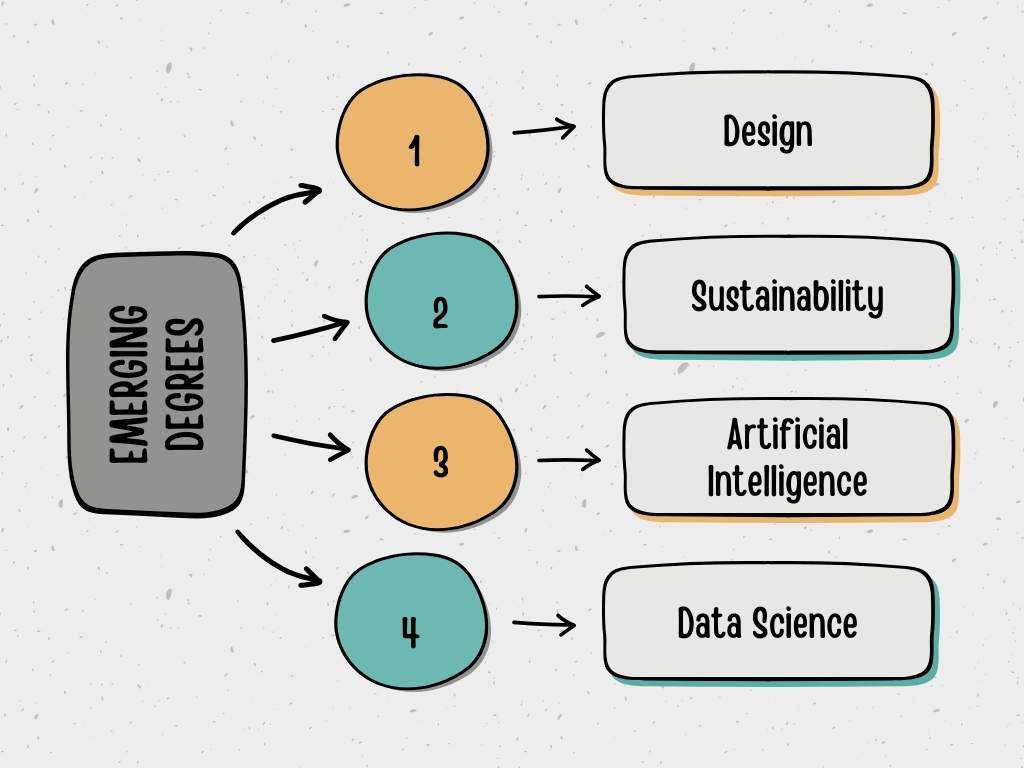
Given below is the list of the emerging degrees that are reshaping higher education today:-
|
Why Traditional Degrees Are No Longer Enough in 2026?
Traditional degrees by themselves are no longer sufficient in 2026 because the nature of employment has evolved more quickly than university curricula. For many years, degrees were built on stagnant career paths, engineering led to engineering jobs, law to litigation, and accounting to commerce. Automation, artificial intelligence, platform-based economies, and climate change have all changed these traditional routes. Employers increasingly look for candidates with flexibility, interdisciplinary thinking, digital fluency, and problem-solving skills rather than just subject-matter expertise.
A graduate who has only been exposed to theory and has no practical experience with tools, data interpretation, or real-world application frequently finds it difficult to stay relevant. Hiring managers prioritise demonstrable skills, adaptability, problem-solving, digital literacy, and real-world experience over academic credentials. As a result, traditional degrees are still valuable for foundational knowledge, but they are insufficient on their own.

Given below are some reasons why traditional degrees or theoretical knowledge are no longer enough:-
|
Why are Skills More Important than Degrees Today?
The increase in skill assessment and the diminishing influence of degree status are two of the most important but little-discussed changes of 2026. Hiring managers now, instead of relying solely on college names or CGPA ratings, recruiters now depend more and more on portfolios, case simulations, live assignments, published research, and real-world projects.
Today, skills are more important than degrees because the rapidly evolving job markets require immediate, flexible, and practical skills (like AI proficiency, digital literacy, and critical thinking) that the curriculum before the NEP 2020 was not aligned with. While a degree still offers a foundational platform, practical experience and ongoing learning are essential for job readiness and career longevity.
Given below are some of the reasons why skills are gaining the upper hand over degrees today:-
|
Degrees that were nonexistent ten years ago are reactions to a world that has outgrown conventional academic limitations, not educational experiments. The most important consideration for students is not whether these degrees are ‘new,’ but rather if they are well-thought-out, relevant to the industry, and personally meaningful.
Related Searches:-