


Have you ever realised that you engage with the legacy of electrical engineering, one of the most revolutionary academic fields which has ever been developed, when you turn on a light, stream a lecture online, charge your phone or even just read an article anywhere online. However, there is a question which rarely gets raised outside of serious academic circles, i.e.,
‘Which university first introduced electrical engineering as a recognised academic field of study?’
The answer to this question will take us to Germany in the 19th Century, when electricity was more of a curiosity than a practicality. The Technische Universität Darmstadt (TU Darmstadt), Germany, was the first university in the world to introduce electrical engineering as an engineering academic discipline.
Which University First Introduced Electrical Engineering Globally?
In 1882, Technische Universität Darmstadt in Germany was the first university to introduce the first electrical engineering chair and department in the world. In 1883, the university also launched the first electrical engineering degree program, marking it the first institution in the world to formally offer electrical engineering as a separate discipline.
The Department of Electrical Engineering at the Technische Universität Darmstadt was founded in 1882 by Erasmus Kittler. Within the engineering sciences, there was the inspiration behind the guiding philosophy of quality and innovation grounded in tradition. The Technische Universität Darmstadt offers a Bachelor of Science (B.Sc) degree in Electrical Engineering and Information Technology.
What was Electrical Engineering Education like in the 1880s?
In the 1880s, the field of electrical engineering was relatively new. It was not typically taught as a distinct subject back then. Rather, electricity was covered in physics or mechanical engineering classes. Practical learning, including laboratory work and actual industrial applications, was the primary focus. Universities gradually started to establish different departments and degree programs dedicated to electrical engineering throughout this decade.
To put it simply, the fast expansion of electricity in society throughout the 1880s prompted the development of electrical engineering education. Universities put a lot of effort into transforming an industry dominated by technicians and inventors into an organised, professional engineering discipline.
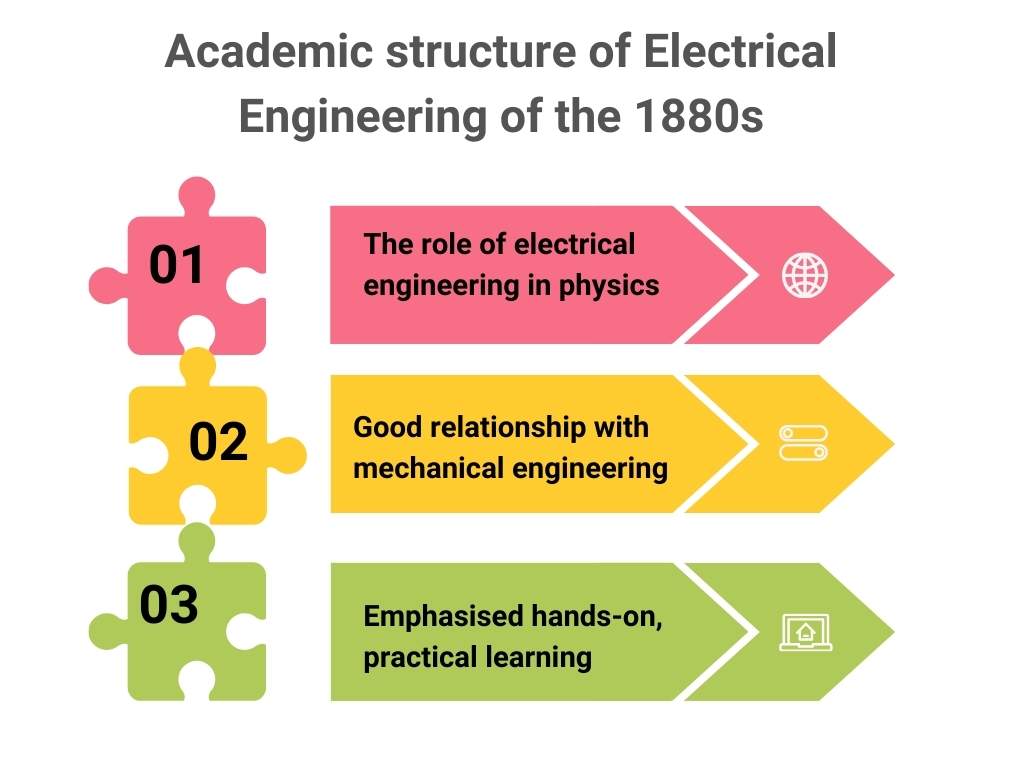
Given below is the academic structure of electrical engineering of the 1880s:-
|
The electrical engineering education in the 1880s taught some important subjects, which were as follows:-
-
Power transmission and distribution
-
Electrically powered equipment
-
About batteries, both secondary and primary
-
Photometry, or the measurement of light
-
Telegraph and Telephone systems
-
Measurements of electricity: Mathematical electricity’
-
The steam engine and thermodynamics
What are the Career Opportunities available in the field of Electrical Engineering?
The job options for electrical engineers are not only numerous but also fundamental in the present-day day technologically advanced, and hyperconnected society. We directly witness the results of electrical engineering knowledge every time we stream any kind of video, or an electric car on the road, or charge a device. Electrical engineering is a fundamental, frequently undetectable foundation that underpins almost all contemporary industries. Although they are highly sought after in the electrical and electronics sector, their expertise is as important in industries like automation, medical technology, robotics, aircraft, and automobiles.

Given below is the list of some of the career opportunities available in the electrical engineering field:-
|
Electrical engineering was created, discussed, and purposefully introduced over time. TU Darmstadt established Electrical Engineering as a discipline in 1882, not only as a course.
Related Searches:-