


The Language of the Universe: The description of mathematics as the "language of the universe" is profoundly fitting, reflecting its position as the unseen, pervasive thread that ties the cosmos and human endeavor.
Its principles are obvious everywhere, from the delicate, perfectly calculated spirals of a sunflower (Fibonacci sequence) and the complicated geometry of snowflakes to the enormous, predictable mechanics guiding the expansion of galaxies.
A sole, objective cornerstone of all human growth and invention, mathematics has the potential to transcend cultures, languages, and time.
Math is not an abstract subject found only in textbooks; rather, it is a vital instrument that shapes our everyday lives. It is the foundation of technology (from AI to cryptography), art (through symmetry and proportion), and the intricate models that power science and business.
Exploring the essence of mathematics, its rich history, great practical utility, and the famous contributions of thinkers spanning millennia is not just an academic exercise; it's a trip that illuminates the wonder, practicality, and continuing significance of this field in building our modern world.
Also Check: Which Subject is Known as the Queen of Mathematics?
Which Science Degree Is Known As The Algorithm Master?
What are the different branches of mathematics?
Mathematics is a vast discipline, broadly classified into pure mathematics (the study of concepts for their own sake) and Applied Mathematics (using concepts to solve real-world problems). The modern field is further organized into numerous specialized branches.
| Branch | Primary Focus | Key Concepts & Areas |
| Arithmetic | The study of numbers and basic operations. | Addition, Subtraction, Multiplication, Division, Fractions, Percentages. |
| Algebra | The study of structure, represented by variables and symbols in formulas and equations. | Solving equations, Polynomials, Abstract Algebra (groups, rings, fields), Linear Algebra (vectors, matrices). |
| Geometry | The study of shapes, sizes, positions, and properties of space. | Triangles, Circles, Angles, Area, Volume, Euclidean and Non-Euclidean Geometry. |
| Trigonometry | The study of the relationships between the sides and angles of triangles. | Sine (sin), Cosine (cos), Tangent (tan), Identities, and applications in surveying and navigation. |
| Calculus | The study of continuous change, including limits, rates of change, and accumulation. | Differential Calculus (derivatives, slopes) and Integral Calculus (integrals, area under curves). |
| Number Theory | The study of the properties and relationships of integers (whole numbers). | Prime numbers, Divisibility, Modular Arithmetic, applications in Cryptography. |
| Analysis | The rigorous study of limits, continuity, and the mathematical foundations of calculus. | Real Analysis, Complex Analysis, Functional Analysis, Differential Equations. |
| Statistics & Probability | The study of data (collection, analysis, interpretation) and the mathematics of chance and uncertainty. | Mean, Median, Mode, Regression, Normal Distribution, Statistical Inference. |
| Discrete Mathematics | The study of countable or separate structures, often used in computer science. | Combinatorics (counting), Graph Theory, Logic, Algorithms, Set Theory. |
| Topology | The study of properties of spaces that are preserved under continuous deformations (stretching, bending, but not tearing). | Homeomorphism, Manifolds, Algebraic Topology, Knot Theory. |
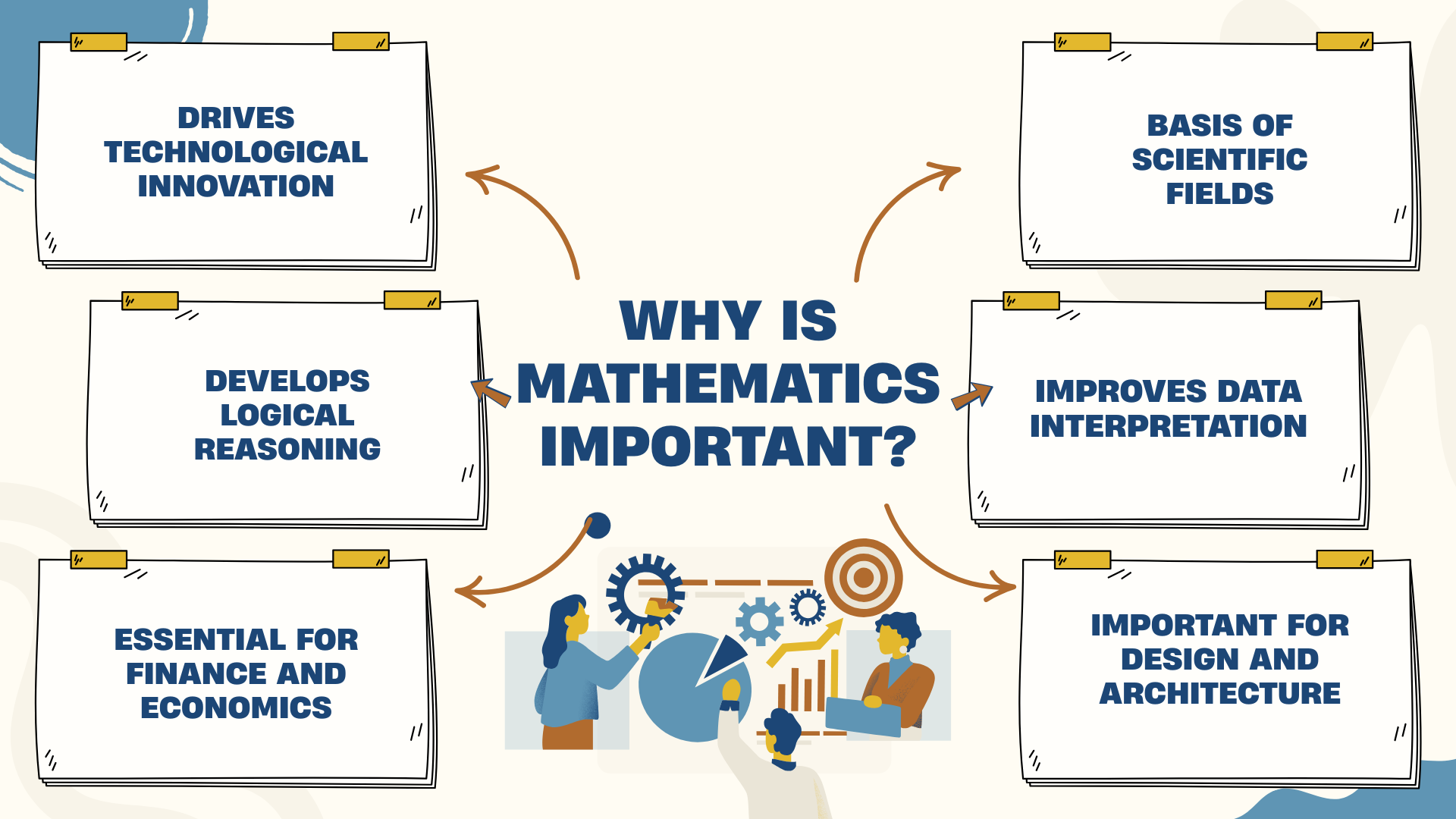
Why Is Mathematics Important?
-
Drives Technological Innovation: Mathematics supports all modern technology, like Artificial Intelligence, cryptography, and engineering design, acting as the key language for scientific advancement and computation.
-
Develops Logical Reasoning: Learning math develops strong problem-solving abilities that are applicable to challenging real-world scenarios and decision-making by teaching the brain to think clearly, critically, and methodically.
-
Essential for Finance and Economics: It gives the tools for managing personal and global money, allowing for the proper computation of interest, debt, budgeting, and complex economic modeling.
-
Basis of Scientific Fields: All pure sciences, including physics, chemistry, and biology, employ mathematics as a language to quantify, model, and forecast natural occurrences as well as carry out thorough experiments.
-
Improves Data Interpretation: Making educated decisions, avoiding manipulation in media and research, and comprehending big datasets all depend on an understanding of statistics and probability.
-
Important for Design and Architecture: To guarantee structural integrity, aesthetic balance, and practical efficiency in construction, architects, engineers, and designers must understand concepts like geometry, symmetry, and proportion.
Please Check:
-
Top IITs in QS Asia Rankings 2026- Indian Engineering Institutes Ranking
-
Guide to FMS Delhi Application: Course Fees and Other Details
Also Read:
Top IIT Colleges That Offer Data Science Courses to Learn Online in 2025
Best Free AI Courses for Beginners in 2025
Best Pharmacy Colleges in India 2025 After 12th Offering High Job Placement
To stay updated on current trends, join the Jagran Josh Telegram Community!