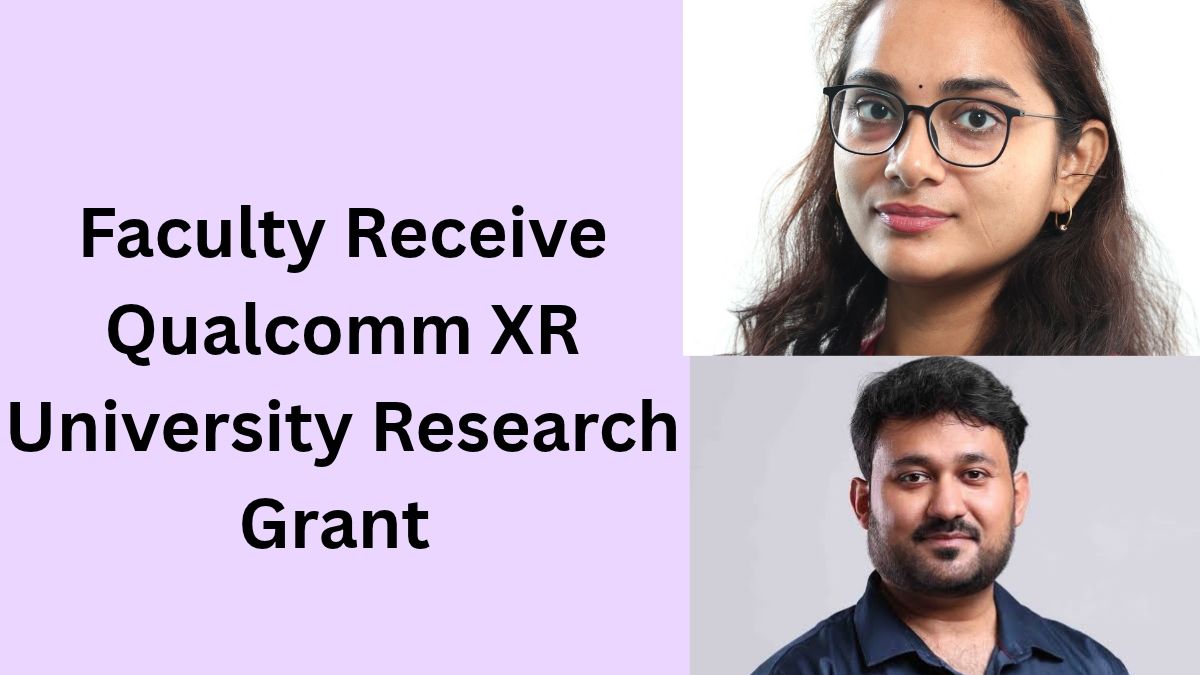
Researchers from Indraprastha Institute of Information Technology Delhi, Dr Richa Gupta and Dr Anmol Srivastava, received the Qualcomm XR University Research Grant 2026 for their project titled “PathSense: Behavior-Informed Auditory Augmented Reality Framework to Support Allocentric Indoor Navigation of Large Spaces for Blind and Low-Vision Users in India.”
Dr Richa Gupta is the Principal Investigator (PI) of the project, while Dr Anmol Srivastava, the Co-Principal Investigator (Co-PI), has received the grant of Rs. 62 Lakh for a period of three years.
The research project focuses on how Audio Augmented Reality (AAR) can help blind and low-vision (BLV) individuals navigate indoor spaces independently. The research will look at how they understand their surroundings without visual cues and how different forms of non-visual information can help them make sense of indoor spaces and navigate them independently.
The research also aims to develop a behaviour-informed framework for representing environmental information through multimodal interactions and study how BLV users perceive and interpret different non-visual representations of indoor spaces, with the aim of generating empirical evidence to inform the design of future Auditory Augmented Reality (AAR) systems for accessible navigation in India.
Dr Richa Gupta, who is also a faculty member at IIIT Delhi, while speaking on receiving the grant, mentioned that "For someone who is blind or has low vision, navigating a large indoor space can involve challenges that people with sight may not always notice. Through PathSense, we want to understand how people with visual impairments perceive and make sense of the spaces around them, and what kind of information can help them navigate with greater independence. This grant will allow us to study these experiences in greater depth and build research-based insights that can guide the development of more accessible navigation systems."
Dr Anmol Srivastava who is also a faculty at IIIT Delhi, stated that "One of the important aspects of this research is understanding how environmental information should be communicated when visual cues are not available. It is not simply about providing directions, but about helping users build an understanding of the space they are moving through. We hope that the findings from PathSense will inform the design and development of future Auditory Augmented Reality (AAR) systems and provide valuable insights into creating more accessible and inclusive Extended Reality (XR) experiences."
As per communication from the institutions, this research also has relevance beyond indoor navigation. Its findings could be useful in other areas of XR research, including multimedia rendering, spatial computing and multimodal interaction design. They will help researchers understand how information about the environment can be shared with users through different forms of interaction.