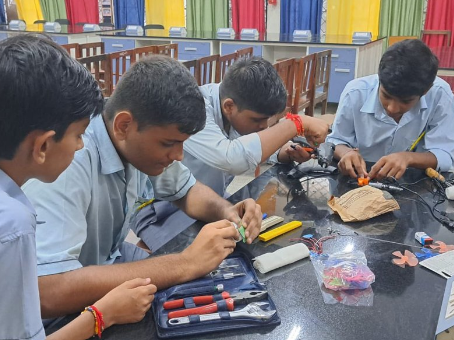
The Ministry of Education has launched the Seva First Innovation Challenge 2026, inviting school students, ITI and polytechnic trainees, undergraduate students and researchers to develop practical solutions to real-world problems. The challenge offers a total prize pool of Rs 5.4 crore and aims to encourage young innovators to create solutions that can benefit communities and support national development.
According to the official portal, registrations opened on September 25 and will remain open until October 24, 2026. The challenge is being conducted across five states and three Union Territories, with participation organised through educational institutions.
Seva First Innovation Challenge 2026: Who Can Apply?
The challenge has three participation categories based on students’ educational levels:
- Junior: School students from Classes 6 to 12.
- Technical: Students enrolled in Industrial Training Institutes (ITIs) and polytechnics.
- Open: Undergraduate students, postgraduate students and research scholars.
Students cannot register independently. Each participating school, ITI, polytechnic, college or university must nominate a coordinator to register the institution and submit entries on behalf of students or teams.
The challenge is open in Andhra Pradesh, Karnataka, Kerala, Tamil Nadu and Telangana, as well as the Union Territories of Lakshadweep, Puducherry, and Andaman and Nicobar Islands.
What Are the Themes and Categories?
Participants can submit ideas under five broad themes: Swachh and Sustainable Bharat; Samriddh Annadata, Samriddh Bharat; Swasth and Samavesh Bharat; Shikshit and Kaushal Bharat; and Surakshit Bharat.
These themes cover areas such as environmental protection, agriculture, rural livelihoods, healthcare, accessibility, education, skill development, manufacturing, transport and digital public infrastructure.
Entries can be submitted under two tracks. Track A focuses on products and technology, including devices, prototypes, software and engineering solutions. Track B covers business models, service delivery, governance and institutional innovations.
How to Apply for Seva First Innovation Challenge 2026?
The application process is institution-led. Eligible institutions must nominate a coordinator, who will complete the online registration and submit student entries.
1. Visit the official website, sevafirst.mic.gov.in.
2. Register the participating institution using its official details, including the relevant institutional identification number, state and district.
3. Verify the account using the code sent to the institution’s official email address.
4. The nominated coordinator can then enter student or team details and select the appropriate participation level, theme and innovation track.
5. Prepare a concise description of the problem and proposed solution, add supporting material where available, and submit the entry before October 24, 2026.
The expected level of demonstration varies by category. School students can submit a well-reasoned idea or simple solution, with a prototype encouraged but not mandatory. ITI and polytechnic students are expected to demonstrate a working prototype for technology entries or a costed, field-tested model for service and governance ideas. Undergraduate students and above are expected to provide a demonstrated prototype or pilot with a credible implementation plan.
Seva First Innovation Challenge 2026: Prize Money
The official portal lists the following awards in each of the three participation categories:
- First prize: Rs 10 lakh
- Second prize: Rs 5 lakh
- Third prize: Rs 3 lakh
The challenge also offers selected innovators opportunities for expert mentorship, laboratory and fabrication access, incubation and pilot support, and potential pathways to adoption by government bodies and industry.
Entries will be evaluated on problem clarity, originality, feasibility, cost, impact on beneficiaries and scalability. The indicative schedule places state-level screening by NITs from October 25 onwards, followed by exhibitions and the finale within the announced November–December window.