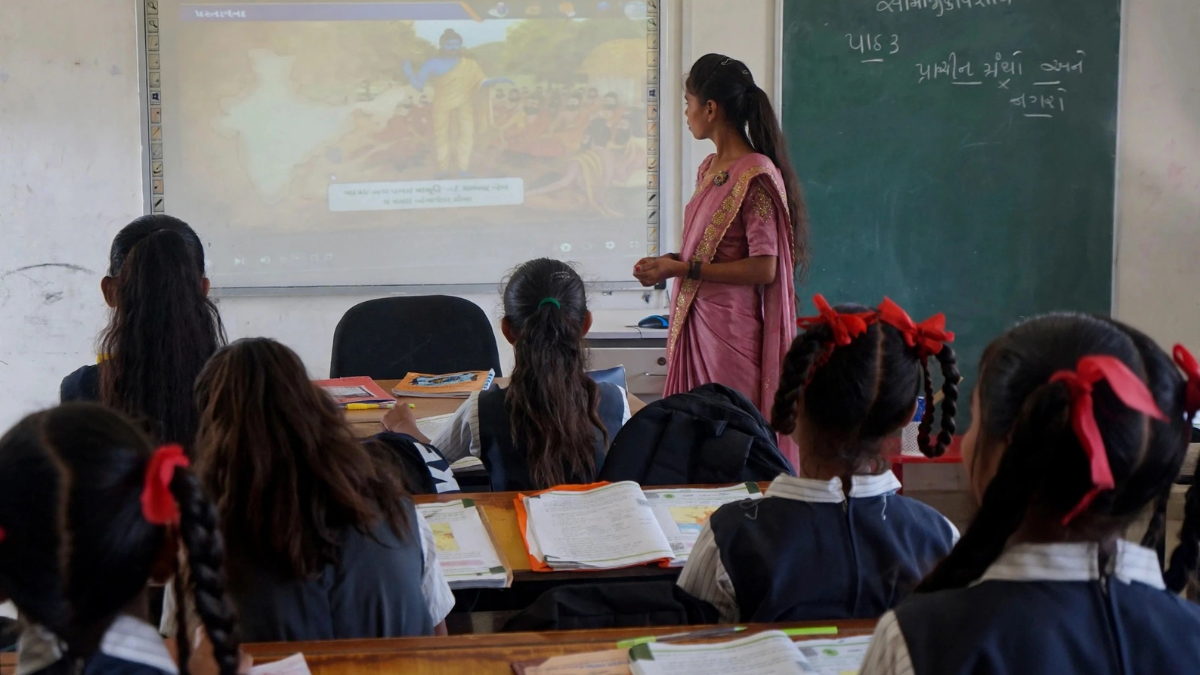
The West Bengal government has announced restrictions on political activities by teaching and non-teaching staff in government-run and government-aided schools. The decision was taken at a state Cabinet meeting on October 28, 2026, and was announced by School Education Minister Dipak Barman the following day.
Alongside this decision, the state government is considering a new teacher accountability system for primary schools. Under the proposed system, teachers' performance may be linked to students' learning progress, annual salary increments and promotions.
The government is also examining changes to primary-level teaching methods and the possibility of bringing back the pass-fail system in schools. These measures are part of a wider effort to review school education and teacher responsibilities in the state.
Also read:
West Bengal Restricts Political Activities by School Staff: What Has Changed?
The state government has decided to prohibit teaching and non-teaching staff in government-run and government-aided schools from participating in political activities.
Chief Minister Suvendu Adhikari said the restriction would apply to teachers recruited through future West Bengal School Service Commission (SSC) recruitment processes. He clarified that existing teachers who are already involved in politics would not be affected by the proposed change.
According to the announcement, future recruits will not be allowed to participate directly in politics or contest elections at different levels.
| Issue | Details |
| Decision | Restrictions on political activities by school staff |
| Approved by | West Bengal Cabinet |
| Announcement date | October 28, 2026 |
| Main authority | State government and School Education Department |
| Future recruitment | Chief Minister said the restriction would apply to future SSC recruits |
| Existing teachers | Chief Minister said those already in service would not be affected |
| Elections covered | Panchayat, municipal, Assembly and Lok Sabha elections |
School Education Minister Dipak Barman said the government wouldthe necessary rules to implement the decision. He also indicated that participation in non-political organisations would be allowed.
However, the exact scope of the restriction will become clearer after the government publishes the formal rules.
What Is the New Teacher Accountability System?
The West Bengal government is considering introducing a teacher accountability system in primary schools from the next academic year. In simple words, this means teachers may be asked to explain how much their students have learned and whether they are making sufficient academic progress.
Under the proposed system, students' learning outcomes could become one of the factors considered while deciding teachers' annual salary increments and promotions.
For example, School Education Minister Dipak Barman explained that if 15 out of 20 students in a teacher's class are unable to develop basic reading skills or show adequate academic improvement, the teacher may have to explain the reasons.
The government would examine why the students have not made the expected progress before considering the teacher's performance.
How Will the Proposed Teacher Accountability System Work?
| Area | Proposed approach |
| Student learning | Teachers may be assessed based on students' academic progress |
| Basic reading skills | The government may examine whether students can read at the expected level |
| Teacher performance | Teachers may be asked to explain poor learning outcomes |
| Annual increments | Performance may be considered while deciding salary increases |
| Promotions | Students' learning progress may also influence promotion decisions |
| Implementation | Proposed for primary schools from the next academic year |
The proposal is intended to make teachers more responsible for students' classroom learning. However, the government has not yet announced the final assessment method or detailed implementation rules.
West Bengal May Introduce One Teacher for All Subjects in Primary Classes
The state government is also considering a change in the way subjects are taught in primary schools.
At present, different teachers may be assigned to teach subjects such as Bengali, English and Mathematics. Under the proposed arrangement, one teacher may be responsible for teaching all subjects to a primary-level class.
This means that instead of having separate teachers for different subjects, a single teacher could teach multiple subjects to the same group of students.
The government is examining this approach as part of its plans to review classroom teaching arrangements. However, it is still under consideration and should not be treated as an implemented rule.
Government May Bring Back the Pass-Fail System in Schools
West Bengal is also examining the possibility of reintroducing the pass-fail system in schools.
Under this system, students would be assessed to determine whether they have passed or failed their examinations. The proposal could change how students' academic performance is evaluated and how schools identify children who need additional support.
The government has not yet announced the final decision or explained which classes would be covered.
West Bengal Plans to Recruit 13,000 Primary School Teachers
The state government is also planning to appoint at least 13,000 primary school teachers in the near future. According to the School Education Minister, these appointments could help bring the student-teacher ratio down to approximately one teacher for every 20 students.
What Is the Student-Teacher Ratio?
The student-teacher ratio refers to the number of students compared with the number of teachers in a school or classroom. For example, a ratio of 20:1 means there are approximately 20 students for every one teacher.
A lower student-teacher ratio can make it easier for teachers to give individual attention to students, although the actual impact also depends on classroom conditions and teaching quality.
| Government plan | Expected change |
| Recruitment of primary teachers | At least 13,000 appointments planned |
| Student-teacher ratio | Expected to reach around 20:1 |
| Primary education | Greater focus on student learning outcomes |
| Secondary education | Government also plans to improve the situation |
The minister also said that the government would work towards improving the teacher-related situation at the secondary school level.
What Do These Decisions Mean for Teachers and Students?
The proposed changes could affect teacher recruitment, classroom responsibilities and the way schools assess students' academic progress. For future teacher applicants, the political activity restriction may become an additional condition of recruitment once the formal rules are notified.
For existing teachers, the Chief Minister has said that the proposed restriction will not affect those already involved in politics. Meanwhile, the proposed accountability system could make students' learning progress an important factor in evaluating primary school teachers.
For students, the proposed changes may bring greater attention to basic reading skills, classroom learning and academic performance.
However, the teacher accountability system, changes to primary-level teaching and the possible return of the pass-fail system are still under consideration. Their final details will depend on future government decisions.
Read more:
100 Years Later, Ramanujan's 2 Equations Help Researchers Discover Infinite New Formulas
JNU PhD Reservation Row Deepens as Students' Body Announces Indefinite Sit-In Over SC, ST Seats