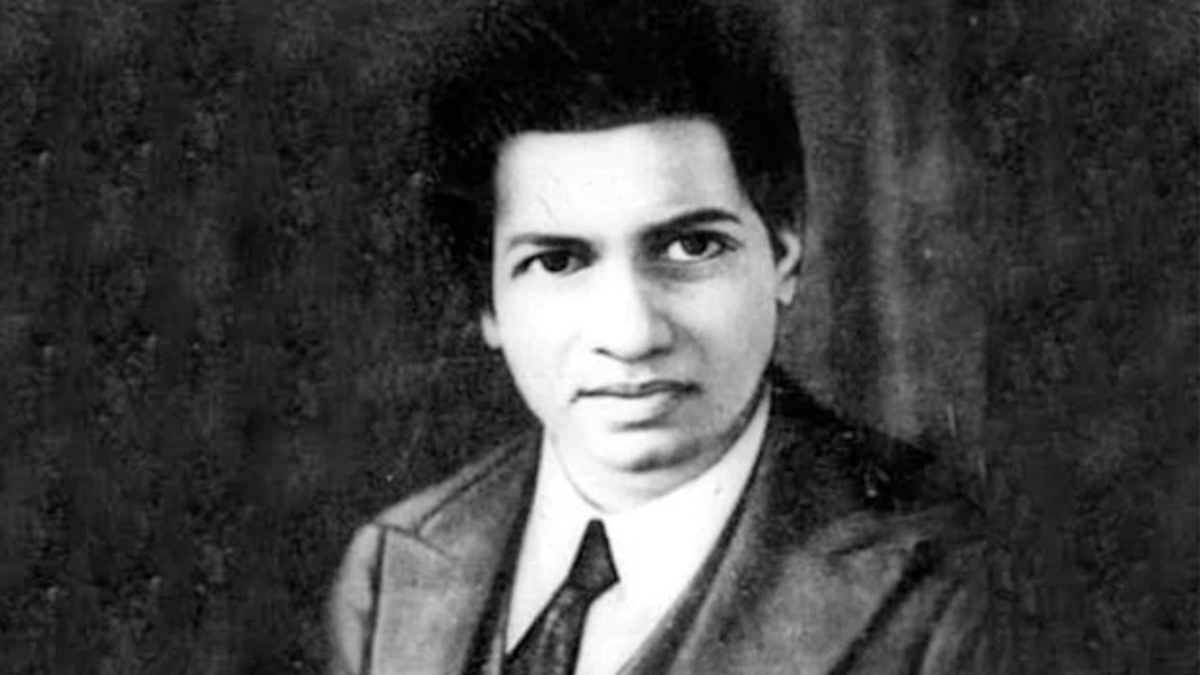
More than a century after Indian mathematician Srinivasa Ramanujan introduced some remarkable mathematical formulas, researchers have found a new way to understand and expand his work. Yifeng Huang, a mathematician at Emory University in the United States, along with his collaborators, has developed a mathematical framework that connects Ramanujan's famous equations with a branch of mathematics known as knot theory.
The research shows that the equations, known as the Rogers-Ramanujan identities, are connected to a simple mathematical knot called the trefoil knot. By studying related knots, researchers found a way to generate an infinite number of new mathematical identities.
The development is significant because mathematicians had long considered these equations to be special, individual discoveries. The new research suggests that they are part of a much larger mathematical structure.
Also read:
Who Was Srinivasa Ramanujan?
Srinivasa Ramanujan was one of India's most celebrated mathematicians. Born in 1887, he made important contributions to number theory, infinite series and mathematical equations despite having limited formal training in advanced mathematics.
In 1912, Ramanujan began sending letters containing his mathematical discoveries to researchers in England. One of these letters reached British mathematician G. H. Hardy at the University of Cambridge. Hardy recognised his extraordinary mathematical ability and helped bring his work to international attention.
Ramanujan's work included several unusual formulas that mathematicians continued to study long after his death in 1920, at the age of 32. The Rogers-Ramanujan identities are among his best-known contributions.
What Are the Rogers-Ramanujan Identities?
To understand the new discovery, it is important to know what the Rogers-Ramanujan identities mean.
In simple words, these are two mathematical formulas that show how two seemingly different ways of calculating numbers can produce exactly the same result.
One side of the formulas involves an infinite series, which means adding a sequence of mathematical terms that continues without an end. The other side uses an infinite product, which means multiplying a sequence of mathematical expressions.
At first glance, these two methods look unrelated. However, the identities prove that their results are equal under the appropriate mathematical conditions.
These formulas are also connected to a concept called number partitions.
What Is a Number Partition?
A number partition means finding all the different ways a number can be written as the sum of smaller positive whole numbers.
| Number of Terms | Partition Breakdown |
|---|---|
| 1 Term | 6 |
| 2 Terms | 5 + 1 4 + 2 3 + 3 |
| 3 Terms | 4 + 1 + 1 3 + 2 + 1 2 + 2 + 2 |
| 4 Terms | 3 + 1 + 1 + 1 2 + 2 + 1 + 1 |
| 5 Terms | 2 + 1 + 1 + 1 + 1 |
| 6 Terms | 1 + 1 + 1 + 1 + 1 + 1 |
These are different partitions of 6. The order of the numbers does not matter, so 5 + 1 and 1 + 5 are counted as the same partition.
The Rogers-Ramanujan identities connect two different rules for counting such partitions. One rule places restrictions on how far apart the numbers must be, while the other allows only numbers from particular sequences.
For instance, the two rules can produce the same number of partitions for 6, even though the permitted combinations are different. The remarkable part is that this relationship holds for every positive whole number, not just 6.
What Is the New Discovery by Emory University Researchers?
Yifeng Huang's work focuses on understanding why the Rogers-Ramanujan identities are true and whether they are connected to a bigger mathematical idea.
The research, developed with collaborators, connects these identities to a geometric framework involving mathematical knots. The team showed that the original Rogers-Ramanujan identities correspond to a trefoil knot in a particular mathematical space.
This connection is important because it provides a new way to understand the equations. Researchers also found that studying related knots can lead to infinitely many new identities of the same broader mathematical kind.
In other words, instead of treating Ramanujan's formulas as isolated discoveries, mathematicians can now study them as part of a larger system that can produce many more mathematical relationships.
What Is Knot Theory? Explained in Simple Words
Knot theory is a branch of mathematics that studies knots and how they are connected, twisted or shaped.
Think of a piece of string tied into a knot. In everyday life, you can untie the string by pulling its ends. In mathematical knot theory, however, a knot is treated as a closed loop, with its ends joined together. Mathematicians study whether one loop can be changed into another without cutting it or allowing it to pass through itself.
A simple example is the trefoil knot.
The trefoil knot is one of the simplest mathematical knots that cannot be untangled into a plain circle without cutting it. Its shape is similar to a familiar three-loop decorative knot.
Researchers found that the Rogers-Ramanujan identities are associated with this knot in a particular mathematical framework. They then used related knot structures to identify an infinite family of new mathematical identities.
This is how a subject that appears to be about tangled strings can help mathematicians understand number patterns and equations.
How Did Artificial Intelligence Help in the Research?
The research also involved mathematicians Ken Ono and Kenny Lau, who worked with Huang on the project.
According to media reports, Ono initially found Huang's ideas difficult to accept. However, after examining the mathematical work, he became involved in developing and checking the proof.
The researchers also used ExoMath's AI-based mathematical system, ExoProver, over several months. The system helped them work on the mathematical proof and examine Huang's ideas.
However, the discovery was not simply made by artificial intelligence. The mathematical ideas, research and proof involved the work of the researchers, with AI serving as a supporting tool.
Why Is This Discovery Important?
The research is important because it offers a new way to understand mathematical formulas that have remained significant for more than a century.
Its key contributions include:
- A new connection: It links Ramanujan's equations with knot theory, a different area of mathematics.
- More mathematical identities: The framework helps researchers generate infinitely many related identities.
- A deeper understanding: It shows that formulas once considered isolated examples may be part of a larger mathematical structure.
- New research possibilities: The connection could help mathematicians explore further relationships between number theory, geometry and other areas of mathematics.
The discovery also highlights how Ramanujan's work continues to inspire mathematical research more than 100 years after his original findings.
Read more:
India to Add 75,000 Medical Seats by 2029: Check MBBS, PG Seat Numbers and Funding
ISC Class 12 Physics Syllabus for Board Exam 2026-27: Download PDF Here!