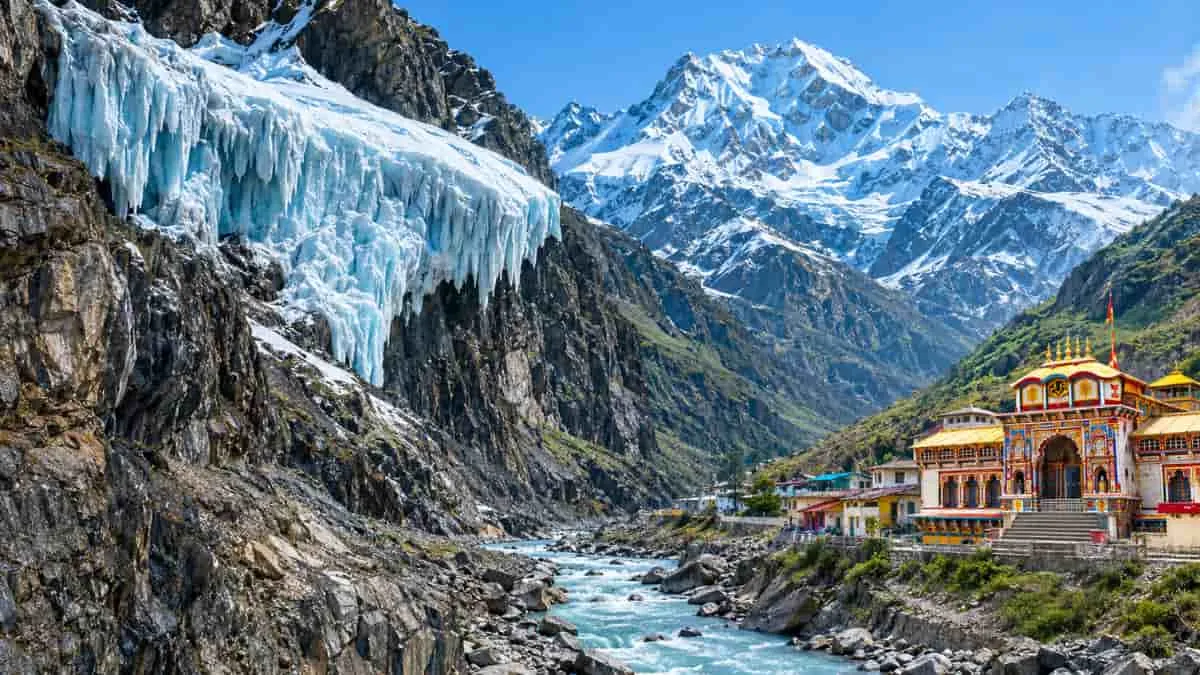
Hanging glaciers are masses of ice found on steep mountain slopes, cliffs and elevated rocky surfaces. Unlike valley glaciers that flow through mountain valleys, hanging glaciers remain attached to steep mountainsides, often at very high altitudes.
These glaciers can become dangerous when large sections of ice break away and fall downhill, triggering ice avalanches, landslides and debris flows. In some situations, such events can also contribute to Glacial Lake Outburst Floods (GLOFs).
The Himalayan region of India is particularly vulnerable because of rising temperatures, changing snowfall patterns and fragile mountain ecosystems. Recent scientific studies published in 2026 have highlighted the potential risks posed by hanging glaciers in Uttarakhand, particularly in the Alaknanda basin and around Badrinath.
What Are Hanging Glaciers?
A hanging glacier is a body of glacial ice located on a steep mountain slope or cliff, rather than within a conventional mountain valley.
They are called hanging glaciers because they appear suspended above the surrounding landscape. These glaciers develop where snowfall accumulates over several years and gradually transforms into dense ice.
Their steep location makes them vulnerable to gravity. When the ice becomes unstable or loses support, large sections can break away and rush down the mountainside at high speed.
Key characteristics of hanging glaciers:
Related Stories
-
They are found on steep mountain slopes and cliffs.
They generally occur at high altitudes.
They develop through the accumulation and compression of snow.
They can trigger ice avalanches when large ice sections collapse.
They pose risks to settlements, roads and infrastructure located below them.
How Do Hanging Glaciers Form?
Hanging glaciers form through the gradual accumulation and compression of snow in high-altitude mountain regions.
The process involves the following stages:
-
Snow accumulation: Snow falls during winter and accumulates on high mountain slopes where temperatures remain low.
-
Compression: New snowfall compresses older snow under its weight.
-
Formation of glacial ice: Over several years, compressed snow changes into firn and eventually dense glacial ice.
-
Glacier movement: Gravity causes the ice to move slowly downhill, depending on the mountain's shape and slope.
-
Development of instability: Changes in temperature, ice thickness and mountain conditions can create cracks and fractures.
-
Ice collapse: When the ice becomes unstable, a large section may detach and fall downhill, triggering an ice avalanche.
What Causes Hanging Glacier Instability?
Several environmental and geological factors can increase the instability of hanging glaciers.
1. Global warming: Rising temperatures accelerate ice melting and can weaken the connection between glaciers and underlying rocks.
2. Changing snowfall patterns: Irregular snowfall and warmer conditions can disturb the natural balance between ice accumulation and melting.
3. Steep mountain slopes: Gravity puts continuous pressure on ice masses located on steep slopes, increasing the possibility of sudden ice movement.
4. Meltwater: Water entering cracks and fractures can influence glacier movement and weaken ice-rock contact under certain conditions.
5. Earthquakes: The Himalayas are tectonically active. Earthquakes can disturb unstable mountain slopes and potentially trigger ice-rock avalanches.
Why Do Hanging Glaciers Pose a Growing Risk to India?
The Himalayan region supports millions of people and important river systems. It also contains roads, hydropower projects, bridges, villages and major pilgrimage destinations.
A sudden hanging glacier collapse can threaten these settlements and infrastructure.
Two important research studies published in 2026 have highlighted this concern.
1. 219 Hanging Glaciers Identified in the Alaknanda Basin
A study published on April 16, 2026, in npj Natural Hazards, titled Basin-scale Inventory and Exposure Assessment of Hanging Glaciers, Central Himalaya, identified 219 hanging glaciers in the Alaknanda basin of Uttarakhand.
The research involved scientists associated with the Indian Institute of Science (IISc), IIT Bhubaneswar and other institutions.
Major findings of the study:
-
Total hanging glaciers identified: 219
-
Total glacier area: 71.7 ± 3.5 square kilometres
-
Estimated total ice volume: 2.39 ± 0.42 cubic kilometres
-
Estimated hanging ice mass: 0.74 ± 0.14 cubic kilometres
-
Average slope: Approximately 33 degrees
The study found that nearly 30% of the hanging ice mass was concentrated in the Upper Alaknanda basin.
Computer-based avalanche simulations also indicated that potential flows could exceed 50 metres in height in the Badrinath-Mana sector.
The research highlighted the need for glacier monitoring and improved disaster preparedness in Uttarakhand.
2. Hanging Glacier Collapse Could Threaten Badrinath
Another study published in the journal Landslides on October 28, 2026, examined the potential impact of hanging glacier collapses around Badrinath.
The research, supported by the Defence Research and Development Organisation (DRDO), involved researchers from IISc, the University of Cambridge and DRDO.
Scientists assessed three hanging glaciers located between 4,700 and 5,465 metres above sea level.
According to the worst-case computer simulations, the collapse of the largest assessed glacier could damage:
-
398 buildings
-
2.66 kilometres of roads
-
Two bridges
-
One helipad
-
One parking area
The study estimated that an avalanche could reach a maximum velocity of 78.5 metres per second and a flow height of 73.5 metres at the assessed site.
However, the modelling did not indicate a direct impact on the Badrinath Dham shrine itself. Researchers recommended identifying high-risk zones and restricting construction in vulnerable areas.
What Happens When a Hanging Glacier Collapses?
A hanging glacier collapse can trigger several dangerous events:
-
Ice avalanches: Large masses of ice can rush downhill, destroying buildings, roads and bridges.
-
Glacial Lake Outburst Floods (GLOFs): Falling ice can displace water in a glacial lake or contribute to the failure of its natural dam, releasing large volumes of water downstream.
-
Landslides: Falling ice and rocks can destabilise mountain slopes and trigger landslides.
-
Debris flows: Mixtures of ice, rocks, soil and water can move rapidly through valleys.
-
Loss of life and livelihoods: Local communities, tourists, pilgrims and workers can face serious risks.
How Can India Reduce the Risk?
Although glacier collapses cannot be completely prevented, their impact can be reduced through scientific monitoring and disaster preparedness.
-
Glacier monitoring: Use satellite images, drones and field surveys to track changes in glacier size, cracks and movement.
-
Early-warning systems: Monitor glacier instability and potential avalanche activity to improve emergency preparedness.
-
Hazard mapping: Identify vulnerable settlements, roads and infrastructure located below unstable glaciers.
-
Controlled construction: Restrict development in high-risk avalanche zones.
-
Public awareness: Educate local communities, tourists and pilgrims about evacuation routes and emergency procedures.
-
Scientific research: Strengthen cooperation among institutions such as IISc, DRDO and the Geological Survey of India.
Conclusion
Hanging glaciers are natural features of the Himalayan mountain environment, but their sudden collapse can create serious disasters. Rising temperatures, changing snowfall patterns and unstable mountain slopes are important factors that can increase their vulnerability.
The identification of 219 hanging glaciers in the Alaknanda basin and the 2026 research highlighting potential risks to Badrinath demonstrate the importance of glacier monitoring in India.
Regular scientific assessments, early-warning systems and responsible infrastructure development are essential to protect Himalayan communities from glacier-related hazards.