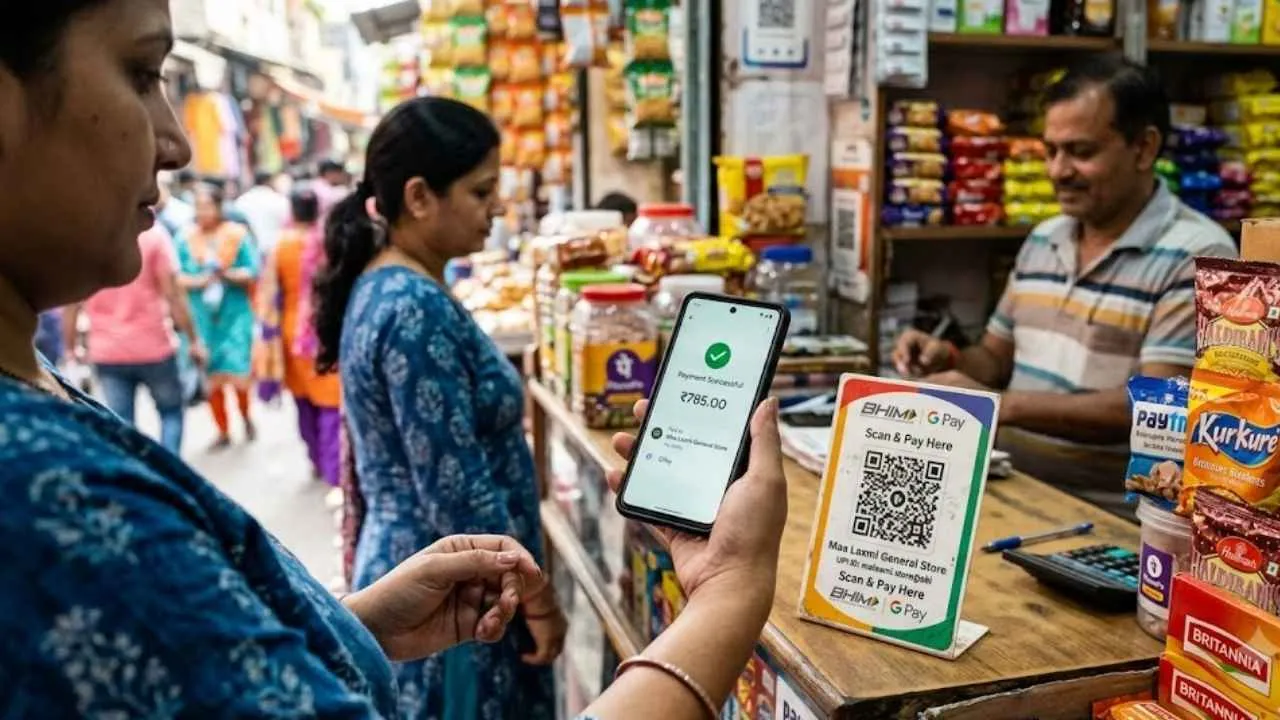
The buzz about Unified Payments Interface (UPI) is loud now. Customers are panicking about paying more money on everything over ₹2000. Recently, UPI has undergone a regulatory update. This update will be applicable from 15th of October 2026.
This new framework will have a 0.4% Merchant Discount Rate (MDR) applied to certain merchant transactions above ₹2,000.
This has created chaos among customers who have a day-to-day transaction history above ₹2,000. After seeing this, authorities like the National Payments Corporation of India and the Ministry of Finance have explained a few points and have asked UPI users not to panic.
They have clarified that all everyday users will not come under the slab. They will remain unaffected, with most routine digital transactions being completely free and hassle-free as usual.
According to the scheme makers, the new structure aims to act as a balancing tool between merchant costs. UPI is trying to balance merchant costs without disturbing the ease of digital payments.
If we try to understand in simpler terms, our UPI will be as smooth as it was earlier; it has just added a layer of structure behind the payment.
Let’s see 7 major categories of transactions that remain completely free under the new UPI framework.
7 Things that will remain completely free under the new UPI framework.
Person-to-Person (P2P) Transfers
If you are worried that you will be charged if you send money to your family, friends or kids, relax. Under the new UPI framework, all money transfers between individuals remain totally free, no matter how much the amount is. Sending money to family, friends, or between personal bank accounts has no charges, and this makes P2P transactions fully zero-cost under UPI.
Everyday Retail Payments up to ₹2,000
Here is what you need to know about: all the transactions that are made between you and shops, restaurants or online platforms are free up to ₹2,000 per transaction. This is because most daily purchases fall in this range. This keeps routine spending unaffected under the new framework.
Government and Utility Bill Payments
According to the notification, all the payments that you will make for your electricity bill, water bill, LPG bill, and government services remain free. Now the confusion was, will it be free over ₹2,000? So, yes! Even transactions above ₹2,000 are exempt, ensuring essential public utility payments stay completely unaffected.
Small Merchants and Street Vendors
All the small merchants, kirana stores, and street vendors remain exempt from the new MDR charges that UPI has introduced. Any businesses that earn up to ₹1 lakh monthly via UPI will continue receiving payments without deductions or charges. This supports digital payment adoption by smaller merchants without affecting them.
Insurance Premium Payments
All insurance payments including life, health, and general insurance remain free. These essential financial transactions continue without any additional charges under the revised UPI framework.
No Direct Charges For Consumers
Any consumers will not pay any direct or hidden UPI fees, this has been made clear in all the notifications. The 0.4% MDR applies only between businesses. These charges cannot be passed to users by banks or payment apps.
Educational Institution Payments
School fees, college tuition, coaching fees, and exam registrations remain MDR-free. This ensures education-related payments stay affordable for students and parents across India under the updated UPI rules.
While the new framework has definitely disrupted things for customers, it brings only a small structural change. These changes apply to certain merchant transactions above ₹2,000. Key categories like P2P transfers, utility payments, education, and insurance remain fully free. UPI is still smooth, fast, and pocket-friendly as it continues to support daily spending without adding any extra burden on regular users. Although this may lead to a drop in the number of UPI users due to initial confusion, merchants falling under the new MDR framework may refrain from using it. Experts predict that the use of physical currency may increase.