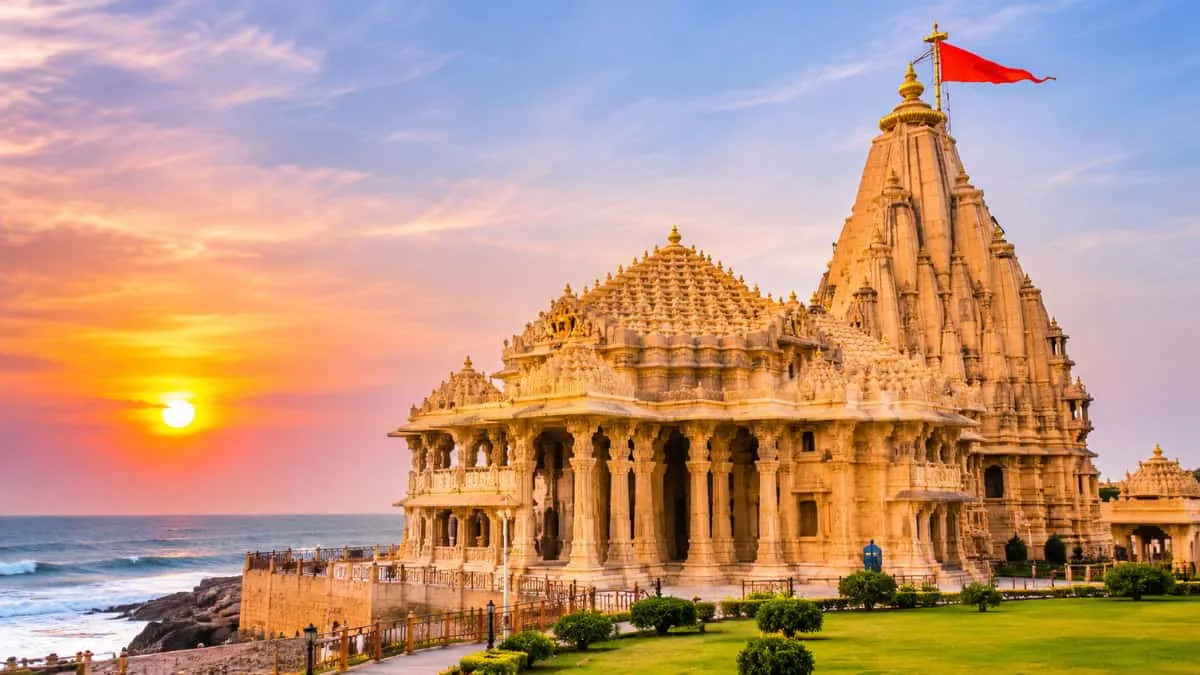
Somnath Temple has recently been in the news following an important development in the Gujarat High Court on October 30, 2026. The court first set aside the state government's restriction on the sale, storage and preparation of non-vegetarian food near the temple. However, a Division Bench of the Gujarat High Court stayed this decision later the same evening, allowing the restrictions to continue until further orders.
The case relates to restrictions imposed within a 500-metre radius of Somnath Temple and along certain roads connected to the pilgrimage area. The development has once again brought attention to Somnath Temple, one of the most famous Hindu pilgrimage sites in India.
Located in Prabhas Patan near Veraval in Gujarat's Gir Somnath district, Somnath Temple is considered the first among the twelve Jyotirlingas of Lord Shiva. It is also known for its remarkable history, beautiful architecture and repeated reconstruction over several centuries.
Let's explore the history, architecture, religious significance and important facts about Somnath Temple.
Why Is Somnath Temple in the News?
On October 30, 2026, the Gujarat High Court passed an important order concerning restrictions on non-vegetarian food around Somnath Temple.
The matter began after the District Magistrate of Gir Somnath issued a notification on August 10, 2026, prohibiting the preparation, storage and sale of meat, fish and other non-vegetarian food items in specified areas around the temple.
The restriction covered:
Related Stories
-
Areas within a 500-metre radius of Somnath Temple.
Certain roads connecting important religious destinations in the Somnath pilgrimage circuit.
Shops, hotels, restaurants and roadside food stalls operating in the notified areas.
Six restaurant owners challenged the notification before the Gujarat High Court.
On October 30, Justice Nisha M. Thakore allowed their petitions and set aside the restrictions. However, the Gujarat government immediately approached a Division Bench of the High Court.
Later that evening, a Division Bench comprising Acting Chief Justice Manash Ranjan Pathak and Justice Nirzar S. Desai stayed the single-judge order. As a result, the restrictions continued to remain in force pending further proceedings.
The matter was listed for further consideration on November 25, 2026.
Important: The Division Bench's decision was an interim order. It did not finally decide the legality of the restrictions.
Somnath Temple: Overview
Somnath Temple is one of the most important religious destinations in India. It is situated on the western coast of Gujarat, overlooking the Arabian Sea.
The temple is dedicated to Lord Shiva and is believed to be the first of the twelve Jyotirlingas. These Jyotirlingas are considered highly sacred places of worship for devotees of Lord Shiva.
Here are some important facts about Somnath Temple:
|
Particulars
|
Details
|
|
Temple Name
|
Somnath Temple
|
|
Location
|
Prabhas Patan, Veraval, Gujarat
|
|
District
|
Gir Somnath
|
|
Dedicated to
|
Lord Shiva
|
|
Religious Significance
|
First among the 12 Jyotirlingas
|
|
Architectural Style
|
Chalukya (Chaulukya) style
|
|
Present Temple Completed
|
May 1951
|
|
Reconstruction Led By
|
Sardar Vallabhbhai Patel
|
|
Inauguration Ceremony
|
11 May 1951
|
|
President at Inauguration
|
Dr. Rajendra Prasad
|
|
Nearby Water Body
|
Arabian Sea
|
|
Important Religious Site
|
Triveni Sangam
|
History of Somnath Temple
The history of Somnath Temple goes back several centuries. It has witnessed repeated destruction and reconstruction during different periods of Indian history.
The temple is not only a major religious centre but also an important part of India's cultural and historical heritage.
1. Ancient History and Religious Beliefs
According to Hindu mythology, Somnath Temple is associated with Chandra, the Moon God.
The word Somnath means 'Lord of the Moon'. According to religious belief, Chandra was cursed by his father-in-law, Daksha Prajapati, because he favoured one of his 27 wives over the others.
As a result of the curse, Chandra began losing his brightness. He worshipped Lord Shiva at Prabhas Patan to seek relief from the curse.
Lord Shiva blessed him and restored his brightness. This is traditionally associated with the waxing and waning of the Moon.
The temple is also associated with the ancient pilgrimage site of Triveni Sangam, where the Hiran, Kapila and Saraswati rivers are believed to meet.
2. Attack by Mahmud of Ghazni in 1026
One of the most widely discussed events in the history of Somnath Temple was the attack by Mahmud of Ghazni in 1026.
During this attack, the temple was plundered and its religious structure was damaged. Historical accounts describe the incident as one of the significant events in the medieval history of the temple.
3. Reconstruction Under Kumarapala
The temple was reconstructed several times after the attacks.
In the 12th century, the Gujarat ruler Kumarapala (1143–1172) contributed to its reconstruction. An inscription from 1169 mentions the temple's rebuilding in stone.
4. Later Destruction and Reconstruction
Somnath Temple faced further destruction during subsequent invasions of Gujarat.
Historical accounts mention attacks during the rule of Alauddin Khalji's forces in 1299 and the destruction associated with Zafar Khan in 1395.
Despite these events, the temple continued to be rebuilt, maintaining its importance as a major pilgrimage destination.
Source: IE archive photo
Reconstruction of Somnath Temple After Independence
The reconstruction of Somnath Temple after India's Independence was an important moment in its modern history.
In November 1947, Sardar Vallabhbhai Patel visited Junagadh and supported the reconstruction of the temple.
The Somnath Trust was established to manage the reconstruction work and collect funds for the project.
Traditional temple builders from Gujarat, known as Sompura artisans, were involved in constructing the present temple.
The reconstruction was completed in May 1951. On May 11, 1951, India's first President, Dr. Rajendra Prasad, participated in the temple's consecration ceremony.
Today, the present Somnath Temple stands as an important symbol of India's religious and cultural heritage.
Architecture of Somnath Temple
Somnath Temple is an excellent example of traditional Hindu temple architecture.
The present structure follows the Chalukya or Chaulukya style, which is also associated with the temple-building traditions of Gujarat.
The temple is known for its detailed stone carvings, impressive pillars and beautifully designed tower.
Some important architectural features include:
1. Shikhara
The temple has a tall and beautifully designed shikhara (main tower) that rises above the sanctum.
It is one of the most noticeable features of the temple and can be seen from the surrounding coastal area.
2. Mandapa
The mandapa is the pillared hall inside the temple.
It provides space for devotees and visitors and connects different parts of the temple structure.
3. Garbhagriha
The garbhagriha is the innermost and most sacred part of the temple.
It houses the Shiva Lingam, which is worshipped by devotees.
4. Stone Carvings
The temple features detailed carvings on its walls, pillars and other architectural elements.
These carvings reflect the traditional craftsmanship of Indian temple builders.
5. Location Along the Arabian Sea
One of the most distinctive features of Somnath Temple is its location beside the Arabian Sea.
The combination of the temple's traditional architecture and the surrounding coastline makes it an important religious and tourist destination.
Religious Significance of Somnath Temple
Somnath Temple holds a special place in Hinduism because it is believed to be the first among the twelve Jyotirlingas of Lord Shiva.
A Jyotirlinga is considered a sacred representation of Lord Shiva.
According to Hindu religious traditions, the twelve Jyotirlingas are located in different parts of India and are important pilgrimage destinations for devotees.
Somnath is also associated with the ancient Prabhas Kshetra, a sacred region mentioned in Hindu religious traditions.
Thousands of devotees visit the temple to offer prayers, participate in religious ceremonies and seek the blessings of Lord Shiva.
What Is Triveni Sangam Near Somnath Temple?
Triveni Sangam is an important religious site located near Somnath Temple.
The word Triveni means the meeting of three rivers.
According to Hindu belief, three rivers meet at this sacred location:
-
Hiran River
-
Kapila River
-
Saraswati River
The confluence is considered sacred, and many pilgrims visit the site to perform religious rituals and prayers.
Important Facts About Somnath Temple
Here are some interesting facts about Somnath Temple that are useful for general knowledge and competitive examinations:
-
Somnath Temple is located in Prabhas Patan near Veraval in Gujarat.
-
It is believed to be the first among the twelve Jyotirlingas of Lord Shiva.
-
The name Somnath means 'Lord of the Moon'.
-
The temple is situated along the Arabian Sea.
-
Mahmud of Ghazni attacked the temple in 1026.
-
The present temple was reconstructed after India's Independence.
-
Sardar Vallabhbhai Patel played an important role in initiating its reconstruction.
-
The present temple follows the Chalukya style of architecture.
-
The reconstruction was completed in May 1951.
-
Dr. Rajendra Prasad participated in its consecration ceremony on May 11, 1951.
-
The temple is associated with the sacred Triveni Sangam.
-
Somnath is an important pilgrimage and tourist destination in Gujarat.
How to Reach Somnath Temple?
Somnath Temple is well connected by rail and road. Visitors from different parts of India can reach the temple using the following transport options.
- By Air: The nearest airport is Diu Airport, approximately 63 km from Somnath. Porbandar Airport is another option.
- By Rail: Somnath Railway Station provides rail connectivity to different cities. Visitors can also travel through Veraval Railway Station.
- By Road: Somnath is connected to major cities of Gujarat, including Ahmedabad, Rajkot, Junagadh and Porbandar, through road networks.
Conclusion
Somnath Temple is one of India's most significant religious and historical landmarks. Its association with Lord Shiva, ancient traditions, remarkable architecture and repeated reconstruction make it an important part of India's cultural heritage.
The October 30, 2026, Gujarat High Court development has once again brought the temple into the news. While the court proceedings concern restrictions on non-vegetarian food around the pilgrimage site, Somnath Temple remains widely recognised for its religious importance and historical legacy.
For students and general knowledge readers, understanding Somnath Temple's history, architecture and religious significance provides a useful insight into India's rich cultural heritage.