UGC Promotes AI Integration in Liberal Arts Education, Focus on Future-Ready Skills


UGC is promoting AI integration in liberal arts education to make higher education more future-focused. Check what the AI push means for students and future-ready skills.
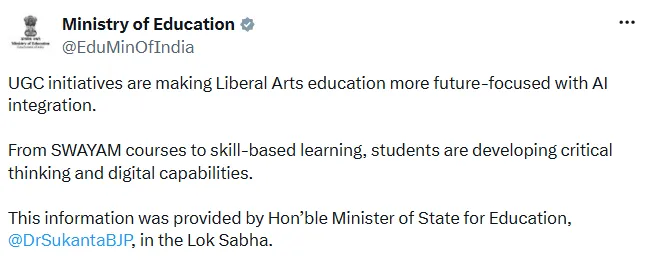
The University Grants Commission (UGC) is promoting a more future-focused approach to liberal arts education by encouraging the integration of Artificial Intelligence (AI) into higher education. The Ministry of Education highlighted the development in a recent social media post, underlining the growing role of AI in reshaping academic learning and curriculum.
UGC Promotes AI Integration in Liberal Arts Education
The Ministry of Education stated that UGC initiatives are making liberal arts education more future-focused through AI integration. The move reflects the broader transformation taking place across India's higher education sector, where institutions are increasingly looking at AI as a tool for teaching, learning, research and skill development.
The integration of AI into liberal arts is significant as the discipline covers areas such as humanities, social sciences, communication, languages, culture and interdisciplinary studies. AI-enabled learning can provide students with exposure to emerging technologies while retaining the analytical and critical-thinking foundations of liberal arts education.
UGC initiatives are making Liberal Arts education more future-focused with AI integration.
— Ministry of Education (@EduMinOfIndia) August 10, 2026
From SWAYAM courses to skill-based learning, students are developing critical thinking and digital capabilities.
This information was provided by Hon’ble Minister of State for Education,… pic.twitter.com/TO7sGj1arY
Why AI Matters for Liberal Arts Students
AI is increasingly influencing workplaces across sectors, including media, business, education, research, communications and creative industries. Integrating AI into liberal arts programmes can therefore help students develop technology-related competencies alongside traditional academic skills.
Rather than limiting AI education to technical courses, the emerging approach places greater emphasis on interdisciplinary learning. Students from non-technical backgrounds can learn how AI tools work, how they can be applied responsibly and what ethical questions arise from their use.
Focus on Future-Ready Skills
The UGC's focus comes at a time when universities are increasingly introducing AI-related programmes, courses and faculty-development initiatives. Recent higher education initiatives have also focused on preparing students and educators for AI-driven workplaces.
For liberal arts students, this could translate into greater emphasis on skills such as:
- AI literacy and responsible AI use
- Critical thinking and analytical skills
- Digital research and data interpretation
- Communication and content creation
- Interdisciplinary problem-solving
- Understanding AI ethics and societal impact
AI and Liberal Arts: A Growing Higher Education Trend
The integration of AI into liberal arts is not limited to India. Universities internationally are also exploring ways to incorporate AI into teaching, writing, research, ethics and curriculum design while retaining the human-centred principles of liberal arts education.
In India, the push towards AI-enabled education is part of a larger shift towards making higher education more multidisciplinary and aligned with changing workforce requirements.
Also Check: Assam NEET UG Document Verification 2026 Begins: Today's Schedule and Upcoming Counselling Dates
Apeksha Agarwal is an Education Journalist with over 3.5 years of experience. She covers a wide range of topics, including school board examinations, entrance tests, admissions, results, scholarships, and higher education updates. Over the years, she has closely tracked major examinations such as JEE Main, NEET UG, CUET, and various state-level entrance exams, helping students stay informed throughout their academic journey. Apeksha has a Master's degree in Journalism and Mass Communication and a certificate in Digital Journalism. She is passionate about transforming complex educational developments into clear, accessible, and useful information. Her reporting focuses on providing students, parents, and educators with accurate updates and practical insights on examinations, results, and policy changes. She believes that quality education journalism can make a meaningful difference by helping students make informed decisions about their future.


