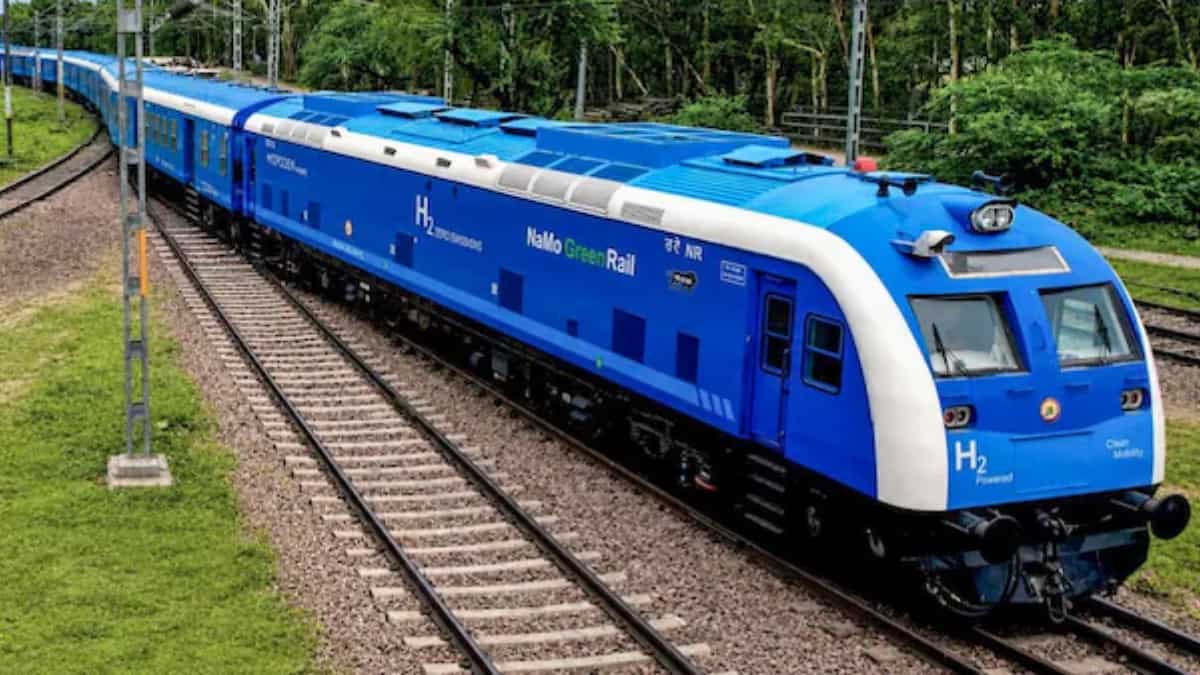
Indian Prime Minister Narendra Modi has flagged off India’s first hydrogen-powered train from Jind station in Haryana on July 17, 2026.
This hydrogen fuel cell trainset generates its own electricity on board using hydrogen, the cleanest fuel, at an affordable price ranging from ₹5 to ₹25, while it has a speed of 75 kmph up to 110 kmph; the train is not only safer but also faster on this 89 km route.
Explore this article in detail and learn more about India’s first hydrogen train & check its fare, routes & speed.
About India's First Hydrogen Train
India's first hydrogen fuel cell train is a ten-coach train set, which has the capacity to carry around 2600 passengers. It generates its own electricity on board using hydrogen, which is the cleanest fuel.
What is the fare of India's first hydrogen train?
The fare of India’s first hydrogen-powered train is just starting from ₹5 up to ₹25. This train offers lower fares because of using the advanced 1,200 kW Proton Exchange Membrane (PEM) fuel cell propulsion system. Its ticket fare is lower than the platform ticket, whose price is ₹10.
Routes of India's first hydrogen train
India’s first hydrogen-powered train is initially operated on the Jind-Sonipat section of the Northern Railways, a total of 89 km in total route length, which connects Jind Junction, Gohana Junction, and Sonipat Junction.
The routes of this train include intermediate stations and local halts, which are:
-
Jind City
Pandu Pindara Junction
Lalit Khera Halt
Bhambhewa
Isapur Kheri Halt
Butane Halt
Khandrai Halt
Rabrah Halt
Lath Halt
Mohana
Barwasni Halt
Sonipat New
Speed of India's first hydrogen train
India’s first hydrogen-powered train uses an advanced propulsion system, and it is equipped with a multi-layer safety system that makes it capable of an operational speed of 75 kmph on the Jind–Sonipat section and a design speed of 110 kmph.
The train is not only safer but also faster on this 89 km route.
PM Modi Also Inaugurated the Jalandhar Cantonment Railway Station
During the same visit to flag off India’s first hydrogen-powered train from Jind station in Haryana on July 17, 2026, PM Narendra Modi also inaugurated the Jalandhar Cantonment Railway Station in Punjab under the Amrit Bharat Station Scheme, where he will flag off the Sant Ravidas Express, which is connecting Amritsar and Varanasi.
With all these inaugurations, he will inaugurate major health care projects at PGIMER, including the Advanced Mother and Child Centre.
So, after the inauguration of India's first hydrogen train on July 17, Indian Railways is progressing toward reinforcing India’s leadership in sustainable mobility while contributing to the National Green Hydrogen Mission and reducing carbon emissions by 45% below 2010 levels by 2030 and NET ZERO by 2050.