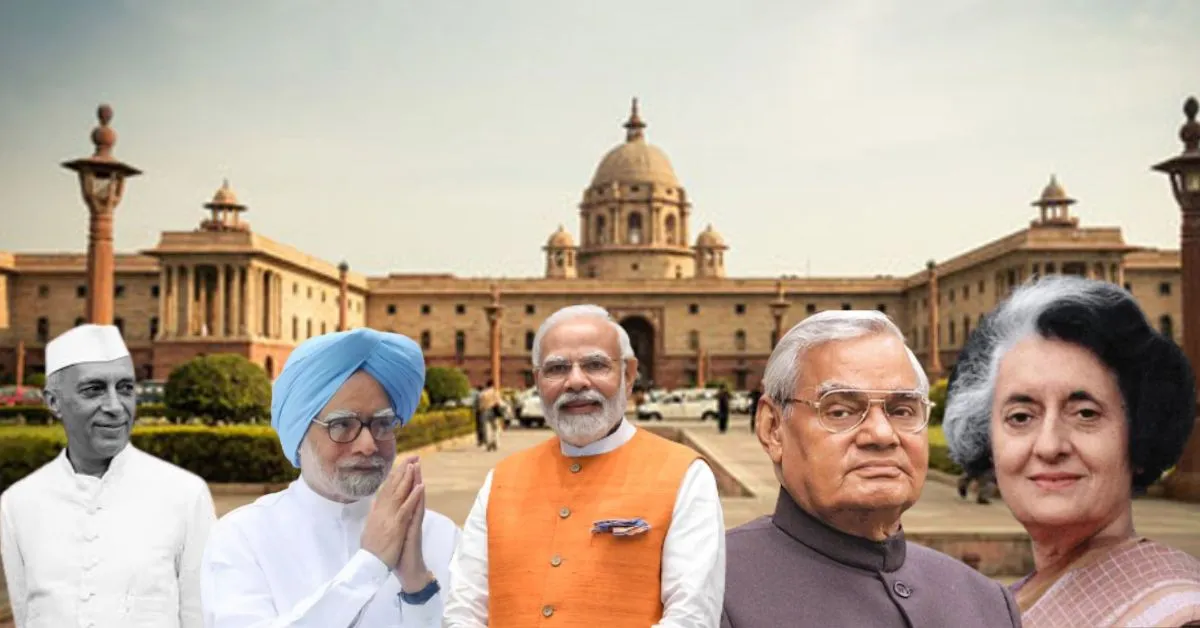
India is a vast, diverse and politically vibrant country and holding the position of the Prime Minister of the nation is more than just administrative responsibilities but also managing public expectations, national identity and creating a better future for the nation. Since independence in 1947, India has seen a total of 14 Prime Ministers. From freedom fighters and economists to political strategists and mass leaders these leaders took the position and left indelible marks throughout their tenures.
The first Prime Minister of India, Jawaharlal Nehru laid the foundation of a modern and secular nation. He was then followed by Indira Gandhi who helped shape the political discourse in 1970. Later, Manmohan Singh took the leadership position and his quiet yet steady leadership marked a decade of economic and global repositioning.
Now recently, Narendra Modi has emerged as one of the most important political figures and as of July 2025, has officially become the second longest-serving Prime Minister in India’s history, overtaking Indira Gandhi’s record for an unbroken tenure. Here is a list of the longest-serving Prime Ministers in India.
Longest Serving Prime Ministers of India
India has seen fourteen individuals serve as Prime Minister from August 15, 1947 to mid‑2025. Their total tenures span from just a few days to over sixteen years. Here is a complete look at the PMs who have served the nation for the longest:
1. Jawaharlal Nehru (INC)
-
Tenure: August 15, 1947 – May 27, 1964
Duration: 16 years, 286 days
2. Narendra Modi (BJP) (as of September 2026)
-
In office since May 26, 2014
-
By September 17, 2026, he surpassed Indira Gandhi, completing 4,497 consecutive days and becoming India’s second longest continuous-serving PM
-
Duration: 12 years 3 months 22 days
Did You KnowIndian Prime Minister Narendra Modi is turned 76 on September 17, 2026. He was born on September 17, 1950, in Vadnagar, Gujarat, Modi became the first PM of India to be born after the country gained independence in 1947.
|
3. Indira Gandhi (INC)
-
First term: January 24, 1966 – March 24, 1977
-
Duration: 11 years, 59 days (total across later term: 15 years, 350 days) 
4. Manmohan Singh (INC)
- Tenure: May 22, 2004 – May 26, 2014
-
Duration: 10 years, 4 days
5. Atal Bihari Vajpayee (BJP)
-
Combined terms: 1996 (16 days), 1998–1999 (13 months), 1999–2004 (full term)
-
Total continuous last term: 6 years, 80 days.
Top 5 Longest Continuous Tenures
|
Rank
|
Prime Minister
|
Term Start–End
|
Duration
|
|
1
|
Jawaharlal Nehru
|
Aug 1947 – May 1964
|
16 years, 286 days
|
|
2
|
Narendra Modi (incumbent)
|
May 2014 – Till Now
|
12 years 3 months 22 days crossing Indira now
|
|
3
|
Indira Gandhi
|
Jan 1966 – Mar 1977
|
11 years, 59 days
|
|
4
|
Manmohan Singh
|
May 2004 – May 2014
|
10 years, 4 days
|
|
5
|
Atal Bihari Vajpayee
|
Mar 1998 – May 2004 (final term)
|
6 years, 80 days
|
Narendra Modi: The Rise to Second‑Longest Serving PM
Narendra Modi first took office on May 26, 2014 and he was re-elected May 30, 2019 serving his second term as the Prime Minister of India. Later in the 2024 elections he got re-elected and is serving his third consecutive term.
By September 17, 2026, Modi completed 4,497 days as Prime Minister which exceeds Indira Gandhi’s 4,077 consecutive days (from January 24, 1966 to March 24, 1977). He thus became the second longest-serving Prime Minister in continuous terms.