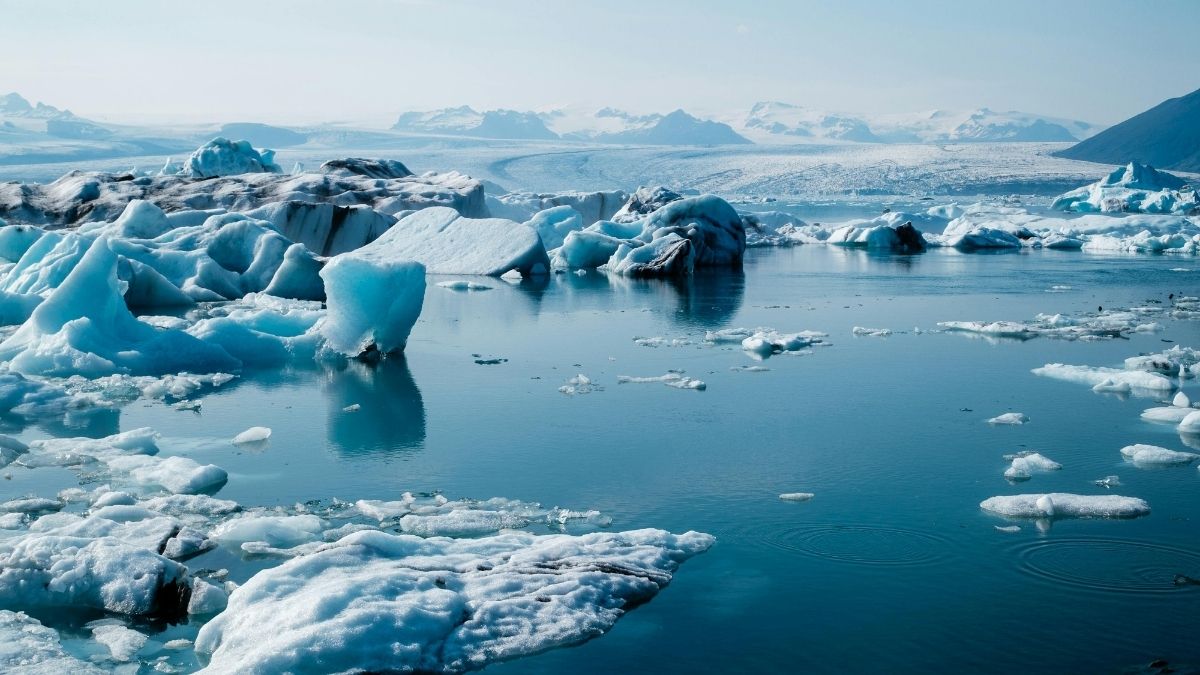
Melting icebergs are accelerating a surprising event 2,500 metres below the Arctic Ocean as the world’s climate warms. A groundbreaking study by the Alfred Wegener Institute (AWI) and Woods Hole Oceanographic Institution, published in Nature in 2026, reveals that massive ice chunks drifting from Greenland and the Russian Arctic are fundamentally reshaping the muddy seafloor.
When these melting icebergs break up, they leave behind huge boulders, called dropstones, in the deep ocean. These rare hard surfaces are quickly becoming thriving deep-sea homes for sponges, corals, and sea anemones.
While this is an exciting change in Arctic marine life, marine biologists warn that these new biodiversity hotspots are a sobering reminder of rapid glacier disintegration.
How are Melting Icebergs Creating Dropstone Habitats?
Scientists monitoring the deep-sea AWI-Hausgarten observatory recently tracked an unusual surge in dark, debris-laden icebergs floating through the Fram Strait. These massive ice blocks carry vast amounts of shale, quartz, and gravel scraped from Arctic landmasses by glaciers. As rising ocean temperatures cause them to melt hundreds of kilometres away from the shore, they release tons of rocks into the abyss.
"Where previously there were only isolated stones of various sizes, we are now finding much larger accumulations," notes Dr. Kirstin Meyer-Kaiser of the Woods Hole Oceanographic Institution. Because the deep Arctic seabed is primarily composed of soft sediment, these newly deposited rocks provide the rare solid ground that specific marine organisms desperately need to survive.
3 Ways Dropping Rocks Transform the Seafloor
-
Forming Miniature Islands: The soft, muddy sediment of the seabed offers zero attachment points. The dropped rocks act as permanent, solid anchors for sea life.
Fostering Hard-Substrate Specialists: Organisms like sea anemones, sponges, and rare deep-water corals can finally settle and thrive in these regions.
Establishing Biodiversity Hotspots: Every stone accumulation creates a flourishing, localized ecosystem within a previously featureless, barren zone.
What are Deep-Sea Dropstones and Why Do They Matter?
To understand the gravity of this climate-driven mechanism, it helps to look at the exact function of dropstones in the ocean ecosystem.
|
Feature
|
Detail
|
|
Definition
|
Isolated rock fragments and gravel dropped into marine sediments by melting icebergs.
|
|
Depth
|
Found plunging up to 2,500 metres beneath the surface of the Arctic Ocean.
|
|
Ecological Significance
|
They artificially introduce hard-bottom habitats, completely altering deep-sea ecology.
|
|
Primary Source
|
Disintegrating tidewater glaciers located in north-east Greenland and the Russian Arctic.
|
Is This Ecological Shift a Net Gain for the Ocean?
While the sudden emergence of dropstone ecosystems might sound like a victory for underwater life, scientists urge extreme caution. The deep-sea colonization process is notoriously slow, often taking decades for just a handful of species to establish themselves permanently.
Furthermore, this rocky habitat creation is driven by severe environmental distress. Shrinking sea-ice cover and disrupted nutrient balances are already threatening the broader marine food web by reducing critical resources like nitrate. The harsh reality is that these localized micro-habitats cannot offset the massive, systemic ecological loss caused by warming oceans.
The deep-sea transfiguration wrought by melting icebergs is ultimately a tribute to nature’s amazing adaptability in the face of dramatic climate shifts. But these rocky havens below the waves are a stark warning. We need to fix what’s causing global warming in order to save our oceans from changing ecosystems before it’s too late.