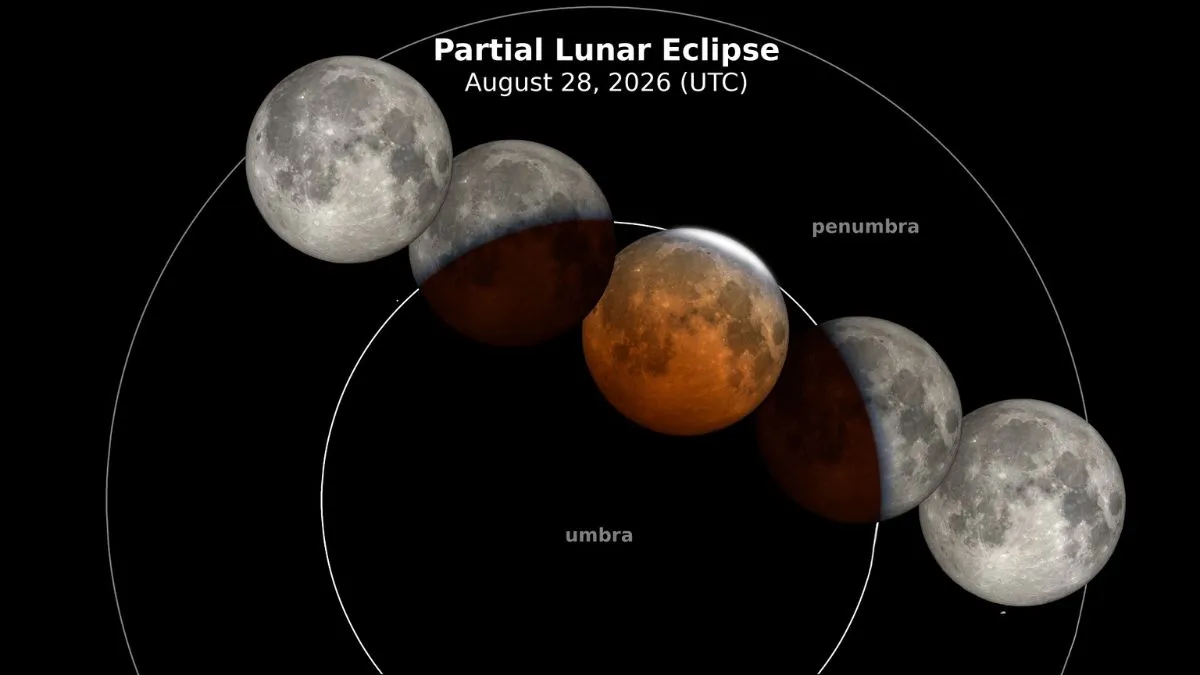
The August 2026 partial lunar eclipse will take place on August 28, 2026. In some parts of the world, the eclipse will begin on the night of August 27.
According to NASA, on August 28, 2026 (the evening of the 27th in some time zones), the Moon passes into the shadow of Earth, creating a deep partial eclipse. At the moment of greatest eclipse, 4:13 a.m. Universal Time, 96.3% percent of the Moon's disk is within Earth's umbra, the central part of the shadow where the Sun is completely blocked by Earth. This part of the eclipse is visible in the Americas (except Alaska and northwestern Canada), western Europe and western Africa.
The penumbra is the part of Earth's shadow where the Sun is only partially covered by Earth. The effect of the penumbra on the Moon's appearance is subtle. But after the partial phase begins, at 2:34 UTC (10:34 p.m. Eastern on the night of the 27th), the umbra's dramatic effect is easily visible as it takes an increasingly large bite out of the disk of the full Moon.
Less than an hour later, the part of the Moon still in sunlight will be small enough for observers' eyes to adapt to darkness and perceive the coppery color of the part of the Moon within the umbra. The visualizations here mimic this dark adaptation by increasing the apparent photographic exposure around the time of greatest eclipse.
Source: NASA
August 2026 Lunar Eclipse: Important Facts
-
It will occur on August 28, 2026.
It will start from August 27 at some places.
It's a partial lunar eclipse.
During maximum eclipse 96% of the Moon's surface will pass into Earth's shadow.
Maximum eclipse will happen about 04:13 UTC.
The event will take about 3 hours 18 minutes.
It will be seen primarily in the Americas, Europe and Africa.
The eclipse will not be seen in India.
Special eye protection is not required.
The part of the Moon that is not illuminated by the Sun can turn coppery or reddish.
Partial Lunar Eclipse August 2026: Key Details
|
Detail
|
Information
|
|
Date
|
August 28, 2026
|
|
Eclipse type
|
Partial lunar eclipse
|
|
Maximum eclipse
|
Around 04:13 UTC
|
|
Maximum umbral coverage
|
About 96%
|
|
Duration
|
About 3 hours 18 minutes
|
|
Main visibility
|
Americas, Europe and Africa
|
|
India visibility
|
Not visible
|
|
Viewing equipment
|
Naked eye, binoculars or telescope
|
|
Eye protection
|
Not required
|
Where Will the August 2026 Lunar Eclipse Be Visible?
The eclipse will be visible from large parts of the Americas, Europe and Africa.
Best-visible regions
-
North America
-
South America
-
Western Europe
-
Western Africa
-
Parts of eastern and western regions around the visibility boundary
-
Areas of the Pacific and Atlantic Oceans
Will the Lunar Eclipse Be Visible in India?
No. The August 28, 2026 partial lunar eclipse will not be visible from India.
The reason is simple: the Moon will be below the horizon in India during the relevant eclipse phases.
The Government of India's India Meteorological Department (IMD), Positional Astronomy Centre, Kolkata states that the eclipse is not visible in India. Its published astronomical information gives the eclipse period as approximately 8:04 AM to 11:22 AM IST.
This means people across cities such as:
-
Delhi
-
Mumbai
-
Kolkata
-
Chennai
-
Bengaluru
-
Hyderabad
-
Ahmedabad
-
Pune
will not be able to see the eclipse directly from India.
The August 28, 2026, partial lunar eclipse of the Moon, as almost the entire lunar disk passes into the shadow of the Earth. The event, however, will not be visible for people in India, as the Moon will not be visible above the horizon during the eclipse.