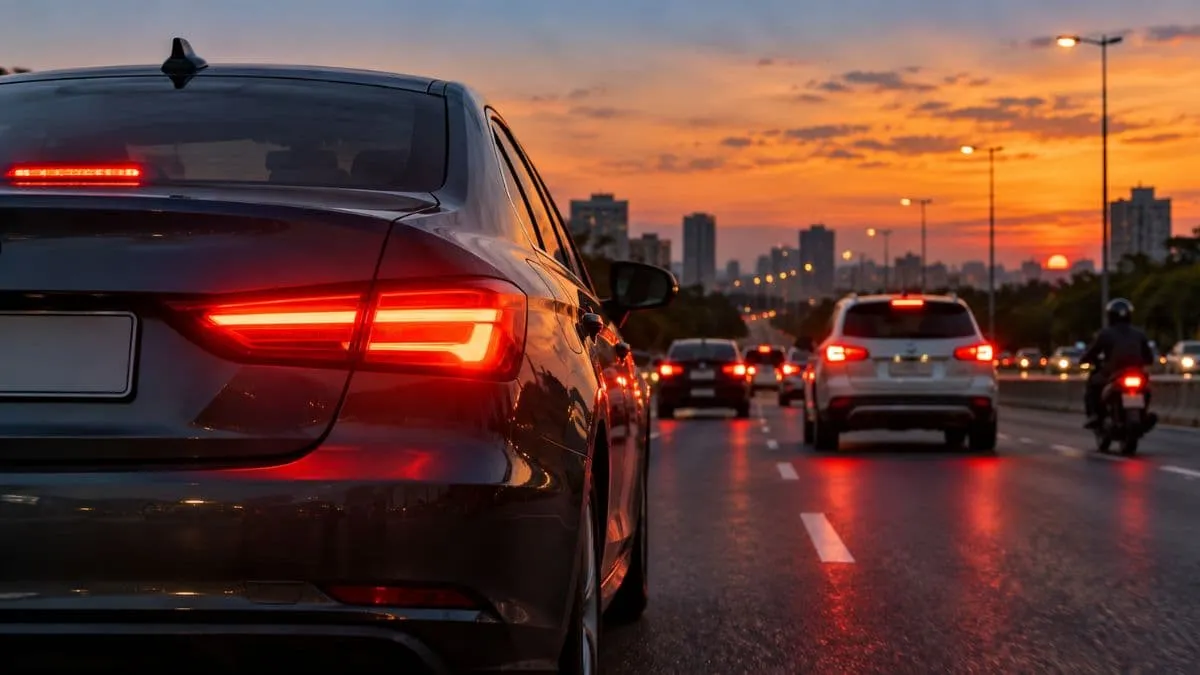
Have you ever noticed that the lights at the back of cars, buses, trucks and motorcycles are usually red?
White headlights are commonly used for the front of vehicles. However, red taillights and red brake lights are visible when viewed from the back.
But why are vehicle backlights red? There is science behind red taillights. As per the UNECE, the red at the back is linked to the traffic rule and the behavior of light in the atmosphere, with the road safety aspects. Other vehicle-lighting regulations in India include the requirement to color the tail and stop lights red.
So, let’s explore this article and see what NASA & UNECE say about this.
Why Are Vehicle Backlights Red?
The biggest reason is to give other road users a clear and standard signal.
If you see red lights coming up ahead as you are driving at night, you can tell immediately that the car is going in the same direction as you.
The red light can also tell you that the vehicle is:
-
Present in front of you
Moving in the same direction
Slowing down
Stopping
Standing on the road in low-light conditions
This simple colour system helps drivers understand what is happening without having to see the entire vehicle clearly.
What Does the Red Light at the Back of a Vehicle Mean?
Not every red light at the back does exactly the same job.
|
Type of Light
|
Colour
|
Main Purpose
|
|
Tail/Rear Position Lamp
|
Red
|
Shows the presence of the vehicle from behind
|
|
Stop/Brake Lamp
|
Red
|
Warns that the vehicle is slowing or stopping
|
|
Rear Fog Lamp
|
Red
|
Helps make the vehicle visible in poor visibility
|
|
Reversing Lamp
|
White
|
Shows that the vehicle is reversing
|
|
Rear Number Plate Lamp
|
White
|
Helps illuminate the number plate
|
What is the Science Behind Red Light?
There is also an interesting science behind the colour red. Light is a wave and each colour has a different wavelength.
So, according to the NASA, “A red light has a longer wavelength than a blue and violet light. Longer wavelengths pass through the atmosphere more easily, shorter wavelengths are scatter stronger, which is known as light scattering.”
Let’s understand this with an example:
Observe the sky in the daytime.
How is it often blue?
The shorter blue wavelengths are scattered more by the air molecules. Red light is scattered less by these small molecules.
The same characteristics of light that make red a useful signal for tasks that could be carried out over distance also play a role in this behavior.
There is an important point here, however: The red light colour of a vehicle is not chosen solely due to its reduced scattering. This is also due to the importance of standardisation and road safety.
Did You Know?Red is at the longer-wavelength end of the visible-light spectrum. NASA states that red light has a longer wavelength, and less energy than the colours at the violet end of the visible spectrum.
Therefore, that red light that you see on the back of a car is really tied to a broader issue – the science of light and wavelengths.
|
Why Not Use Blue or Green at the Back?
Suppose one car had a blue rear light, another had a green light and another had a yellow light. The driver would have to know the meaning of all the colours. This may cause confusion on a heavy traffic road.
Vehicle-lighting systems, on the other hand, have specific colours for specific purposes. This establishes a shared ‘visual vocabulary' for drivers.
For example:
White → generally associated with the front or reversing
Red → associated with the rear and stopping
Amber → commonly used for direction indicators
This makes it easier for drivers to understand another vehicle quickly.
Why is the color of the brake lights red?
This is one of the most important reasons for using red at the back. The red stop lights flash brighter when the brake pedal is depressed.
The following driver doesn't have to be able to see the braking foot. The bright red light provides an instant warning: the vehicle ahead is slowing down or stopping.
According to international vehicle regulations, red is the color for stop lights. As per, UNECE's lighting requirements include red stop lamps and red rear-position lamps.
This is particularly helpful when commuting on heavily trafficked roads or highways as even a slight lapse in judgment between seeing a vehicle brake can cause a problem.
What's the difference between Tail Lights and Brake Lights?
They're both red, but they have different roles.
Tail Light
Rear-position lights, also known as tail lights, help other motorists know that there is a car in the vicinity.
It is normally on when the vehicle's lighting system is being used.
Brake Light
When the driver steps on the brakes, the brake light increases in brightness.
It's designed to provide a strong warning of slowing or stopping.
What happens to the red light in the atmosphere?
Gases and very small particles are present in the atmosphere. It transmits light and a certain amount of light can be scattered.
According to NASA, "The bluer wavelengths of light are scattered more strongly than the longer red wavelengths.
That is why, red light can be utilized for signaling.
But in not every situation red lights are clearly visible. Fog, rain, dust and smoke (and other particles) may reduce visibility.
So, it's not correct to claim that red light can pass through all weather conditions better than other colours.
Is Red Backlight a Rule in India?
Yes, Indian vehicle rules include requirements regarding the colour of vehicle lamps. According to UNECE, the Central Motor Vehicles Rules have rules for vehicle lights, including restricts on colour towards the front and rear. India's automotive standards also call for red for significant rear lighting functions.
This does not just mean that the red light you see on the back of a normal vehicle is just a personal choice of the manufacturers.
So, it is part of a large vehicle-safety and lighting system.
Key Points to Remember
-
Car's tail lights are usually red.
-
Red signals are used to denote a clear, standard signal for road users.
-
Red light has the longest wavelength among blue, red and violet.
-
Shorter blue wavelengths are scattered more by atmospheric molecules. (NASA Science)
-
Red tail lights indicate a vehicle is coming towards you from behind.
-
Red break lights are used to alert drivers when a vehicle is slowing or stopping.
-
Lights are typically white on reversing lights.
-
The various colours of the lamps prevent confusion in the road.
-
India's vehicle regulations and regulations govern vehicle lighting.
So, the next time you pass two red lights on the back of a vehicle, think about what they are doing more than just lighting up the vehicle.
The red rear lights are a part of a well-thought-out road safety system. The colour is used to provide the driver with a common signal and the science of light is used to explain the difference between the behavior of red and shorter wavelength colours as they pass through the atmosphere.