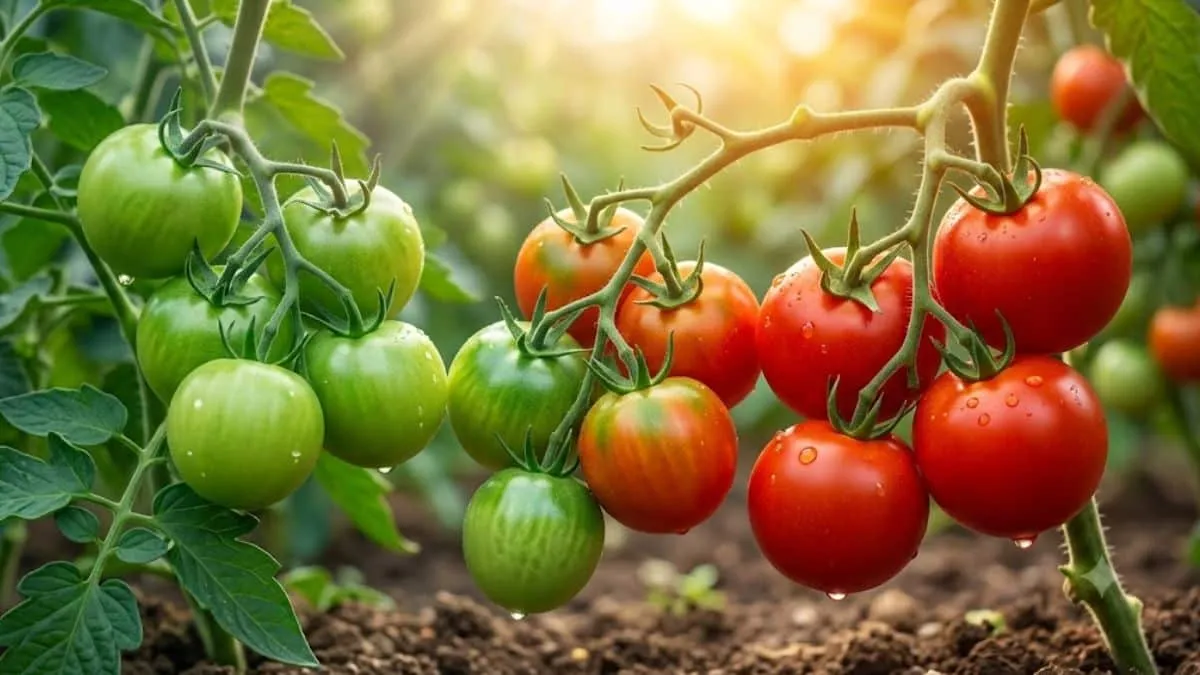
Have you ever noticed that tomatoes in the market are usually green or red? Green tomatoes are firm and less ripe while red tomatoes are soft and ripe.
But have you ever wondered why the colour of a tomato changes from green to red? It is because of the two natural pigments that are present within the tomato: chlorophyll and lycopene. The amount of these pigments varies with the growth and ripening of the tomato.
Why Are Tomatoes Green When They Are Unripe?
The tomato has a high amount of chlorophyll when it is still growing. The natural green pigment of plants is chlorophyll. It's also the colour that will give leaves their green hue.
Chlorophyll is responsible for the green colour of an immature tomato fruit. This chlorophyll slowly disappears as the tomato ripens.
So, in simple words, we can say that, More chlorophyll means Green tomato
Why Does a Tomato Turn Red?
As the tomato matures its green colour begins to fade. Meanwhile, the tomato also synthesizes greater amounts of carotenoids, particularly a pigment called lycopene.
The well-known red colour in ripe tomatoes is due to lycopene. Research shows that lycopene becomes the major carotenoid in a typical ripe red tomato.
So:
Less chlorophyll + More lycopene = Red tomato
Green vs Red Tomato
|
Feature
|
Green Tomato
|
Red Tomato
|
|
Ripening stage
|
Unripe or mature-green
|
Ripe
|
|
Main visible pigment
|
Chlorophyll
|
Lycopene
|
|
Colour
|
Green
|
Red
|
|
Texture
|
Usually firm
|
Usually softer
|
|
Taste
|
More sour/tart
|
Generally sweeter and more developed
|
What Happens Inside a Tomato During Ripening?
The colour change does not happen suddenly. It is a gradual process.
You can understand it in these simple steps:
-
Young tomato: The fruit is green because it contains chlorophyll.
Tomato grows: It becomes larger and reaches the mature-green stage.
Ripening starts: Chlorophyll begins to break down.
Carotenoids increase: Pigments such as lycopene begin to build up.
Colour changes: The tomato may pass through yellowish or orange stages.
Full ripening: Lycopene becomes abundant and the tomato develops its familiar red colour.
Does Every Tomato Become Red?
No. This is an interesting point. Tomatoes do not all have to become red when they ripen.
Different tomato varieties can have different colours, including red, orange, yellow, pink, green, white and purple. The final colour depends on the types and amounts of pigments produced by that particular variety.
That is why you may sometimes see yellow or orange tomatoes in addition to the common red ones.
Why Are Red and Green Tomatoes Common?
The two most common tomato colours are red and green, which indicate two critical periods in the tomato's growth.
-
Green: The tomato starts to lack in chlorophyll and has not reached normal ripening.
-
Red: Chlorophyll has been reduced and lycopene has been built up during ripening.
However, saying that tomatoes only appear in red and green would not be scientifically correct.
As per the National Library of Medicine, Other tomato varieties can naturally be found in different colours.
What Is Lycopene?
Lycopene is a naturally occurring carotenoid dye. It contributes to a large part of the red color of ripe tomatoes.
During ripening, the tomato's chlorophyll decreases while lycopene and other carotenoids increase. This is the primary reason for the fruit from green to red.
Does Temperature Affect Tomato Colour?
Yes. According to the Cornell Vegetable Program, the ripening of tomatoes can also be affected by temperature.
Research has found that very high temperatures have been shown to disrupt the normal production of lycopene.
This may result in a slower rate of normal red colour and may cause the tomato to change color as it ripens that is not typically found.
That’s why tomatoes may not ripen in exactly the same way under different weather conditions.
Think of tomato colour like a small natural change happening inside the fruit:
Green tomato due to Chlorophyll decreases which make the Lycopene increases and gives the Red tomato.
So, the green colour mainly comes from chlorophyll, while the familiar red colour of a ripe tomato mainly comes from lycopene.
So, tomato colour is more than just appearance. It is an indicator of the maturity of the fruit.
As a tomato grows, its more chlorophyll makes it green. Chlorophyll decreases as lycopene increases during ripening. This changes the tomato's colour from green towards red.
So, the next time you see a green or red tomato, you should keep in mind that its colour is a natural result of the change of natural pigments during ripening.