Speed of Sound vs Speed of Light: Know the Difference
Do you know why we first see the light & after a few seconds, we hear the sound of thunder? Let’s understand this and know the difference between the speed of sound and the speed of light in detail.
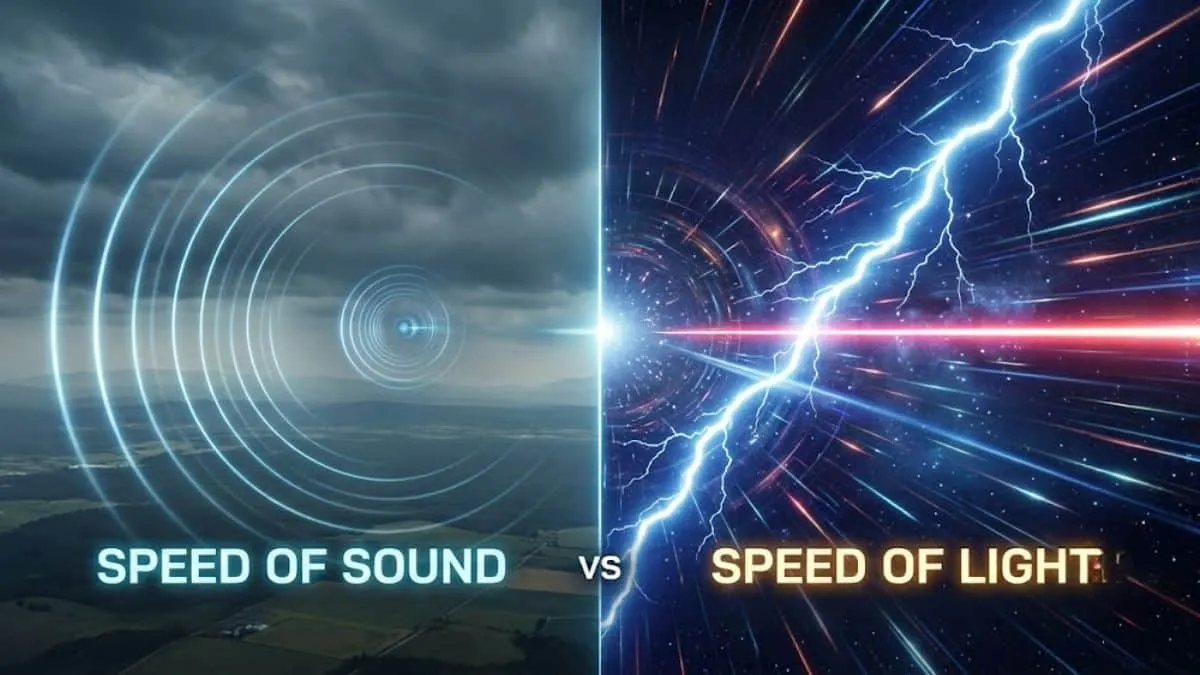
Speed of Sound vs Speed of Light: Have you ever watched lightning in the sky during a storm and noticed that the light appears first, and after a few seconds, you hear the sound of thunder?
Do you know why it happens? Because the speed of light is much faster than the speed of sound.
Thus, on Earth, we first see the light; after a few seconds, we hear the sound of thunder. However, they both travel in the form of waves, but they are very different from each other.
Sound requires a medium to travel, like air, water or any solid material, but on the other hand, light does not require a medium, and it can travel through space.
So, let’s understand the speed of sound and the speed of light in detail.
What Is the Speed of Sound?
Sound is produced when something vibrates. When a school bell rings it that causes the air around it to vibrate. These vibrations pass through air and are finally detected by our ears.
These vibrations must be transmitted by particles in order for sound to occur. This is why sound can't travel through a vacuum.
Speed of sound varies. It varies primarily with the material it is traveling through and, in a gas, with its temperature.
For example:
-
Under normal conditions, sound travels at speeds of approximately 340–343 metres per second in air.
-
In fresh water, it can be found at 1480 metres per second.
-
In steel, it moves faster than 5000 metres per second.
This is because the sound can travel in a different way in various materials.
Why Does Temperature Affect Sound?
In air, higher temperatures generally mean higher speed of sound. For instance, sound propagates at approximately 340 m/s near sea level at "normal" temperatures. In high altitudes, it can drop to approximately 295 m/s as the air is very cold.
Another explanation of why aircraft speeds are often quoted in Mach numbers is due to the presence of compressibility effects.
What Is the Speed of Light?
Light is a form of an electromagnetic wave. It can move through air, water or even without any material.
This implies that light can pass through empty space. In a vacuum, the speed of light is: 299,792,458 metres per second
This, in simple terms, is about 300,000 kilometres per second.
Light can make several laps around the earth in a single second at this speed, and the speed of light in space is called c.
Speed of Sound vs Speed of Light: Quick Comparison
| Feature | Speed of Sound | Speed of Light |
| Type of wave | Mechanical wave | Electromagnetic wave |
| Needs a medium? | Yes | No |
| Speed in air/vacuum | About 343 m/s in air at 20°C | 299,792,458 m/s in vacuum |
| Can travel through space? | No, not through a vacuum | Yes |
| Speed changes with medium? | Yes | Yes, when passing through materials |
| Common example | Thunder | Sunlight |
The exact speed of sound depends on the material and its temperature. At around 15°C, sound travels through air at about 340 m/s.
The speed of light in a vacuum is 299,792,458 metres per second. This is an exact value in the International System of Units (SI).
Why Do We See Lightning Before Hearing Thunder?
This is one of the easiest ways to understand the huge difference between the two speeds.
Lightning produces both a bright flash and thunder. The light reaches our eyes extremely quickly, while the sound takes much longer to reach our ears.
So, when a storm is far away:
Lightning → reaches you first
Thunder → reaches you later
How Much Faster Is Light Than Sound?
The speed of sound in air is around 340 m/s at a temperature of 15 °C, and light travels through a vacuum at 299,792,458 m/s.
Therefore, the speed of light in air is about 880000 times greater than the speed of sound in air.
It's for this reason that the flash of lightning seems to happen in a blink of an eye, while thunder can reach us in a few seconds.
Speed of Sound vs Speed of Light: Key Facts
-
Sound needs a medium to travel.
-
Light can pass through a vacuum.
-
The speed of sound, v, is much slower than the speed of light, c.
-
The velocity of sound varies from material to material and with temperature.
-
In a vacuum, the speed of light is precisely equal to 299,792,458 m/s.
-
Lightning is seen before thunder is heard because light travels much faster than thunder.
-
Some solids conduct sounds faster than air.
-
Light's speed decreases through materials like water and glass.
-
The light speed in a vacuum is a fundamental limit in modern physics.
Why Is the Difference Important?
The difference between these two speeds provides us with an understanding of much of the world around us.
We see light before we hear sound when we watch fireworks, see lightning or hear a distant explosion.
It also could aid researchers in learning about the way information is transmitted to us from far away objects in space. For instance, when we observe the Sun, we see sunlight that left the Sun 8 minutes and 20 seconds ago.
Conclusion
The speed of sound and speed of light are completely different. Sound is a mechanical wave and requires a medium to propagate, like air, water or solid. Its velocity varies with the material and temperature.
Light is a type of electromagnetic wave and is able to propagate through vacuum. It travels at a constant speed of 299,792,458 metres per second in a vacuum.
So the next time you see lightning before thunder, keep in mind it's a simple natural demonstration of the vast difference between the speed of light and the speed of sound.

Prabhat Mishra is a Subject Matter Expert and digital journalist with an extensive background in the competitive exam landscape and over 4 years of experience in education, national and international news, and current affairs. Over his tenure with top knowledge platforms like Mentorship India, IAS BABA, IAS SARTHI, and now Jagran Josh, he has a deep understanding of government exams like UPSC and State PCS, including UP and Bihar, as he has already qualified for the UPPCS 2022 Mains and Bihar 68th Mains. With his core expertise in history, polity, geography & current affairs, he specialises in creating well-researched, aspirant-centric content and simplifying complex topics for competitive examinations.

-1789642453657_t.webp)
-1789481527292_t.webp)