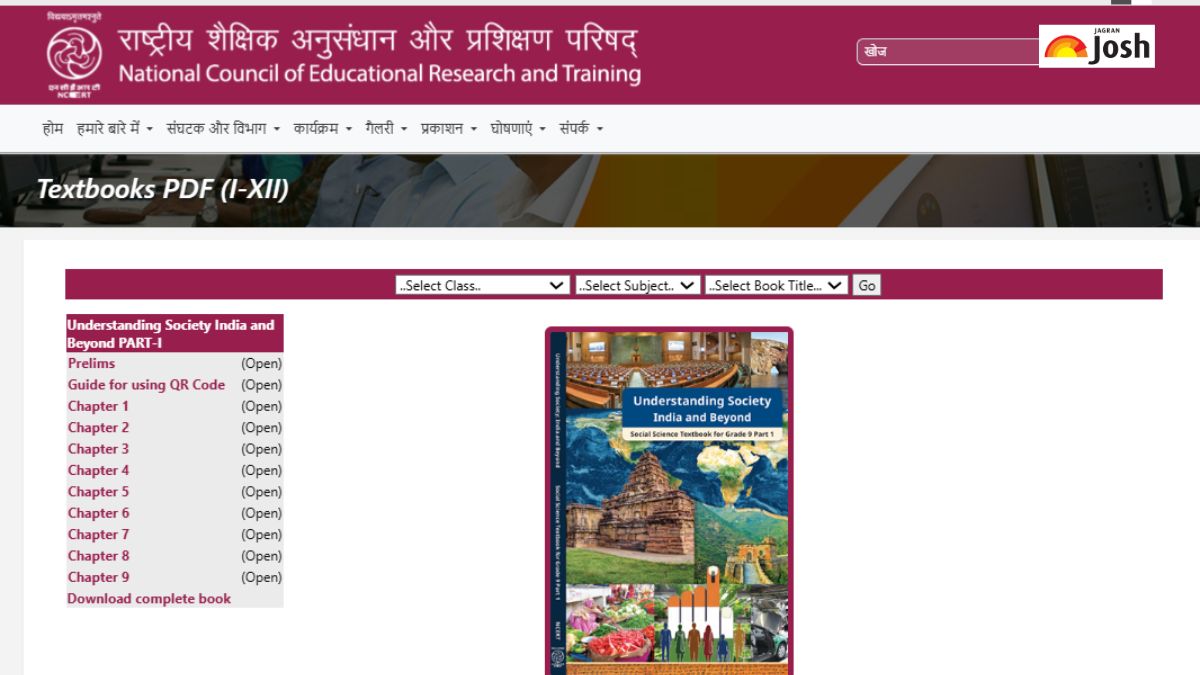
National Council of Educational Research and Training, NCERT released the revised Social Science textbook for Class 9 on September 29, 2026. Part 1 of the textbook is unchanged, and the Part 2 with changes and additions was released recently. Students and parents can buy the textbooks through authorized NCERT’s sales channels, or official website of NCERT, ncert.nic.in.
According to NCERT, the revisions in the Class 9 social science textbook have been made in alignment with the New Education Policy (NEP 2020) and the National Curriculum Framework for School Education, NCF-SE 2023. The new textbooks have been introduced in accordance with the updated school curriculum framework. Read the article below to learn more about the 5 key additions that have been made in the NCERT Class 9 Social Science Textbook.
Key Changes in NCERT Class 9 Social Science Textbook
The new chapters of NCERT book have been developed in line with NEP 2020 and have included some of the important events of Indian history, military and politics. Check below to know the major additions made to the Part 2 Social Science textbook for Class 9:
Emergency of 1975
The Emergency which was imposed in the country in 1975 by the Indira Gandhi-led government has been introduced as a separate section and has been described as “one of the major challenges” to Indian democracy. According to the chapter, a majority of Fundamental Rights were suspended during the emergency period, including press censorship, arrest of political leaders and activists, etc.
This is the first time a reference has been made to the Emergency at Class 9 level. The book states that democratic institutions “came under severe strain, and citizens’ freedom was restricted” during the 1975 to 1977 period.
Indian Judiciary
The Indian Judiciary system has come to focus in the revised Social Science NCERT book. The judiciary has been described as an “impartial and independent institution” which protects the rights of the citizens and upholds the spirit of the Constitution. It explains the role, purpose and importance of the judicial system in the country.
Judicial Corruption
Earlier, the content of Class 8 NCERT Social Science textbook read that there were various corrupt practices being undertaken in the Indian judiciary system. This caught the attention of the Supreme Court of India and NCERT faced controversy. The content discussed complaints and challenges faced in the judicial system of India. The textbook was then reworked and the controversial content was removed.
Election Commission and SIR
One of the most important topics which have been talked about in the Class 9 NCERT textbook is the introduction of Election Commission and Special Intensive Revision (SIR). The section explains the EC’s SIR exercise which is aimed to ensure that no eligible voters are left out of electoral rolls and people who are ineligible to vote are not included in the electoral list.
The books talks about the working of EC, challenges faced over the years, highlights, Election Commissioner’s roles and responsibilities, how important they are during elections, etc.
Upanishads to Mahabharat
The revised Class 9 NCERT social science book traces India’s roots back to Upanishads and Mahabharat and India’s motto, “Satyameva Jayate” and the Supreme Court’s “Yato Dharamstato Jayah”.
Governance and Public Policy chapter of the new book translates the national motto as Truth only Triumphs and the Supreme Court’s motto as Where there is Dharma, there is victory. These are placed along the Sengol and Gandhi’s conception of Ram Rajya.
The books states that these are “not just symbolic or superficial” but shows institutional values and responsibility to ensure good governance.
As per the textbooks, “Since Independence, Indian institutions have continued to draw upon traditional ideas and values of governance and have adapted them to the needs of a modern democracy. For example, the British-era ‘Order of the Star of India’ used the phrase ‘Heaven’s Light, Our Guide’ as its motto, but after Independence, we have adopted ‘Satyamev Jayate’ (Truth alone triumphs) from the Mundaka Upanishad as our national motto,”, “This reflects the continuing importance of Indian ethical values in public life. The motto of the Supreme Court of India was chosen to be ‘Yato Dharmastato Jayah’. The phrase is taken from the Mahabharata and it means ‘where there is dharma (righteous duty), there is victory’,”
The textbook also calls the Sengol a “cultural marker of rulership and good governance” and mentions that the Sengol was handed to Prime Minister Jawaharlal Nehru after partition and the sceptre’s ceremonious placement at the Lok Sabha by Prime Minister Narendra Modi in 2023.
The council has been releasing revised books across classes and subjects as part of a broader curriculum revision process.
Read More:
MCC NEET UG Round 3 Provisional Seat Allotment Result OUT at mcc.nic.in, Check Details Here
Himachal Pradesh Govt Releases Rs 35.34 Crore To Upgrade ITIs, Polytechnics; Check Details