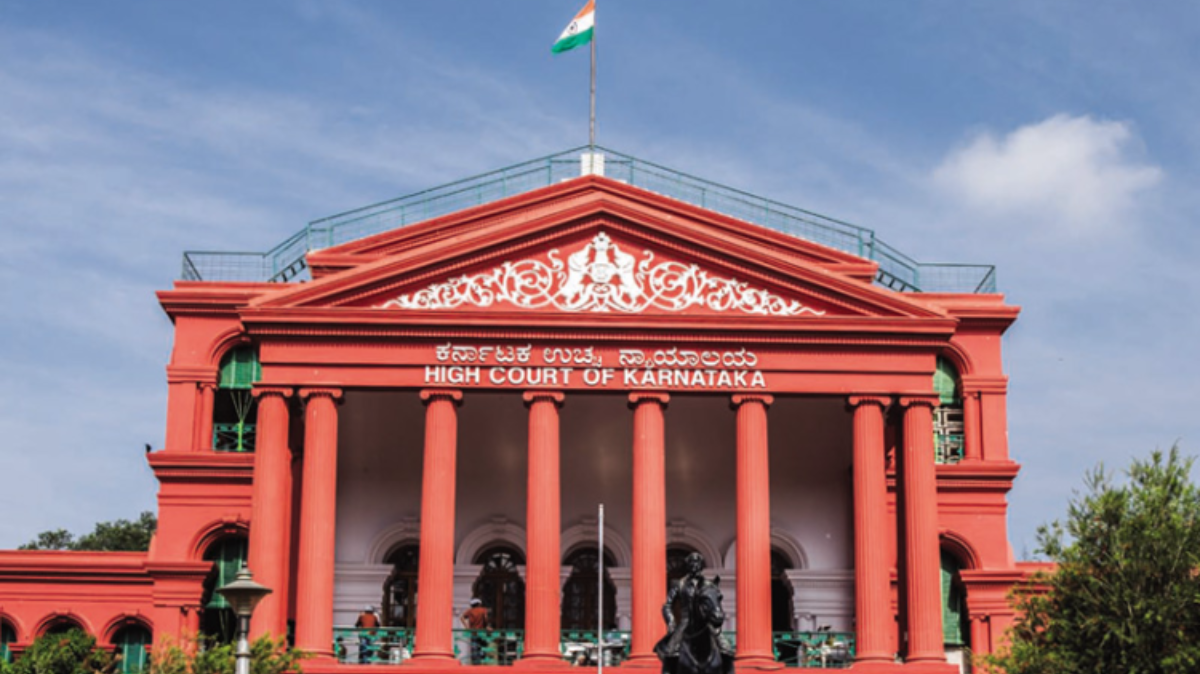
The Karnataka High Court has said that a State Bar Council cannot reject an application for enrolment as an advocate solely because the applicant did not have a bachelor’s degree before pursuing a three-year LL.B. course, without first referring the issue to the Bar Council of India (BCI).
Justice Suraj Govindaraj passed the order while considering a petition concerning the enrolment of a candidate who had completed a Master’s degree but did not possess a bachelor’s degree before joining the three-year LL.B. programme. The court noted that the question of whether the petitioner’s Master’s degree could qualify as an equivalent qualification had not been placed before the BCI.
What Karnataka High Court Said
The court referred to Rule 4(a) of the Bar Council of India’s Legal Education Rules, 2008. The provision deals with eligibility for admission to a three-year law course and refers to a bachelor’s degree in any discipline “or any other qualification considered equivalent by the Bar Council of India.”
The High Court observed that the reference to an alternative qualification was significant. Therefore, according to the court, the State Bar Council could not simply reject the enrolment application on the ground that the candidate lacked a conventional bachelor’s degree.
Instead, the question of whether another qualification is equivalent for the purpose of the rules has to be considered by the BCI.
The court also referred to the provisions of the Advocates Act, 1961 concerning enrolment applications. Under Section 26(2), when an enrolment committee of a State Bar Council proposes to refuse an application for admission as an advocate, the application has to be referred to the BCI for its opinion, along with the reasons for the proposed refusal. The Karnataka State Bar Council’s official material also reflects this requirement.
Implications for Law Graduates
The ruling is significant for candidates seeking enrolment as advocates because it clarifies the role of the State Bar Council and the BCI when questions arise over eligibility qualifications.
The High Court did not hold that every person without a bachelor’s degree is automatically entitled to enrolment. Instead, it emphasised that where the rules allow an equivalent qualification to be considered, the State Bar Council cannot decide the issue conclusively on its own without following the prescribed process.
The ruling therefore places the question of equivalence before the BCI rather than allowing the State Bar Council to reject such an application outright.
ALSO READ| After Winning Nobel Prize in Medicine, Karl Deisseroth Teaches Stanford UG Class On Optogenetics
ALSO READ| Indian Student Pratyush Prabhakar, Former Government Adviser, Elected VP at Harvard Kennedy School