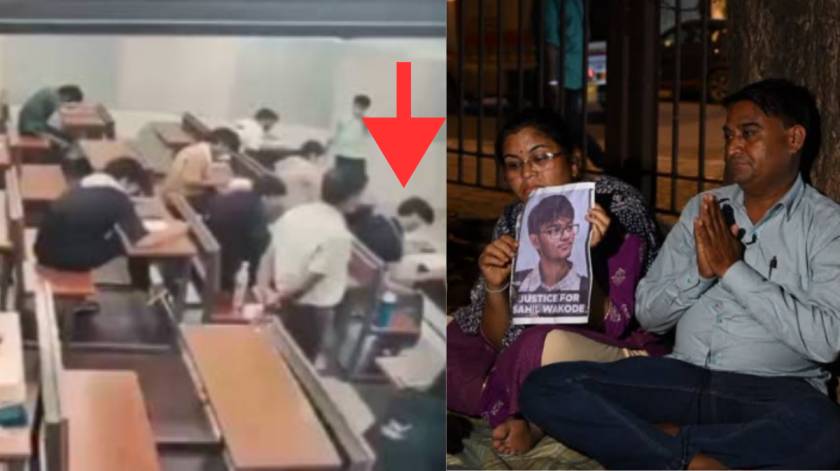
As the investigation into the alleged suicide of Indian Institute of Technology (IIT) Bombay student Sahil Wakode continues, the Mumbai Crime Branch has recorded statements of 40 individuals, including his parents, fellow students and hostel staff.
Sources have claimed that Sahil was asked to sign an ‘apology letter’ after he was allegedly caught cheating during an examination and was asked to leave the examination hall. However, the institute’s examination malpractice procedure does not specifically mention any such requirement.
What Does IIT Bombay Procedure Say?
According to the IIT Bombay procedure issued in 2015, when a student is caught cheating during an examination by an invigilator, the relevant material is to be confiscated and a fresh answer book is to be provided, allowing the student to continue the examination.
The matter is subsequently referred to the Departmental Academic Disciplinary Action Committee (D-ADAC), which examines the available evidence and determines whether academic malpractice has occurred.
What Happens If The Student Is Not Proven Guilty?
The official procedure states that “in case the evidence is not clear, the benefit of the doubt goes to the student.” This means that a student should not be held guilty when the available evidence does not establish the alleged malpractice.
The procedure does not mention an ‘apology letter’ as a step to be followed after a student is caught cheating during an examination.
Students Allege Procedure Was Not Followed
Students protesting in connection with the alleged suicide of Sahil Wakode have claimed that the prescribed examination malpractice procedure was not followed in his case. They have questioned why he was allegedly removed from the examination hall instead of being provided with a fresh answer book, as outlined in the procedure.
The students have also raised concerns about differences in the implementation of academic malpractice procedures across departments, alleging that the central administration does not strictly monitor how the rules are implemented. They have demanded a standard operating procedure (SOP) to ensure a uniform process in academic malpractice cases.
Mumbai Crime Branch Records Statements Of 40 People
The Mumbai Crime Branch has so far recorded statements from 40 people in connection with the case, including Sahil’s parents, classmates, hostel staff and others.
Professor Suryanarayana Doolla, against whom a case was registered on allegations of abetment of suicide, has not yet had his statement recorded, according to the information available. The FIR was initially registered by Powai Police before the investigation was transferred to the Crime Branch.
The Mumbai Police’s Special Investigation Team (SIT) has also sought documents from IIT Bombay related to the case. Sahil had reportedly spoken to a friend at around 1:25 pm after returning to his hostel room from the examination hall. According to the friend, Sahil expressed regret about copying in an attempt to make up for marks from an earlier paper.
Investigators have sent two mobile phones, a laptop and a tablet belonging to Sahil Wakode to the Forensic Science Laboratory in Kalina for forensic examination. The digital analysis is expected to help investigators establish the sequence of events and examine information relevant to the circumstances surrounding the death of the second-year BTech student.
ALSO READ| WhatsApp Introduces New Parental Controls For Teens; Check All New Features
ALSO READ| IIT Bombay, IISc Team Up With IBM To Drive Next-Gen AI And Computing Research