IIT JAM 2027 Registration Date Extended, Apply Till October 19; Details Here


IIT JAM 2027: IIT Kharagpur has extended the registration deadline for IIT JAM 2027 to October 19, 2026. Prospective postgraduate candidates can complete their application forms and choice selections online via jam.iitkgp.ac.in. The nationwide computer-based entrance examination will take place on February 14, 2027, across three structured test sections.
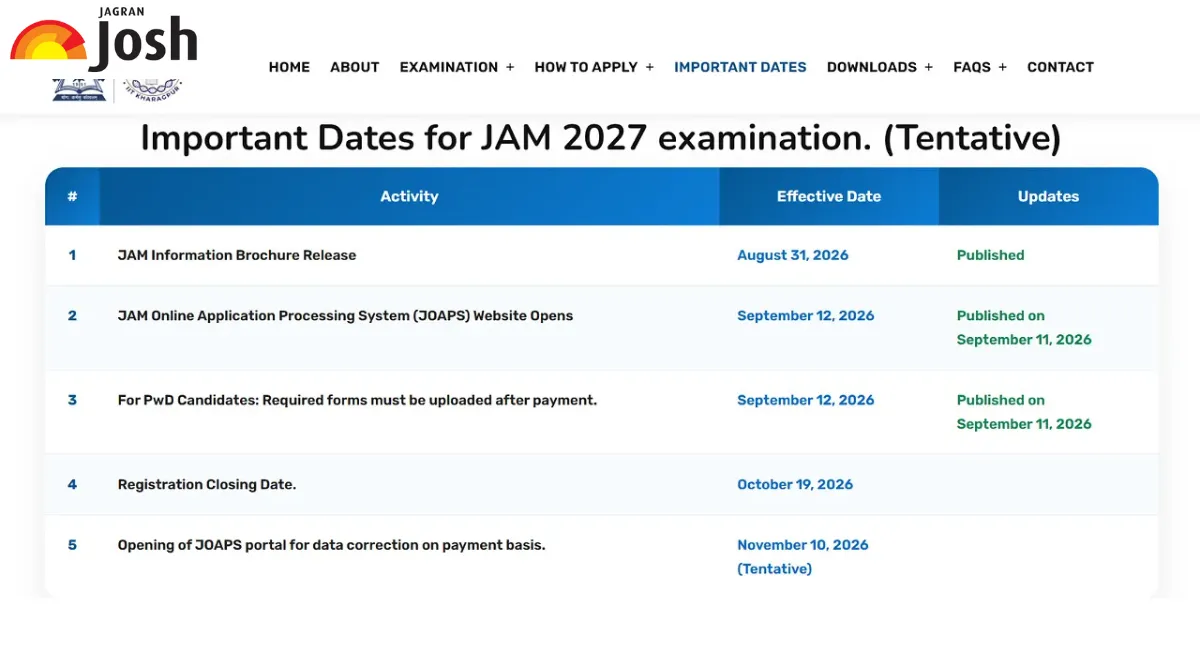
IIT JAM 2027: The Indian Institute of Technology (IIT) Kharagpur has officially extended the deadline for the registration of the Joint Admission Test for Masters (IIT JAM) 2027 till October 19, 2026. Aspirants who wish to take admission in the post-graduate degree courses like M.Sc., M.Sc. & Ph.D. dual-degree course, joint M.Sc. & Ph.D. and integrated Ph.D. programs at the 23 IITs and affiliated institutes can register for the examination through JOAPS portal available at jam.iitkgp.ac.in. This country-wide entrance examination shall be conducted on February 14, 2027, in two sessions of computer-based test for seven test papers.
The extension will give extra time to the aspirants to finish the profile creation process, choose the test cities as per their choice, attach the category and personal valid certificates, and pay the application fees using net banking, debit cards, or UPI mode. After the successful completion of the registration process, the portal will be opened for the data correction from November 2026 to get the hall tickets in early January 2027.
Also Read: LSR College Reopens Offline Classes Following Brief Online Shift After Kalkaji Gang-Rape Incident
IIT JAM 2027: Revised Important Dates
Below are the revised important dates related to the IIT JAM 2027:
| Event | Official Date |
| Online Registration Start Date | September 11, 2026 |
| Extended Registration Deadline | October 19, 2026 |
| JOAPS Data Correction Window Opens | November 10, 2026 |
| Admit Card Release Date | January 2027 |
| IIT JAM 2027 Exam Date | February 14, 2027 |
| Declaration of Results | March 18, 2027 |
IIT JAM 2027: Exam Pattern
The test for the IIT JAM 2027 will be held through a Computer-Based Test (CBT) that runs for three hours (180 minutes). The question paper is valued at 100 marks with 60 questions divided into three sections.
Section A has 30 MCQs of 50 marks, which include 10 questions of one mark each and 20 questions of two marks each. In the MCQs, there are four options with just one option being right, and negative marking is done in this section alone, whereby you are penalized 1/3 mark for each one-mark MCQ and 2/3 mark for each two-mark MCQ.
Section B contains 10 MSQs valued at two marks each, making 20 marks, with each question having four options where one or more answers can be correct, and you get marks only when you select all the right options, without selecting anything else, and no negative or partial marking is done in this section. Section C includes 20 NATs of 30 marks, which have 10 questions of one mark each and 10 questions of two marks each.
Also Read:
UPSC NDA 2 Result 2026 Expected Soon at upsc.gov.in; Check Likely Release Date & What's Next
IIT JAM 2027: The Indian Institute of Technology (IIT) Kharagpur has officially extended the deadline for the registration of the Joint Admission Test for Masters (IIT JAM) 2027 till October 19, 2026. Aspirants who wish to take admission in the post-graduate degree courses like M.Sc., M.Sc. & Ph.D. dual-degree course, joint M.Sc. & Ph.D. and integrated Ph.D. programs at the 23 IITs and affiliated institutes can register for the examination through JOAPS portal available at jam.iitkgp.ac.in. This country-wide entrance examination shall be conducted on February 14, 2027, in two sessions of computer-based test for seven test papers.
The extension will give extra time to the aspirants to finish the profile creation process, choose the test cities as per their choice, attach the category and personal valid certificates, and pay the application fees using net banking, debit cards, or UPI mode. After the successful completion of the registration process, the portal will be opened for the data correction from November 2026 to get the hall tickets in early January 2027.
Also Read: LSR College Reopens Offline Classes Following Brief Online Shift After Kalkaji Gang-Rape Incident
IIT JAM 2027: Revised Important Dates
Below are the revised important dates related to the IIT JAM 2027:
| Event | Official Date |
| Online Registration Start Date | September 11, 2026 |
| Extended Registration Deadline | October 19, 2026 |
| JOAPS Data Correction Window Opens | November 10, 2026 |
| Admit Card Release Date | January 2027 |
| IIT JAM 2027 Exam Date | February 14, 2027 |
| Declaration of Results | March 18, 2027 |
IIT JAM 2027: Exam Pattern
The test for the IIT JAM 2027 will be held through a Computer-Based Test (CBT) that runs for three hours (180 minutes). The question paper is valued at 100 marks with 60 questions divided into three sections.
Section A has 30 MCQs of 50 marks, which include 10 questions of one mark each and 20 questions of two marks each. In the MCQs, there are four options with just one option being right, and negative marking is done in this section alone, whereby you are penalized 1/3 mark for each one-mark MCQ and 2/3 mark for each two-mark MCQ.
Section B contains 10 MSQs valued at two marks each, making 20 marks, with each question having four options where one or more answers can be correct, and you get marks only when you select all the right options, without selecting anything else, and no negative or partial marking is done in this section. Section C includes 20 NATs of 30 marks, which have 10 questions of one mark each and 10 questions of two marks each.
Siddhi Sharma is an education journalist at Jagran Josh. A Journalism and Mass Communication graduate from IP University, she brings sharp newsroom instincts developed during her previous stint at Zee News. At Jagran Josh, Siddhi specializes in decoding the educational updates. Her coverage is highly exam-centric, ranging from curated news blogs for competitive exams to crucial school board and university news. Combining her strong media foundations with a research-driven approach, she creates reliable, high-utility content that helps students and aspirants stay ahead of the curve. Her writing is factual, engaging, and tailored to meet the fast-paced needs of modern learners and exam aspirants.


-1790165957009_t.webp)