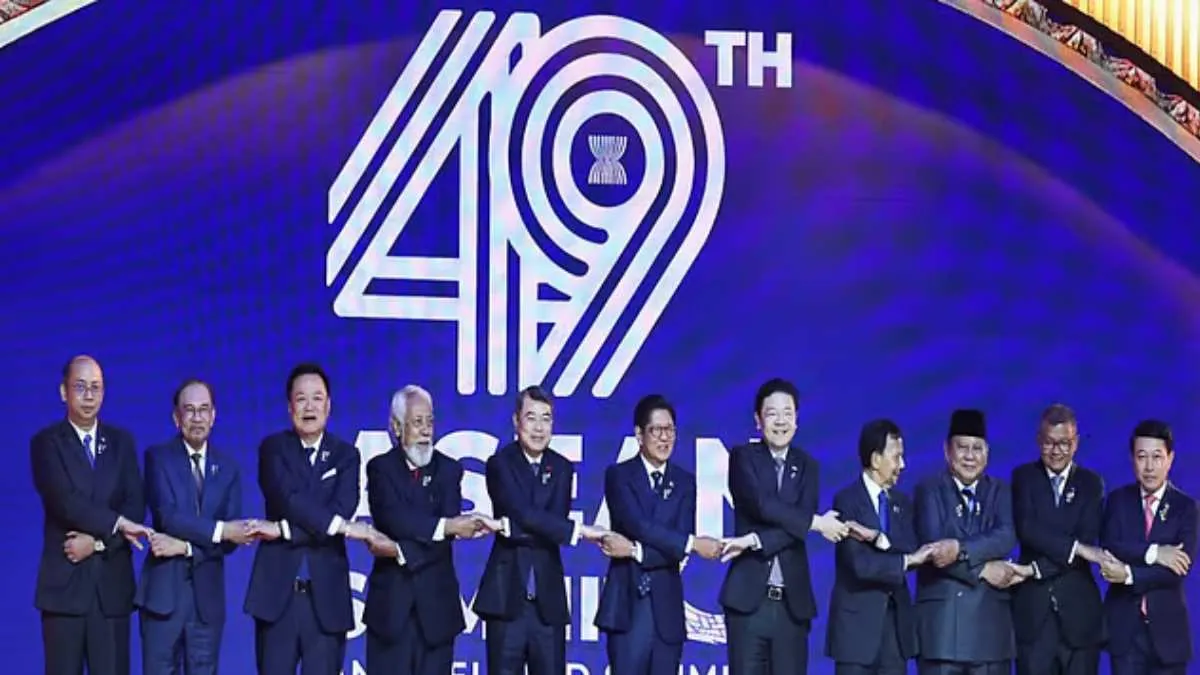
Southeast Asian countries that consist the ASEAN economic bloc are meeting in the Philippines this week as the region continues to grapple with the issues of oil shortages triggered by the US-Israel war on Iran, and by US-China rivalry, which has struck economies hard.
The Manila summit being held from November 15 to 17, includes US President Donald Trump and numerous other global leaders.
What is the ASEAN?
The 11-member Association of Southeast Asian Nations (ASEAN) aims to forge a single market, although it cannot enforce decisions on members. It consists of Indonesia, Malaysia, the Philippines, Singapore, Thailand, Brunei, Vietnam, Laos, Myanmar, Cambodia and East Timor, with a total population of nearly 694 million, or 8.4 percent of the world’s population.
The ASEAN is a regional grouping that supports economic growth, cooperation and stability across Southeast Asia. Developed on August 8, 1967, through the Bangkok Declaration, it initially united Indonesia, Malaysia, the Philippines, Singapore and Thailand. Brunei, Vietnam, Laos, Myanmar and Cambodia joined later. Timor-Leste became its 11th member in October 2025.
ASEAN is an economic and diplomatic bloc, connecting a consumer market with manufacturing and shipping networks. Its members unite on trade, investment, infrastructure, technology and regional security. Unlike the European Union, ASEAN has no integrated authority. It makes decisions through consultation and consensus, while observing national sovereignty.
Related Stories
ASEAN Member Countries and International Guest Attending the Ongoing ASEAN Summit in Manila
|
Country
|
Leader / Representative
|
Designation
|
|
Philippines
|
Ferdinand Marcos Jr.
|
President and Summit Host
|
|
Indonesia
|
Prabowo Subianto
|
President
|
|
Malaysia
|
Anwar Ibrahim
|
Prime Minister
|
|
Singapore
|
Lawrence Wong
|
Prime Minister
|
|
Thailand
|
Anutin Charnvirakul
|
Prime Minister
|
|
Brunei
|
Hassanal Bolkiah
|
Sultan
|
|
Vietnam
|
Le Minh Hung
|
Prime Minister
|
|
Laos
|
Saleumxay Kommasith
|
Prime Minister
|
|
Cambodia
|
Hang Chuon Naron
|
Deputy Prime Minister
|
|
Myanmar
|
U Han Win Aung
|
Director-General and Representative
|
|
Timor-Leste
|
Xanana Gusmao
|
Prime Minister
|
International Leaders and Special Guests
|
Country / Organisation
|
Leader / Representative
|
Designation
|
|
United States
|
Donald Trump
|
President
|
|
India
|
Narendra Modi
|
Prime Minister
|
|
Canada
|
Mark Carney
|
Prime Minister
|
|
Brazil
|
Luiz Inácio Lula da Silva
|
President
|
|
Russia
|
Sergey Lavrov
|
Foreign Minister
|
|
United Nations
|
António Guterres
|
Secretary-General
|
|
International Monetary Fund
|
Kristalina Georgieva
|
Managing Director
|
How Is ASEAN Important to India?
India’s involvement with ASEAN started in 1992 and became a dialogue partner in 1995. The relationship was advanced to a summit-level partnership in 2002 and became a Comprehensive Strategic Partnership in 2022. ASEAN is primary to India’s Act East Policy, which aims to deepen economic, diplomatic and security ties with Southeast Asia and the broader Indo-Pacific.
Trade is a pillar of the grouping. According to India’s Commerce Ministry, bilateral trade crossed $128.38 billion in 2025-26, accounting for 10.55 per cent of India’s global trade. ASEAN provides Indian exporters markets for pharmaceuticals, petroleum products, engineering goods, textiles, chemicals and agricultural items. India imports electronics, machinery, palm oil, rubber and other industrial inputs from the region.
The collaboration also matters because of geography. Southeast Asia lies beside important sea routes linking the Indian and Pacific oceans. These waterways carry energy supplies and international trade. Cooperation with ASEAN therefore promotes India’s maritime policy, freedom of navigation and stability.
Connectivity is a key priority of the bloc. Projects such as the India-Myanmar-Thailand Trilateral Highway and the Kaladan Multi-Modal Transit Transport Project link India’s Northeast with Southeast Asian markets and lower logistical challenges.
What Challenges Lie Ahead for ASEAN and India?
ASEAN witnesses brewing concerns over the South China Sea, Myanmar’s political crisis and ties with top powers, especially China and the United States. Its consensus-based approach can make a unified redressal difficult.
India also seeks a more balanced trading ties. The review of the ASEAN-India Trade in Goods Agreement aims to resolve trade imbalances, bolster market access and ease rules for businesses.