10 Largest Tribal Communities in India: State-wise Population and Interesting Facts
Explore the 10 largest tribal communities in India, including Bhil, Gond and Santhal, with their Census 2011 population, major states and interesting facts.
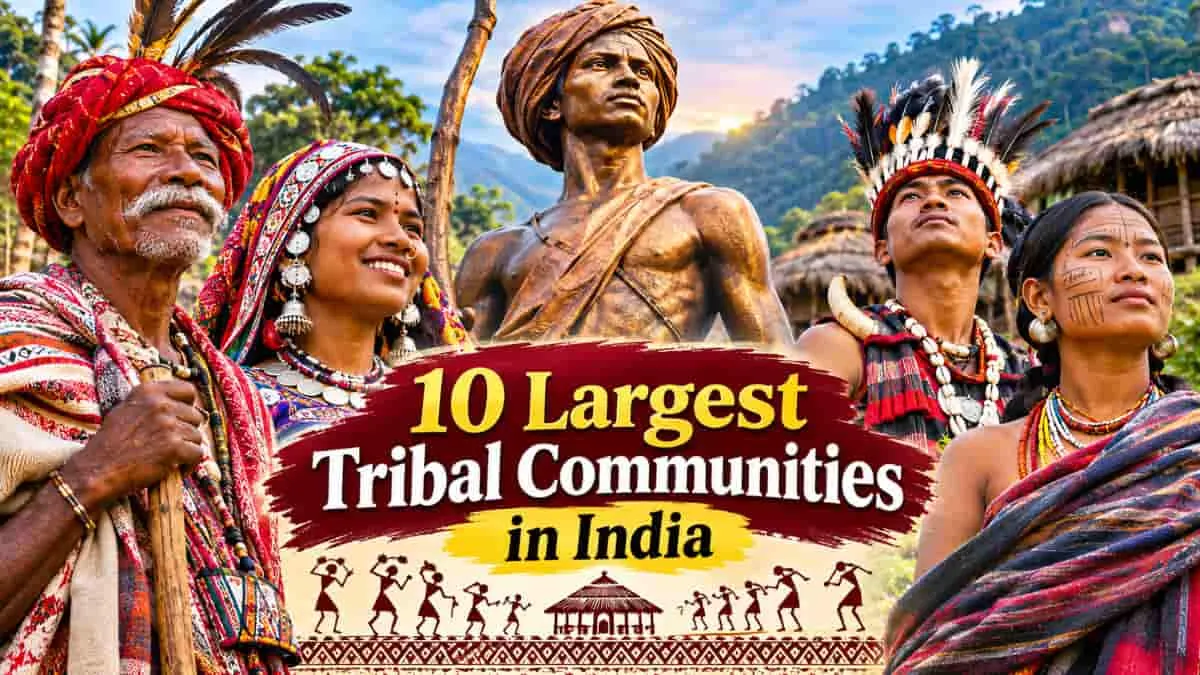
India is home to hundreds of tribal communities, each with its own language, culture, traditions, festivals and way of life. These communities are also known as Scheduled Tribes (STs) under the Indian Constitution.
From the Gonds of Central India to the Bhils of Western India and the Santhals of Eastern India, tribal communities play an important role in India's cultural diversity and history.
But do you know which is the largest tribal community in India? Which state has the highest population of the Gond tribe? Where do the Santhals and Bhils mainly live?
In this article, we will explore the 10 largest tribal communities in India, their population according to official Census data, major states where they live and some interesting facts about their culture.
Important data note: The latest completed nationwide Census providing detailed Scheduled Tribe population data is Census 2011. Therefore, the population figures below should be understood as 2011 Census figures, not current 2026 estimates.
Which Are the 10 Largest Tribal Communities in India?
According to the Ministry of Tribal Affairs' Statistical Profile of Scheduled Tribes in India, 2013, based on Census 2011, the Bhil community is the largest tribal community in India, followed by the Gond and Santhal communities.
The following table presents the top 10 communities, their recorded population and major states of habitation.
| Rank | Tribal Community | Population (Census 2011) | Major States |
| 1 | Bhil | 1,70,71,049 | Rajasthan, Gujarat, Madhya Pradesh, Maharashtra |
| 2 | Gond | 1,32,56,928 | Madhya Pradesh, Chhattisgarh, Maharashtra, Odisha |
| 3 | Santhal | 65,70,807 | Jharkhand, West Bengal, Odisha, Bihar |
| 4 | Naikda (Nayaka) | 37,87,639 | Gujarat, Karnataka, Rajasthan, Maharashtra |
| 5 | Oraon | 36,82,992 | Jharkhand, Chhattisgarh, Odisha, West Bengal |
| 6 | Sugali (Lambadi/Banjara) | 24,07,637 | Andhra Pradesh |
| 7 | Munda | 22,03,006 | Jharkhand, Odisha, West Bengal, Chhattisgarh |
| 8 | Koli Dhor | 21,52,540 | Maharashtra, Gujarat, Dadra and Nagar Haveli |
| 9 | Naga | 16,73,555 | Nagaland |
| 10 | Khond (Kondh/Kandha) | 16,28,501 | Odisha, Jharkhand, West Bengal, Bihar |
Source: Ministry of Tribal Affairs, Statistical Profile of Scheduled Tribes in India, Table 1.23, Census 2011. State names are based on the report's usual-place-of-habitation listing; the table is not a ranking of individual states.
1. Bhil Tribe – Largest Tribal Community in India
-
Population: 1,70,71,049
-
Major states: Rajasthan, Gujarat, Madhya Pradesh, Maharashtra, Chhattisgarh, Karnataka and others.
-
Main region: Western and Central India.
The Bhil community is the largest tribal community in India according to Census 2011. Its population is spread across several states, particularly Rajasthan, Gujarat, Madhya Pradesh and Maharashtra.
The Bhils have a rich cultural heritage, including traditional music, dance, paintings and festivals. They are also known for their traditional knowledge of forests and natural resources.
Interesting Facts About the Bhil Tribe
-
The Bhil community is particularly associated with the western and central parts of India.
-
The traditional Bhagoria festival is celebrated by Bhil and Bhilala communities in parts of Madhya Pradesh.
-
Pithora painting is an important traditional art form associated with some Bhil and Rathwa communities.
2. Gond Tribe – One of India's Largest Tribal Communities
-
Population: 1,32,56,928
-
Major states: Madhya Pradesh, Chhattisgarh, Maharashtra, Odisha, Uttar Pradesh, Jharkhand and others.
-
Main region: Central India.
The Gond tribe is the second-largest tribal community in India. Its members mainly live in the forested and rural regions of Central India.
The Gond community has a long history and is known for its rich traditions, folk stories, music and art. Gond painting is one of the most recognised forms of tribal art in India. It uses colourful patterns and images inspired by animals, trees, birds and everyday life.
Interesting Facts About the Gond Tribe
-
Gond art is recognised for its colourful patterns and nature-inspired paintings.
-
The community has a historical connection with the Gond kingdoms of Central India.
-
Many Gond communities traditionally depend on agriculture, forests and forest-based resources.
3. Santhal Tribe – Major Tribal Community of Eastern India
-
Population: 65,70,807
-
Major states: Jharkhand, West Bengal, Odisha, Bihar and Tripura.
-
Main region: Eastern India.
The Santhal community is the third-largest tribal community in India. It has a strong presence in Jharkhand, West Bengal and Odisha.
The Santhals are known for their traditional dances, music, festivals and agricultural practices. Their language, Santali, belongs to the Austroasiatic language family.
Interesting Facts About the Santhal Tribe
-
Santali is included in the Eighth Schedule of the Indian Constitution.
-
Ol Chiki is the traditional script developed for writing the Santali language by Pandit Raghunath Murmu in 1925.
-
The Santhal Hul of 1855–56 was an important tribal uprising against British rule and exploitation.
State-wise Distribution of India's Major Tribal Communities
The following table gives a quick overview of the states associated with the 10 largest tribal communities.
| State | Major Tribal Communities |
| Madhya Pradesh | Bhil, Gond, Kol, Korku |
| Chhattisgarh | Gond, Oraon, Munda, Baiga |
| Jharkhand | Santhal, Oraon, Munda, Ho |
| Odisha | Khond, Santhal, Gond, Saora |
| Rajasthan | Bhil, Mina, Naikda |
| Gujarat | Bhil, Naikda, Koli Dhor, Rathawa |
| Maharashtra | Bhil, Gond, Koli Dhor, Naikda |
| West Bengal | Santhal, Oraon, Munda, Bhumij |
| Andhra Pradesh | Sugali, Gond, Koya |
| Nagaland | Naga |
Important Facts About Tribal Communities in India
Here are some important facts that are useful for General Knowledge and competitive examinations.
-
Total tribal population: According to Census 2011, India had 10.45 crore Scheduled Tribe people.
-
Percentage of India's population: Scheduled Tribes accounted for approximately 8.6% of India's total population.
-
Largest tribal community: Bhil is the largest tribal community in India.
-
Second-largest tribal community: Gond ranks second.
-
Third-largest tribal community: Santhal ranks third.
-
Largest tribal population by state: Madhya Pradesh had the highest Scheduled Tribe population, with 1,53,16,784 people, according to Census 2011.
-
Constitutional provision: Article 342 of the Indian Constitution deals with the specification of Scheduled Tribes.
-
Tribal uprising: The Santhal Hul (1855–56) and the Munda Ulgulan movement are important examples of tribal resistance against British rule.
Odisha marks Janjatiya Gaurav Diwas 2026 with vibrant celebrations! Remembering the valour and sacrifices of Bhagwan Birsa Munda, communities across the state come together to honour tribal heroes and showcase the richness of their traditions, art, culture and heritage. #JanjatiyaGauravDiwas #JJGD2026 #Dhartiaababirsamunda #Gauravsebhavishyatak
— Ministry of Tribal Affairs, Govt. of India (@TribalAffairsIn) November 15, 2026
Janjatiya Gaurav Diwas: Why Is 15 November Celebrated in India?
Janjatiya Gaurav Diwas is celebrated every year on 15 November in India to honour the contributions, sacrifices and bravery of tribal communities in the country's history and freedom struggle.
The Government of India declared 15 November as Janjatiya Gaurav Diwas in 2021. The day marks the birth anniversary of Birsa Munda, a respected tribal freedom fighter and leader of the Munda community.
Birsa Munda fought against British rule and the exploitation of tribal communities. He led the famous Ulgulan movement (Munda Rebellion) in the late 19th century to protect tribal rights, land and traditional way of life.
Important Facts About Janjatiya Gaurav Diwas
| Aspects | Details |
| Name | Janjatiya Gaurav Diwas |
| Observed on | 15 November |
| First celebrated | 2021 |
| Occasion | Birth anniversary of Birsa Munda |
| Birsa Munda's birth date | 15 November 1875 |
| Community | Munda |
| Famous movement | Ulgulan (Munda Rebellion) |
| Declared by | Government of India |
Prabhat Mishra is a Subject Matter Expert and digital journalist with an extensive background in the competitive exam landscape and over 4 years of experience in education, national and international news, and current affairs. Over his tenure with top knowledge platforms like Mentorship India, IAS BABA, IAS SARTHI, and now Jagran Josh, he has a deep understanding of government exams like UPSC and State PCS, including UP and Bihar, as he has already qualified for the UPPCS 2022 Mains and Bihar 68th Mains. With his core expertise in history, polity, geography & current affairs, he specialises in creating well-researched, aspirant-centric content and simplifying complex topics for competitive examinations.