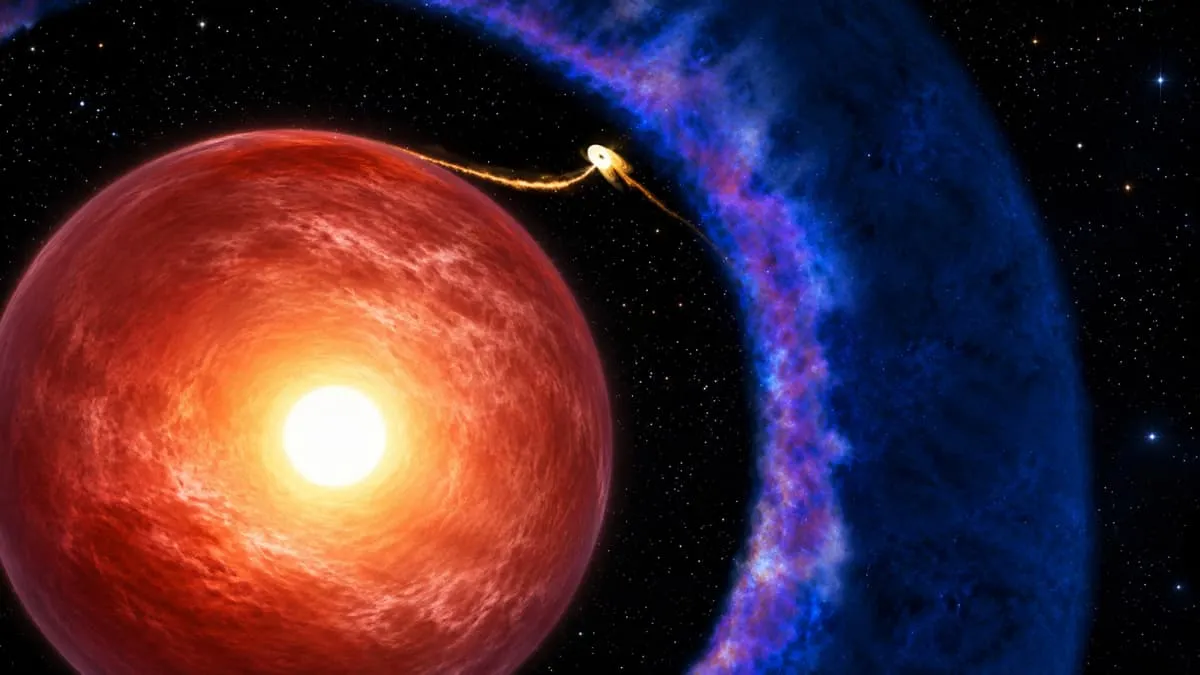
Baby Planet Elias 2-24 b, the youngest known planet, less than 1 million years old: Astronomers have confirmed the discovery of the planet Elias 2-24 b, a Jupiter-sized exoplanet that is less than one million years old. It is now recognised as the youngest known planet discovered so far.
It is located around 450 light-years from Earth, this newly confirmed planet is still growing by collecting gas and dust from the disk surrounding its parent star.
The discovery gives scientists a rare chance to study how planets form and grow. It may also help researchers understand how giant planets like Jupiter developed billions of years ago.
The research team confirmed the planet using observations from the W. M. Keck Observatory in Hawaii, the European Southern Observatory's Very Large Telescope (VLT) and the Atacama Large Millimetre/submillimeter Array (ALMA).
Baby Planet Elias 2-24 b: Key Facts About the Youngest Known Planet
Here are the important facts about Elias 2-24 b:
Related Stories
|
Aspects
|
Details
|
|
Planet name
|
Elias 2-24 b
|
|
Type
|
Exoplanet (planet outside our Solar System)
|
|
Age
|
Less than 1 million years
|
|
Size
|
Approximately Jupiter-sized
|
|
Estimated mass
|
1.9 to 4 times the mass of Jupiter
|
|
Distance from Earth
|
Around 450 light-years
|
|
Parent star
|
Elias 2-24
|
|
Location
|
Ophiuchus star-forming region
|
|
Planet's distance from its star
|
Around 55 AU
|
|
Discovery confirmation
|
September 2026
|
|
Main observatory
|
W. M. Keck Observatory, Hawaii
|
|
Other observatories
|
VLT and ALMA
|
|
Research publication
|
The Astrophysical Journal Letters
|
Source: NASA, W. M. Keck Observatory and the published research paper.
What Is Elias 2-24 b?
Elias 2-24 b is a young giant planet located outside our Solar System. Such planets are called exoplanets.
It is almost as massive as Jupiter, the largest planet in our Solar System. However, unlike Jupiter, which formed billions of years ago, Elias 2-24 b is still in its early stage of development.
Scientists estimate that the planet is less than one million years old. It is also surrounded by a large disk of gas and dust, which provides material for its continued growth.
The planet is located approximately 450 light-years away from Earth. Its parent star is known as Elias 2-24.
One of the most interesting things about this discovery is that scientists can study a giant planet while it is still forming.
Source: NASA
How Did Astronomers Discover Elias 2-24 b?
The discovery was made possible by studying old telescope observations and combining them with newer research.
The research team was led by Andrea Bernardi, a doctoral researcher at Universidad Diego Portales in Chile.
Here is how scientists confirmed the planet:
1. Earlier observations: Astronomers had studied the Elias 2-24 star system and its surrounding disk. Observations from the Atacama Large Millimeter/submillimeter Array (ALMA) showed gaps in the disk where planets could be forming.
2. Finding a possible planet: The European Southern Observatory's Very Large Telescope (VLT) detected a faint point of light in one of these gaps.
3. Studying old Keck data: Researchers examined earlier observations stored in the W. M. Keck Observatory Archive. They found the same object in observations taken in 2018 and 2020.
4. Confirming its movement: By comparing observations taken at different times, scientists found that the object was moving with the star rather than behaving like a distant background star or an imaging error.
5. Confirming the planet: The combined observations provided strong evidence that the object was a real planet orbiting Elias 2-24.
This discovery also shows how old space observations can help scientists make new discoveries when studied using improved research methods.
What Is a Coronagraph and How Did It Help Scientists?
A coronagraph is a special instrument used in astronomy to block the bright light coming from a star.
When astronomers observe a star, its brightness can make it difficult to see nearby planets. Planets are much fainter than the stars they orbit.
A coronagraph blocks most of this bright light, making it easier to observe objects close to the star.
In the case of Elias 2-24 b, astronomers used the coronagraph attached to the Near Infrared Camera 2 (NIRC2) instrument at the Keck Observatory.
This helped researchers identify the faint planet within the surrounding disk of gas and dust.
Why Is the Discovery of Elias 2-24 b Important?
The discovery is important because it gives scientists a rare opportunity to observe a giant planet during its earliest stages of formation.
Here are four major reasons why this discovery matters:
1. It is the youngest known planet
Elias 2-24 b is less than one million years old. Before its confirmation, the youngest known directly imaged planets were more than five million years old.
2. It is still growing
The planet is actively collecting gas from the surrounding disk. This process is known as accretion. It helps a young planet increase its mass and develop its atmosphere.
3. It can improve our understanding of planet formation
The discovery supports the idea that giant planets can form through a process called core accretion. According to this theory, small solid materials first come together to form a core, which then attracts gas and grows into a giant planet.
4. It may help explain the formation of Jupiter
Scientists cannot directly observe how Jupiter formed billions of years ago. However, by studying a young planet such as Elias 2-24 b, they can learn more about the early stages of giant planet formation.
What Makes Elias 2-24 b Different From Other Young Planets?
Before this discovery, the record for the youngest known planet was shared by four planets around two young stars: PDS 70 and WISPIT 2.
Those planets were all more than five million years old. In comparison, Elias 2-24 b is less than one million years old.
|
Feature
|
Earlier record holders
|
Elias 2-24 b
|
|
Age
|
More than 5 million years
|
Less than 1 million years
|
|
Formation stage
|
Young planets
|
Still actively forming
|
|
Observation
|
Directly imaged planets
|
Confirmed using combined telescope observations
|
This makes Elias 2-24 b an important discovery for understanding how quickly giant planets can form.
What Is an Exoplanet?
An exoplanet is a planet that revolves around a star outside our Solar System.
Our Solar System has eight planets, including Earth, Mars, Jupiter and Saturn. However, many other stars in the universe also have planets revolving around them.
These planets are called exoplanets.
Scientists use different methods to discover them, including:
-
Transit Method: Scientists observe a small drop in a star's brightness when a planet passes in front of it.
-
Radial Velocity Method: Scientists study small movements of a star caused by the gravitational pull of an orbiting planet.
-
Direct Imaging: Scientists use special instruments to capture light from planets while reducing the bright light of their parent stars.
Elias 2-24 b is an important example of how direct imaging and observations from different telescopes can help scientists identify young planets.
Conclusion
The discovery of Elias 2-24 b is an important step in the study of planets and their formation. Its extremely young age and ongoing growth give astronomers a rare opportunity to observe how giant planets develop.
Future observations may reveal more about its atmosphere, mass and formation process. The discovery could also help scientists improve existing theories about how planetary systems are formed.