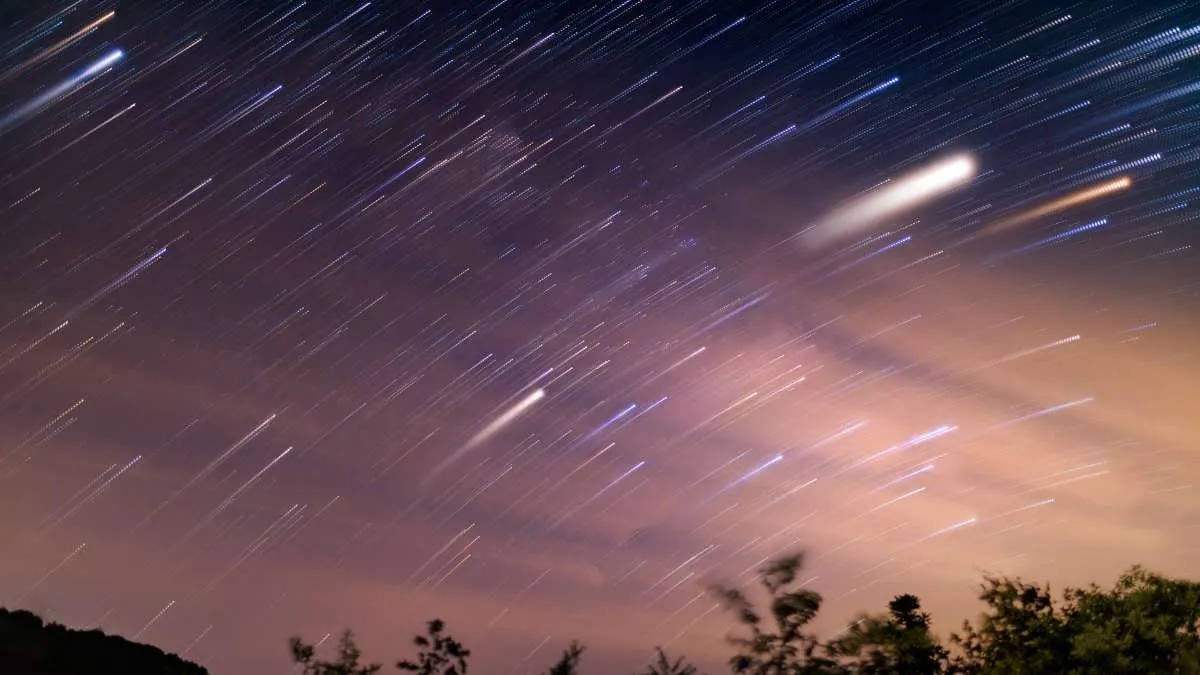
When does Leonid Meteor Shower 2026 peak tonight? Alarm set for 3:00 AM jacket zipped up against the November chill, eyes fixed on a patch of suburban sky and nothing happens for twenty straight minutes.
That is the quiet frustration many stargazers face during the Leonid meteor shower 2026 celestial event which hits its annual peak overnight between November 17 and 18.
This meteor shower is quite hyped for being dramatic fireball storms. But the reality overhead is far more subtle. If you know when the Moon steps out of the way though tonight still offers a sharp celestial show.
Let’s find ou more about exactly when the Leonid Meteor Shower peaks tonight and how can you view it for the first time hereon.
When does 2026 Leonid Meteor Shower Peak in Your Time Zone Tonight?
The Leonids remain active from November 6 through November 30 as per the International Meteor Organization (IMO). The mathematical maximum occurring at 23:45 UTC on November 17.
Still a UTC timestamp does not mean you should rush outside at that exact minute.
Meteors only become plentiful after local midnight. once the constellation Leo climbs high above the eastern horizon and the first-quarter Moon roughly 42% illuminated sets.
Related Stories
|
Country or Region
|
Time Zone
|
Predicted Maximum (IMO)
|
Best Local Viewing Window
|
|
India
|
IST (UTC+5:30)
|
Nov 18, 05:15 AM
|
Nov 18,
01:00 AM – 05:15 AM
|
|
United Kingdom
|
GMT (UTC+0)
|
Nov 17, 11:45 PM
|
Nov 18,
12:30 AM – 05:30 AM
|
|
Central Europe
|
CET (UTC+1)
|
Nov 18, 12:45 AM
|
Nov 18,
01:00 AM – 05:30 AM
|
|
UAE / Gulf
|
GST (UTC+4)
|
Nov 18, 03:45 AM
|
Nov 18,
01:00 AM – 05:00 AM
|
|
USA
(East Coast)
|
EST (UTC-5)
|
Nov 17, 06:45 PM
|
Nov 18,
12:30 AM – 05:00 AM
|
|
USA
(West Coast)
|
PST (UTC-8)
|
Nov 17, 03:45 PM
|
Nov 18,
12:30 AM – 05:00 AM
|
|
Japan
|
JST (UTC+9)
|
Nov 18, 08:45 AM
|
Nov 18,
01:00 AM – 04:45 AM
|
|
Australia
(Sydney)
|
AEDT (UTC+11)
|
Nov 18, 10:45 AM
|
Nov 18,
02:00 AM – 04:30 AM
|
Note: Lingering Leonids remain visible through November 30, though rates drop steadily after November 19.
How Many Shooting Stars will You Actually See Tonight?
You are probably wondering if losing sleep for this is even worth the trouble. Fair question.
Headline reports routinely quote 15 meteors per hour tonight. That figure represents the Zenithal Hourly Rate which is a theoretical benchmark assuming pitch-black rural skies with the shower's radiant positioned directly overhead.
Under typical urban or semi-urban haze NASA notes that observers often spot fewer than three meteors an hour.
"What they lack in numbers, they make up for in brilliance," astronomy writer Stuart Clark noted in The Guardian's November 16 Starwatch column.
Where to Look: Finding Leo, Mars, and Jupiter in the Pre-Dawn Sky
You do not need a star chart tonight. Nature has placed two bright planets of solar system right next to the action.
Just ahead of the peak on November 15 and 16, Mars and Jupiter slid within 1.2 degrees of each other right inside Leo, the constellation from which Leonid meteors appear to radiate.
Look toward the east or southeast after midnight to spot that planetary pair. Do not stare directly at them, though.
Meteor showers become visible only after burning up miles away from the radiant so scanning a wide patch of dark sky around 30 to 40 degrees away from Leo yields longer brighter streaks.
5 Practical Tips for Watching Leonid Meteor Showers Tonight Without a Telescope
-
Ditch the binoculars: Optical gear narrows your field of view, your unaided eyes cover far more sky.
-
Give your eyes 20 minutes: Avoid checking your phone screen, as bright white light resets night vision immediately.
-
Wait until after moonset: Around midnight local time, the setting first-quarter Moon clears out glare for the pre-dawn window.
-
Lie flat on a mat or recliner: Craning your neck upward for an hour causes strain within minutes.
-
Layer up properly: Pre-dawn temperatures drop sharply in November, even across central and northern India.