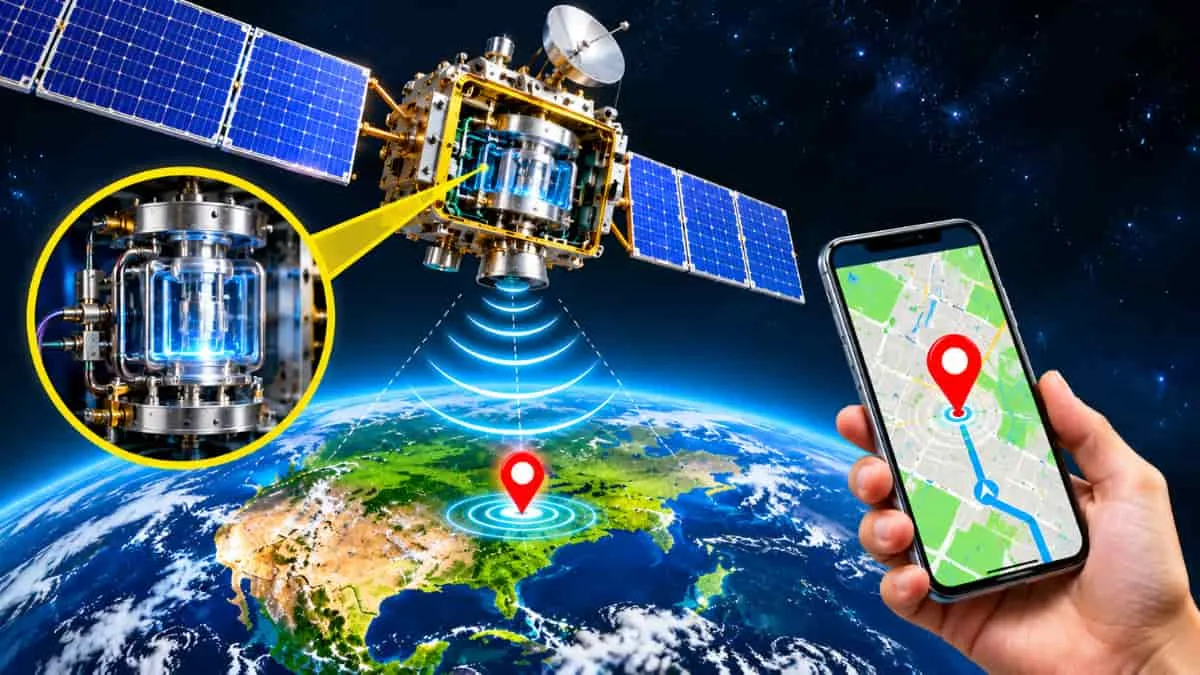
Have you ever wondered how Google Maps knows your exact location? How does your mobile phone show where you are, even when you are travelling in a car, train or aeroplane?
The answer is connected to one of the most amazing inventions in science: the Atomic Clock.
Atomic clocks are among the most accurate timekeeping devices in the world. Some of these clocks are placed inside satellites orbiting the Earth. They help GPS (Global Positioning System) find the location of people, vehicles, ships and aircraft.
These clocks are so accurate that even a tiny mistake in time can affect the location shown on your phone.
But how do these clocks work? Why are they placed in satellites? And how does your phone use their signals to find your location? Let's understand everything in simple words.
What Is the Most Accurate Clock in the World?
An atomic clock is a special clock that uses the natural vibrations of atoms to measure time. Unlike normal clocks, which use moving hands or electronic parts, atomic clocks use the steady behaviour of atoms to keep time.
One of the biggest advantages of an atomic clock is its amazing accuracy. It can measure time down to extremely small fractions of a second.
According to the US National Institute of Standards and Technology (NIST), researchers developed an aluminium-ion atomic clock in 2025 that can measure time to 19 decimal places. It was announced as the world's most accurate clock at that time.
However, there is an important difference between this laboratory clock and the atomic clocks used in satellites.
Related Stories
-
Laboratory atomic clocks: These are built and tested by scientists to measure time with extremely high accuracy.
Satellite atomic clocks: These are smaller clocks designed to work in space. They help satellites send accurate time signals to Earth.
GPS satellites carry several atomic clocks to help people find their locations around the world.
Source: science magzine
What Is an Atomic Clock in a Satellite?
An atomic clock in a satellite is a special timekeeping device that helps the satellite send accurate time information to Earth.
The Global Positioning System (GPS) uses a group of satellites that move around the Earth. Each GPS satellite carries multiple atomic clocks.
According to NIST, these satellite clocks use technologies based on the element rubidium. They are designed to keep time with an accuracy of around three billionths of a second.
These clocks are important because GPS depends on knowing exactly when a signal leaves a satellite and when it reaches a mobile phone or another GPS device.
Even a very small mistake in time can create a large mistake in location.
How Does GPS Work with Atomic Clocks?
GPS works with the help of satellites, radio signals and atomic clocks.
When you open Google Maps on your phone, it receives signals from GPS satellites above the Earth. These signals contain two important things:
-
The exact time when the signal was sent.
-
The position of the satellite in space.
Your phone uses this information to calculate how far away the satellites are from you.
Source:notes
Let's understand the process step by step.
Step 1: Satellites send signals to Earth
GPS satellites continuously send radio signals towards Earth. These signals carry information about the satellite's position and the exact time when the signal was sent.
Step 2: Your mobile phone receives the signals
When you turn on location services, your phone receives signals from GPS satellites that are visible from your location.
Step 3: Your phone calculates the distance
Radio signals travel at the speed of light, which is about 300,000 kilometres per second.
Your phone calculates how long each signal took to reach it. Using this time, it estimates the distance between your phone and each satellite.
Step 4: Four satellites help find your location
Your phone needs signals from at least four GPS satellites to calculate your position in three dimensions.
These satellites help your phone find:
-
Latitude: How far north or south you are.
-
Longitude: How far east or west you are.
-
Altitude: How high you are above sea level.
The fourth satellite also helps correct the timing difference between your phone's clock and the satellite clocks.
This is how your phone can show your location on Google Maps.
Why Are Atomic Clocks Important for GPS?
You may wonder why GPS satellites need such accurate clocks.
The reason is simple: GPS works by measuring time.
Radio signals travel extremely fast. So, even a tiny error in measuring their travel time can create a big mistake in calculating distance.
For example, a timing error of just one-millionth of a second can create a distance error of about 300 metres.
This is why atomic clocks are needed in GPS satellites. They help provide accurate time information so that your phone can calculate your location correctly.
According to NIST, GPS can generally locate a person within about 4.9 metres (16 feet) under suitable conditions. Actual accuracy can change depending on buildings, signal quality and other factors.
How Many Atomic Clocks Are Placed in GPS Satellites?
GPS satellites carry multiple atomic clocks instead of depending on just one clock, but for getting the correct location, time and navigation, there are a minimum 4 atomic clocks placed in GPS Satellites.
These clocks help satellites send accurate timing information to GPS receivers on Earth.
According to the US National Institute of Standards and Technology (NIST), GPS satellites carry several atomic clocks, but all the clocks are based on rubidium technology.
These satellites are also monitored by ground control stations, and these stations check their working condition, track their positions and correct their clocks whenever needed.
It is very important to regularise these clocks timely because if it missed its tracking & updating, it can slow or fast the timing and the GPS location can be disturbed to get the exact location & map on the device.
Are Atomic Clocks in Satellites the Most Accurate Clocks in the World?
No. This is an important fact to understand.
The atomic clocks placed in GPS satellites are highly accurate, but they are not the most accurate clocks ever made.
The most accurate atomic clocks are generally built in scientific laboratories. They use advanced technologies and are tested under controlled conditions.
For example, in July 2025, NIST announced an aluminium-ion quantum logic clock that set a new world record for clock accuracy. It can measure time to 19 decimal places.
Satellite clocks are designed differently. They must be small, strong and capable of working in the difficult conditions of space.
Their main job is to provide accurate timing signals for navigation.
What Is the Difference Between a Normal Clock and an Atomic Clock?
|
Feature
|
Normal Clock
|
Atomic Clock
|
|
Working method
|
Uses mechanical or electronic parts
|
Uses the natural behaviour of atoms
|
|
Accuracy
|
Depends on the type of clock
|
Extremely high
|
|
Main use
|
Daily timekeeping
|
Scientific research, GPS and time systems
|
|
Time measurement
|
Can lose or gain time
|
Keeps time much more accurately
|
|
Location
|
Homes, offices and phones
|
Laboratories and satellites
|
Where Are Atomic Clocks Used Apart from GPS?
Atomic clocks are not only used for finding locations. They are also important for many other technologies.
Some major uses include:
1. Mobile phones: They help provide accurate time signals to communication networks.
2. Aeroplanes: GPS timing helps aircraft navigation systems work correctly.
3. Ships: Ships use satellite navigation to find their positions at sea.
4. Scientific research: Scientists use atomic clocks to study time, space and gravity.
5. Banking: Financial systems use accurate time to record and match transactions.
6. Power networks: Electricity networks use accurate timing to coordinate their operations.
5 Interesting Facts About Atomic Clocks and GPS
1. GPS satellites fly very high: They orbit approximately 20,200 kilometres above Earth's surface.
2. GPS satellites carry multiple atomic clocks: These clocks help satellites send accurate time signals to Earth.
3. GPS signals travel at the speed of light: Their speed is approximately 300,000 kilometres per second.
4. Four satellites help find your location: A GPS receiver generally needs signals from at least four satellites to calculate its three-dimensional position and time.
5. The most accurate clock is made in a laboratory: NIST announced a record-setting aluminium-ion atomic clock in July 2025.
Conclusion
Atomic clocks are among the most important inventions in modern science. They help satellites keep accurate time, and this information allows GPS devices to calculate locations on Earth.
The next time you open Google Maps to find a nearby school, shop or restaurant, remember that satellites and their tiny atomic clocks are helping your phone find the right location.
Without accurate timekeeping, modern GPS navigation would not work properly.