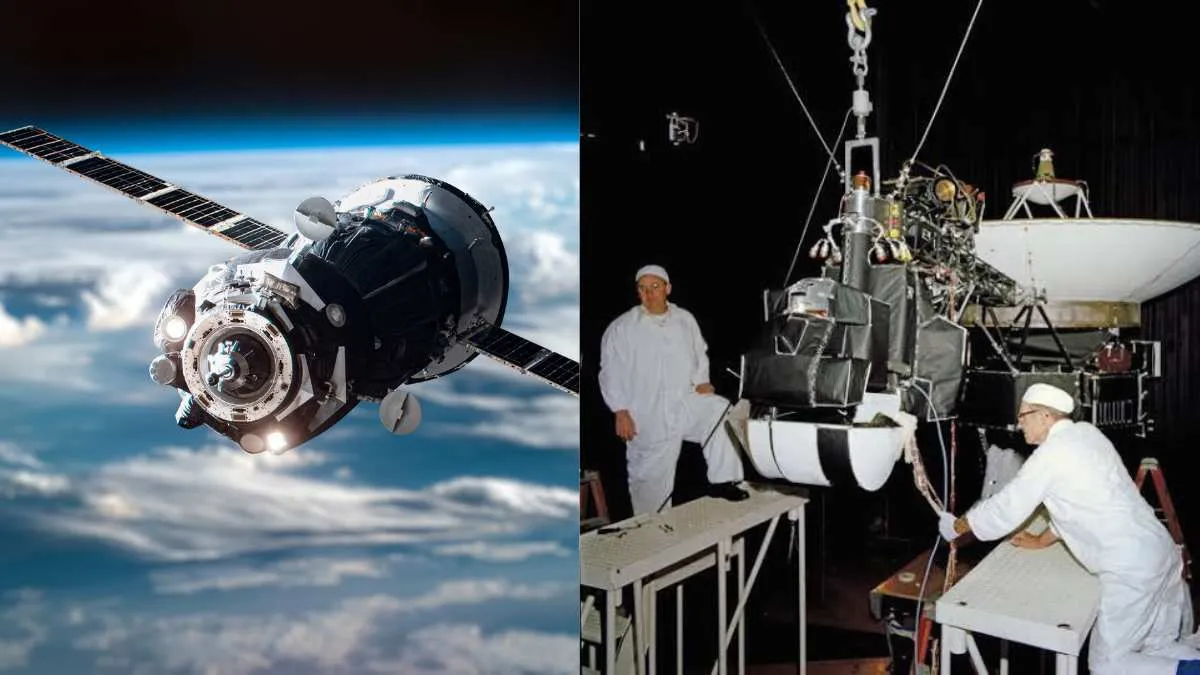
Just four days after becoming the first ever mission to be one light day away from Earth, Voyager 1 encountered yet another technical problem. On November 14, 2026, scientists received a radio signal from Voyager 1; but, there was no engineering or scientific data left on board. Then again on November 18, it became known that Voyager 1 passed 25.9 billion kilometres from Earth.
Read more about where is NASA Voyager 1 and its twin spacecraft is today along with all the historical records it has achieve and what it means for us hereon for general knowledge.
Related Stories
What Happened to NASA Voyager 1 Spacecraft Data?
The disruption started on November 14 when the NASA Deep Space Network’s antenna at Canberra, Australia, picked up the probe.
The carrier tone proved that Voyager 1’s antenna is still pointed at Earth and its Attitude and Articulation Control computer is working properly.
But the lack of telemetry signals a problem in the Flight Data Subsystem which is a computer from the 1970s that gathers data from the scientific instruments and transmits them to Earth.
NASA specialists are also investigating whether the problem stems from the 48-hour loss of contact experienced by Voyager 1 in October 2026.
How do Engineers Fix a Spacecraft One Light-Day Away from Earth?
Identifying a problem from 16.1 billion miles away is an immensely frustrating task. Voyager 1 is over a light-day away from Earth and it takes 24 hours for any message transmitted from the control center to reach Voyager 1.
A 24-hour waiting period after this is required to get a reply. “As Dodd pointed out during the NASA press briefing on Nov. 19,” each individual diagnosis takes up to two full days.
Which Records Define the Twin Voyager Missions?
Both Voyager 1 and Voyager 2 were launched in 1977 in order to explore the planets Jupiter and Saturn, and made new discoveries such as volcanic activities on Io and the mapping of Saturn's rings prior to joining the Voyager Interstellar Mission.
| Mission Details | Voyager 1 | Voyager 2 |
| Launch Date | September 5, 1977 |
August 20, 1977
(launched first)
|
| Major Overtake | Passed Voyager 2 on Dec 15, 1977 | Took a longer planetary tour |
| Planetary Visits | Jupiter and Saturn |
Jupiter,
Saturn,
Uranus, and
Neptune
|
| Interstellar Entry | August 2012 | November 5, 2018 |
| Active Instruments |
2
(Magnetometer, Plasma Wave)
|
3
(Cosmic Ray, Magnetometer, Plasma Wave)
|
Why is Voyager 1 Still Ahead of Its Twin Voyager 2?
Even though Voyager 2 was sent into space 16 days earlier, Voyager 1 had a faster route and therefore surpassed its counterpart on December 15, 1977.
Voyager 2 encountered the planets Uranus and Neptune before venturing further into outer space which makes it the only spacecraft to have done so.
Currently, Voyager 1 is traveling through interstellar space at the speed of around 61,000 km/h whereas Voyager 2 will take until November 2035 to travel one light-day away.
What Comes Next for the Voyager 1 Spacecraft?
NASA teams remain confident they will restore data flow, noting that Voyager 1 recovered from a similar memory chip glitch in 2024.
Both probes run on decaying plutonium power sources, forcing NASA to switch off older sensors like the Low-Energy Charged Particles instrument in April 2026. Even after its power fades in the 2030s Voyager 1 will keep drifting toward the star Gliese 445 for tens of thousands of years