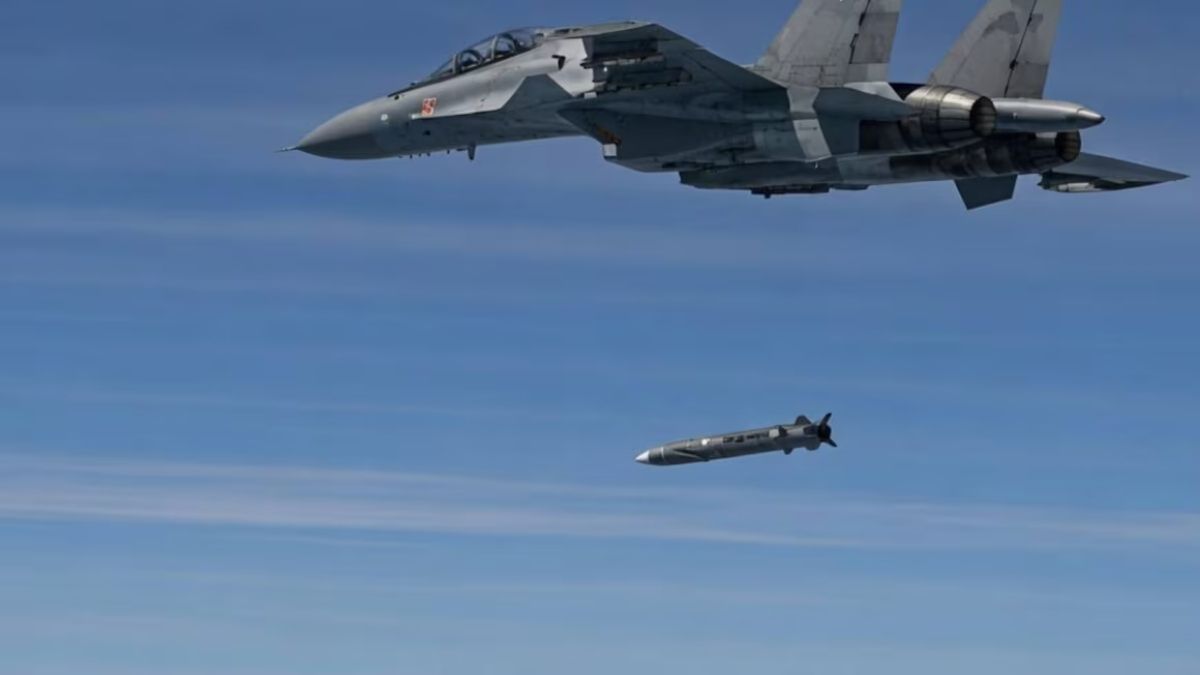
India’s defence architecture has taken a giant leap forward recently with the successful flight test of Rudram-2 missile from a Su-30MKI fighter aircraft. The Rudram 2 missile is an advanced hypersonic air-to-surface missile developed by the Defence Research and Development Organisation (DRDO) to neutralise enemy radar and communication systems.
"The latest trials conducted under extreme release conditions confirmed all core subsystems, meeting pre-defined targets with pinpoint accuracy,” the Ministry of Defence said. Defence Minister Rajnath Singh called the achievement a big win for the Aatmanirbharta (self-reliance) initiative.
But why is the Rudram-2 missile test significant for the Indian Air Force? This indigenous weapon redefines the concept of modern aerial warfare, from destroying enemy air defences to achieving speeds of Mach 5.5.
What are the Key Features of the Rudram 2 Missile?
The DRDO built this indigenous air-launched weapon to hunt down hostile frequency-emitting sources. Operating at hypersonic speeds reaching Mach 5.5, the Rudram missile leaves enemy forces with virtually zero reaction time. This project was taken up at the Research Centre Imarat (RCI), Hyderabad, which was the nodal laboratory.
Here is a breakdown of the primary characteristics of the Rudram 2 Missile:
-
Speed and Range: The system has a formidable strike radius of up to 300-350 kilometres and flies much faster than standard supersonic speeds.
Guidance Mechanism: It has a Passive Homing Head (PHH) with an Imaging Infrared (IIR) seeker. The dual system allows the weapon to lock on target emissions and accurately strike even if the enemy shuts down their radars mid-flight.
Payload: It carries a 200-kilogram pre-fragmented warhead capable of destroying bunkers, airbases, and fortified hangars.
Propulsion: The missile relies on a solid-propellant dual-pulsed rocket motor.
How does the Rudram-2 Missile Test Boost IAF's Combat Edge?
If there are fighter jets flying into hostile airspace, they are most vulnerable to hidden surface-to-air missile ( SAM ) batteries. The Rudram-2 missile test was specifically for Suppression of Enemy Air Defences (SEAD) operations. By firing this anti-radiation missile from a Sukhoi-30MKI at a standoff range, the Indian Air Force can blind the opposition before pushing deep into contested territory.
As confirmed by the Ministry of Defence press release, flight data captured by the Integrated Test Range (ITR) at Chandipur proved the weapon's precision. DRDO Chairman Dr Samir V. Kamat noted that such successful flight-tests mature India’s domestic defence technologies. Essentially, the Indian Air Force now possesses a surgical tool that acts as a door-kicker in modern air campaigns, dismantling radar nets before they even detect an incoming strike package.
4 Major Differences Between Rudram 1 and Rudram 2 Missiles
Military observers looking at the legacy variant versus the latest upgrade see giant leaps in technology. The original NGARM (New Generation Anti-Radiation Missile) established the baseline, but the newer version adds hypersonic capabilities and more advanced terminal guidance.
Below is a brief comparison of the two variants:
|
Feature
|
Rudram 1 (NGARM)
|
Rudram 2
|
|
Operational Speed
|
Mach 2 (Supersonic)
|
Mach 5.5 (Hypersonic)
|
|
Maximum Range
|
Up to 200 kilometres
|
300 to 350 kilometres
|
|
Warhead Capacity
|
55-60 kilograms
|
Approx. 200 kilograms
|
|
Seeker Technology
|
Passive Homing Head (PHH)
|
PHH combined with Imaging Infrared (IIR)
|
Why is the Rudram 2 Missile Important for UPSC Aspirants?
Defence-related questions are a common feature in the civil services examination. Rudram 2 missile upsc topic is important for both the Preliminary exam (Science & Technology section) and the General Studies Paper 3 (Indigenisation of Technology).
Students should focus on:
-
The difference between anti-radiation missiles and regular air-to-surface weapons.
-
The role of nodal agencies like Research Centre Imarat (RCI) and Hindustan Aeronautics Limited (HAL).
-
How SEAD operations align with the broader Make in India and Aatmanirbharta defence strategies.
Understanding these elements is a good beginning to face questions on defence procurement and technological advancement in competitive examinations.
DRDO is already working on the Rudram-3 variant of the Rudram series with a range of 550 km. Such unending advancements ensure complete air supremacy for India, replacing costly foreign imports with indigenous firepower that totally neutralises enemy air defence systems.