5.3 or 5.6 Magnitude? Why Nepal and Sikkim Earthquake Today has 2 Readings, Here’s What Officials Say About Damage Risk
A shallow earthquake struck eastern Nepal’s Koshi Province at 7:02 AM IST on November 24, 2026, sending strong morning tremors across Sikkim, North Bengal, and parts of Bihar. Here is why official agencies logged two different magnitudes, what ground teams found, and how it compares to past Himalayan quakes.
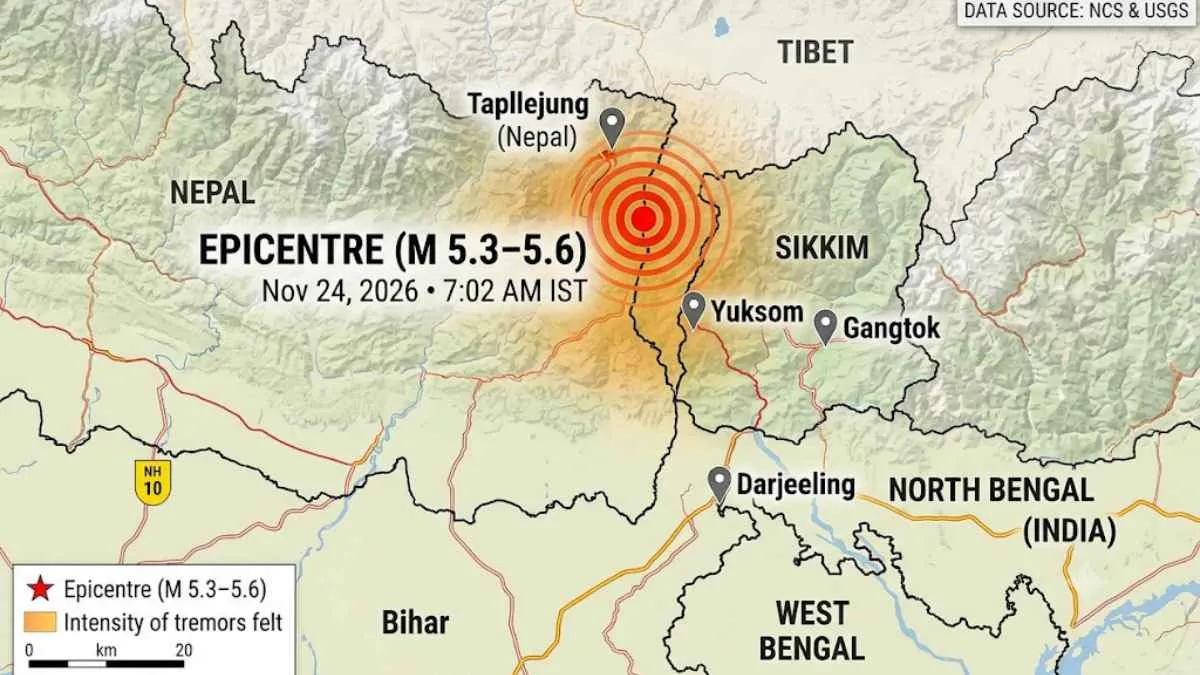
At 7:02 AM on Tuesday of November 24th 2026, people across hillside homes from Gangtok to Darjeeling felt ground shaking beneath their feets quite literally. And if you searched for earthquake today right after stepping out of your door in panic you were not alone.
Within seconds residents across Sikkim, North Bengal, and northern Bihar rushed into open streets due to a shallow tremor rolled beneath the Eastern Himalayas.
Fortunately there is immediate relief: officials across India and Nepal have reported zero casualties or major structural damage so far.
Magnitude 5.3 Earthquake Hits Nepal’s Koshi Province Today
The tremor originated in eastern Nepal’s Taplejung district within Koshi Province, right along the rugged mountain border separating Nepal, Sikkim, and Tibet.
- India’s National Centre for Seismology (NCS) reports on its official bulletin: "EQ of M: 5.3, On: 24/11/2026 07:02:47 IST, Lat: 27.855 N, Long: 87.909 E, Depth: 20 Km, Location: Nepal." This report places the earthquake epicentre today roughly 61 kilometres north-northwest of Yuksom in West Sikkim.
- The US Geological Survey (USGS) placed it 67 kilometres west-northwest of Mangan at a shallower 10-kilometre depth.
- And Nepal’s National Earthquake Monitoring and Research Centre (NEMRC) recorded a local magnitude of 5.6 near Olangchung Gola.
5.6 magnitude earthquake strikes Nepal-Tibet border region
— All India Radio News (@airnewsalerts) November 24, 2026
▪️An earthquake measuring 5.6 on the local magnitude scale struck near Olangchung Gola in Taplejung district, close to the Nepal-Tibet border, this morning.
▪️According to Nepal's National Earthquake Monitoring and…
Nepal's Earthquake Today Impact and Landslide Risk
If you live in a hill town or have family travelling on mountain highways like NH-10 then your biggest worry isn't just the shaking. It's delayed rockfalls.
Even moderate quakes can loosen unstable slopes in the Himalayas. And here is what local administrations have confirmed so far:
| Region or State | Districts Affected by Earthquake Today | Ground Impact and Landslide Status |
| Eastern Nepal | Taplejung (Koshi Province) | Strongest shaking near epicentre; high-altitude border villages under inspection; no fatalities reported |
| Sikkim | Mangan, Yuksom, Gangtok | Sharp tremors felt; residents evacuated buildings; district teams checking mountain roads for rockfalls |
| North Bengal | Darjeeling, Jalpaiguri, Cooch Behar | Tremors were felt at 7:02 AM; zero structural damage or casualties reported by state officials |
| Bihar and Northeast | Bordering districts of Bihar, Meghalaya | Light tremors felt in multi-storey buildings; no infrastructure damage reported |
How Strong is a 5.3 or 5.6 Magnitude Earthquake?
Think of a 5.3 to 5.6 earthquake as moderate. It packs enough energy to swing ceiling fans, crack weak plaster, and wake up an entire neighbourhood… especially when its focal depth is shallow (10 to 20 km).
But it rarely brings down well-built concrete structures.
And if you are wondering why India’s NCS logged 5.3 when Nepal’s NEMRC reported 5.6 magnitude earthquake today then understand that the variance is completely normal.
Local seismographs sitting closer to the fault line pick up higher-frequency shockwaves than distant regional sensors.
Whenever an earthquake strikes near the Sikkim-Nepal border, social media immediately floods with recycled disaster videos. It is important to stay alert for minor aftershocks over the next 24 hours is smart but today’s event was a routine tectonic release rather than a catastrophic rupture.
Did You Know - Japan Mistakenly Once Issued 9.9 Earthquake Alert After Russia Tremor: How Bad Would Megaquake Be?
When was the Last Major Earthquake in Nepal and Sikkim?
The Eastern Himalayas sit in Seismic Zone IV and V which means that major powerful eathquakes are part of living memory for people native to Himalyan regions like Nepal and Sikkim:
1. 2015 Gorkha Earthquake in Nepal
Magnitude 7.8: On April 25, 2015. It was a devastating quake that struck central Nepal and killed nearly 9,000 people, injured 22,000, and flattened historic monuments across Kathmandu.
2. 2011 Sikkim Earthquake near India-Nepal Border
Magnitude 6.9: On September 18, 2011 a powerful tremor near Mangan killed over 100 people across Sikkim, North Bengal, Bihar, and Nepal and triggered massive landslides that cut off North Sikkim for weeks.
3. 1988 Nepal Bihar Earthquake
Magnitude 6.8: On August 20, 1988 earthquake tremors along the Bihar-Nepal border killed roughly 1,000 people across eastern Nepal and northern Bihar (especially Darbhanga and Madhubani).
4. 1934 Bihar Nepal Earthquake
Magnitude 8.1: It was one of South Asia’s deadliest eathquakes on record. The disaster killed over 10,700 people and liquefied soil across northern Bihar and the Kathmandu Valley.
Why Eastern Himalayas are Prone to Frequent Shallow Earthquakes
The reason your floor shook this morning goes back 50 million years. The Indian tectonic plate is still pushing northward into the Eurasian plate at roughly 4 to 5 centimetres every year.
But the rocks beneath Nepal, Sikkim, and northern Bihar cannot slide smoothly so immense pressure builds along fault lines like the Main Himalayan Thrust.
Every few months that locked rock snaps and releases energy as the shallow earthquakes we feel across the subcontinent.

Harshita Singh is an education and general knowledge journalist with over 5 years of experience in educational writing. Specializing in US affairs and GK, Harshita has a track record of breaking down intricate geopolitical and historical subjects into clear, digestible insights for learners. Her strong background in text analysis, coupled with a Bachelor of Arts (Hons) in English from the University of Delhi, helps her produce authoritative, thoroughly researched content that empowers readers to engage confidently with global current affairs. For inquiries or academic insights, you can reach out to her directly at harshita.singh@jagrannewmedia.com.