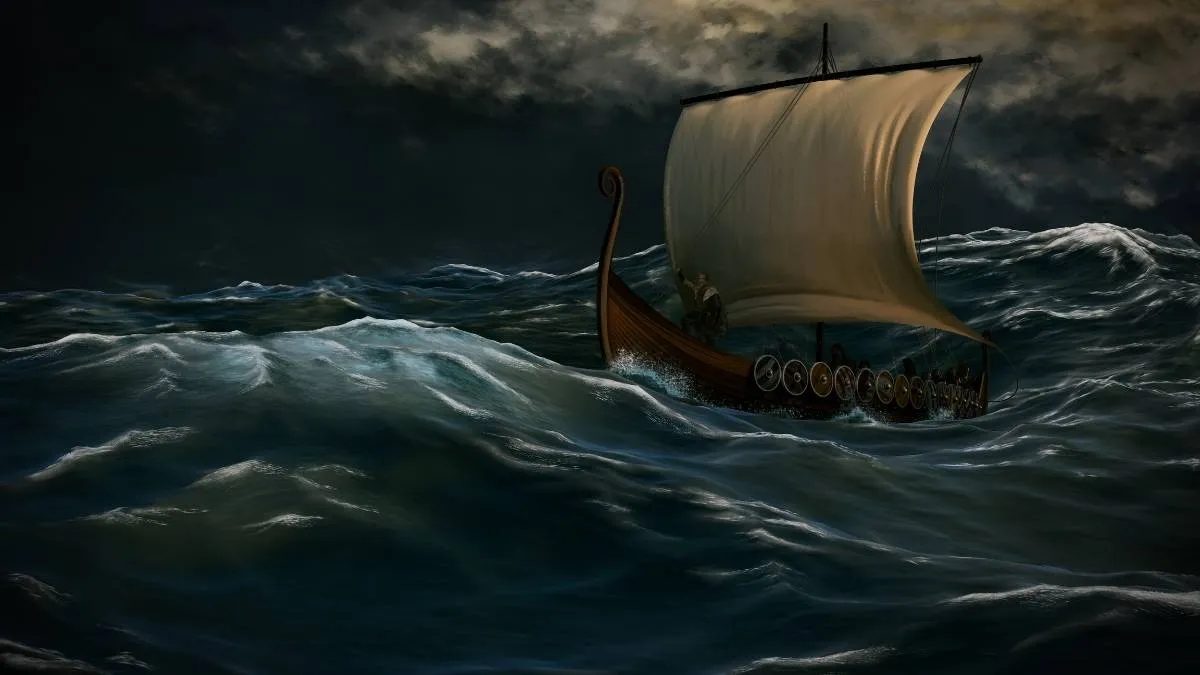
Did Vikings really come to America long before Columbus? For decades history books taught us that Christopher Columbus discovered America in 1492. But modern science has just dropped a massive reality check regarding the discovery of America.
It seems that the story about 'Vikings in America' is not simply a plot for a periodical TV show; it is history proven by the stars. Before the Nina, Pinta, and Santa Maria set sail to America, the Norsemen had already built houses and chopped wood in North America.
Using a groundbreaking cosmic-clock dating method, researchers have pinpointed the exact year the Vikings were active in the New World.
This revelation doesn't just challenge Columbus’s discovery of America; it proves that the Vikings were the first Europeans to cross the Atlantic.
When did the Vikings come to America?
While the sagas of Leif Erikson have been told for centuries, scientists have finally found a smoking gun date. As indicated in an article in the journal Nature, the Vikings were at the L’Anse aux Meadows site in Newfoundland, Canada in 1021 AD.
Scientists searched for a particular radiocarbon peak due to a massive solar storm that occurred on Earth in 993 AD.
It was possible to confirm the cutting of wood 28 years after the storm through the tree rings in wooden items that were created after the storm ring. This proves that Norse explorers were in America 471 years before Columbus reached there.
L’Anse aux Meadows National Historic Site, Courtesy - Ko Hon Chiu Vincen via UNESCO
What Viking Artifacts were found in America?
There is more than just old stories that prove the Vikings were in North America. The archaeological site at L'Anse aux Meadows has given us amazing physical evidence:
-
Wood with Metal Marks: Fragments of wood were found that were clearly cut with metal tools (iron) which the Indigenous populations of that area did not possess at the time.
Sod Buildings: Remains of eight buildings that includes a smithy and a carpentry shop. All the buildings resemble Norse structures found in Greenland and Iceland.
The Bronze Pin: A ring headed bronze cloak pin which is a classic piece of Viking jewelry was recovered from the site.
Spinning Tools: Stone spindle whorls suggest that women were part of the expedition. It also indicates a settled community rather than just a quick scouting party.
Why did Christopher Columbus get the credit for discovering America?
When there were Vikings before him, then why do we mention the discovery of America by Columbus? The answer lies in the aftereffects that come with the discovery.
The Vikings only stayed in Vinland (the name they gave North America) for a temporary period of time.
They might have stayed for 3 to 13 years but later went back due to issues they faced with the Indigenous people. And it was far away from their homeland.
But the voyage made by Columbus in 1492 initiated the permanent flow of Europeans to this newly found land.
Even though Columbus was not the first one to discover this place he changed the course of history forever with his arrival. But in ctermsof exploration alone, the Vikings remain superior.
Arguments about who arrived first in America have come to an end. The Vikings have managed to beat others by half a millennium.
Recent findings from the University of Groningen show that the arrival of NorNorsemen 1021 AD is the earliest moment in history when the humanity has made a full turn around Earth. To sum up, History is rewritten; the Norsemen are the real heroes of the Atlantic.