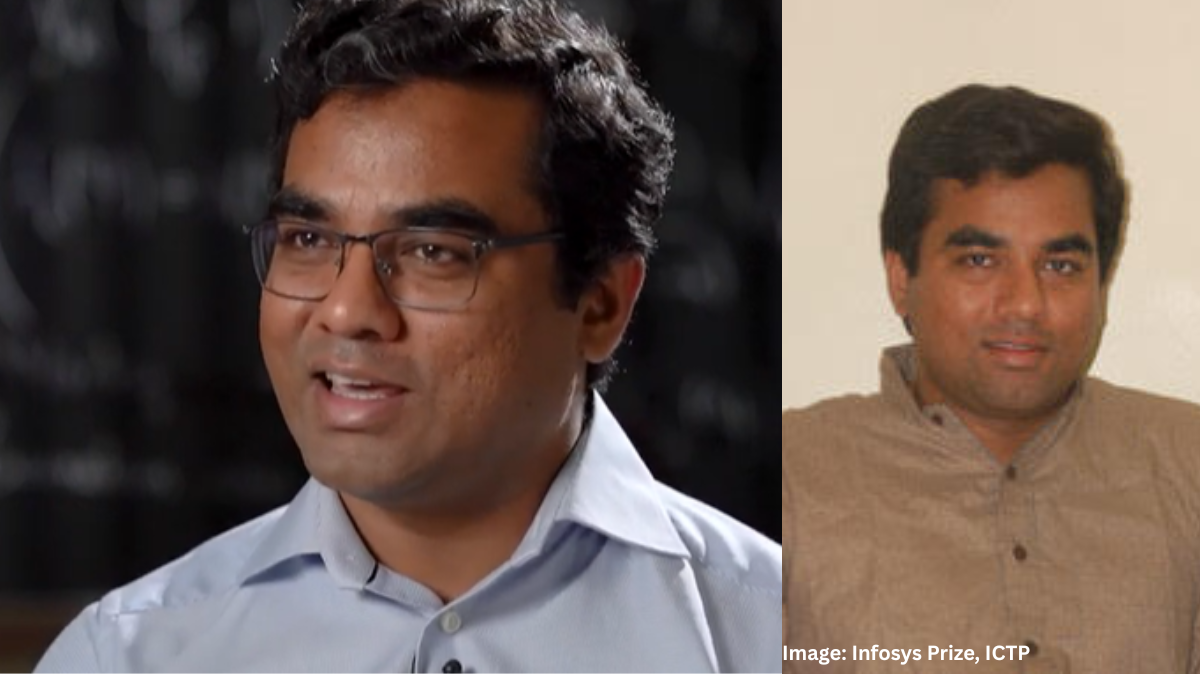
Mahesh Kakde, a professor at the Indian Institute of Science (IISc) Bengaluru, has been awarded the 2026 Ramanujan Prize for Young Mathematicians from Developing Countries for his contributions to algebraic number theory. Along with the honour, Kakde will receive a prize of $10,000 (around Rs 9.68 lakh).
The award recognises Kakde’s work on the implications of Hilbert’s 12th problem, one of the 23 famous problems presented by German mathematician David Hilbert in 1900. It also acknowledges his results in noncommutative Iwasawa theory and his work on the Gross-Stark and Brumer-Stark conjectures.
Work In Algebraic Number Theory
Kakde’s primary area of research is algebraic number theory, a branch of mathematics that uses concepts from algebra, including fields and groups, to study problems in number theory. The field explores questions related to integers and their generalisations.
His research has contributed to the understanding of several major problems and conjectures in modern number theory, earning him recognition in India and internationally.
Several Honours For Kakde
The 2026 Ramanujan Prize is among several major honours received by Kakde during his career. He was awarded the Infosys Prize in Mathematical Sciences in 2022. He was also invited to speak at the International Congress of Mathematicians, where he appeared alongside mathematician Samit Dasgupta.
In 2023, Kakde was named to the Asian Scientist 100, an annual list published by Asian Scientist Magazine that recognises leading researchers, academics and innovators across Asia.
The Ramanujan Prize is awarded with recognition from the International Centre for Theoretical Physics (ICTP) and the International Mathematical Union (IMU).
Mahesh Kakde’s Academic Journey
Before joining IISc Bengaluru as a professor in 2019, Kakde worked at King’s College London. Earlier, he served as a research associate at University College London and worked as an instructor of mathematics at Princeton University.
Kakde completed his Bachelor of Mathematics at the Indian Statistical Institute in Bengaluru. He then earned a Master of Mathematics from the University of Cambridge in the United Kingdom, where he also completed his doctoral degree in pure mathematics in 2008.
ALSO READ| IIT Ropar Launches AI-Powered AVNI App To Help Children Learn About Agriculture, Food And Crops