What Are the Differences Between NSE and BSE?
NSE vs BSE explained in the easiest way. Learn their key differences, indexes, and roles in India’s economy in this article.
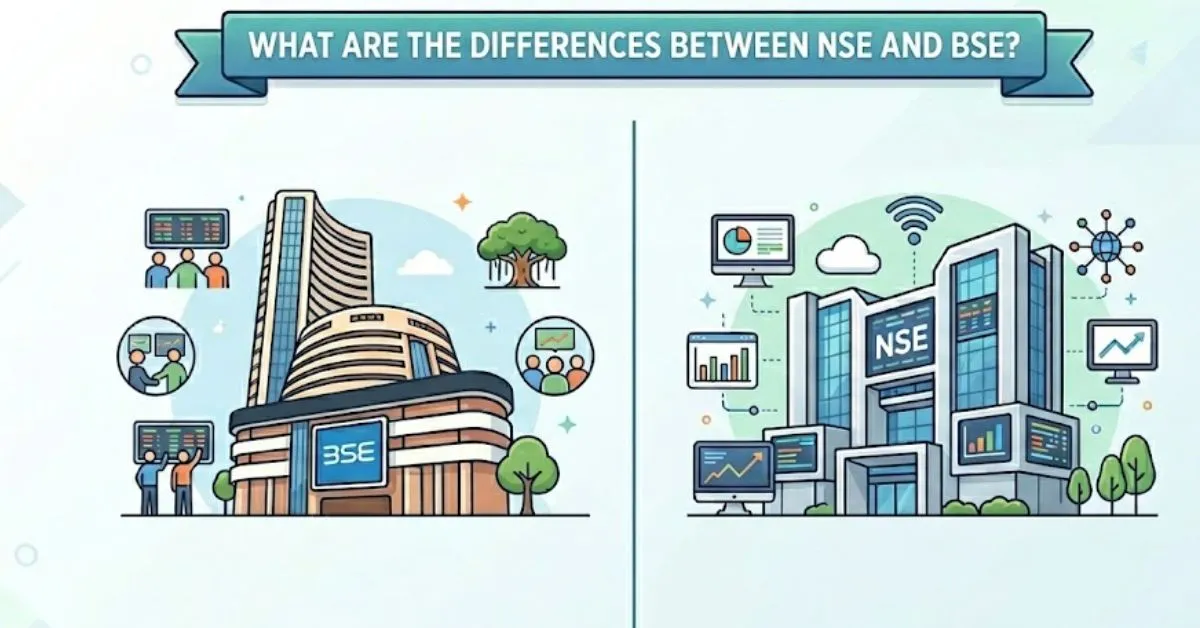
Whenever you hear someone talk about the stock market either on the news or in a discussion, they surely use the terms like ‘Sensex is up’ or ‘Nifty has fallen’. But are you aware what these words are, and their origin? They belong to two largest Indian stock exchanges in India. Here is the meaning of each of them and their differences.
What Is BSE?
BSE is an abbreviation of Bombay Stock Exchange. It is situated in Mumbai at Dalal street. It is the oldest and the first stock exchange in Asia. The Corporate Profile of BSE mentions: “Established in 1875, BSE Ltd. (formerly known as Bombay Stock Exchange Ltd.), is Asia’s first Stock Exchange and one of India’s leading exchange groups and has played a prominent role in developing the Indian capital market."
It has been in existence since 1875. It started with the name of "The Native Share & Stock Brokers' Association" back in 1875. The BSE PSU mentions: “What is now popularly known as BSE was established as "The Native Share & Stock Brokers' Association" in 1875.”
In 1875 it was established but BSE was not recognised as a stock exchange until 1956. The exchange started its online trading system called the BSE Online Trading System (BOLT) in 1995.
The BSE PSU mentions: “BSE's pivotal and pre-eminent role in the development of the Indian capital market is widely recognized. It migrated from the open outcry system to an online screen-based order driven trading system in 1995.”
What is NSE?
The National Stock Exchange of India (NSE) is an Indian stock market that is located in Mumbai. NSE was incorporated in 1992 to bring about transparency in the Indian equity markets and was set up as per the regulations of the Government of India.
In 1994, NSE began its operations. It became the first trading exchange in India to roll out an electronic trading facility. The turnover in NSE was higher than in the BSE in little less than one year of its operations.
The NSE India mentions: “NSE was incorporated in 1992. It was recognised as a stock exchange by SEBI in April 1993 and commenced operations in 1994 with the launch of the wholesale debt market, followed shortly after by the launch of the cash market segment.”
Key Differences Between NSE and BSE
| Feature | BSE | NSE |
| Full Name | Bombay Stock Exchange | National Stock Exchange |
| Founded | 1875 | 1992 |
| Location | Dalal Street | Bandra Kurla Complex |
| Benchmark Index | Sensex Top 30 Companies | Nifty Top 50 Stocks |
| Listed Companies | 5,500+ | 2,671+ |
What Do They Have in Common?
NSE and BSE are a lot more similar than one would assume. Both markets are regulated by SEBI, which looks after the fair trade practices, regulations on the protection of the investors and the integrity of the market. The two exchanges provide a wide variety of financial instruments to trade in, such as securities, bonds, exchange-traded funds (ETFs), derivatives, and mutual funds. Also, the majority of the stocks are traded in both exchanges so an average investor has free will to choose either of these.
In basic terminologies NSE is the largest and the fastest stock exchange in India whereas BSE is the oldest one. Both are significant, both are secure and both are controlled by the government via SEBI.
For more such stories, visit Jagran Josh and gain something new about the world everyday.

Nikhil is a dedicated digital journalist and communications professional with more than five years of experience, currently working within the General Knowledge section at Jagran Josh. He has established himself as a subject matter expert in Finance, Economy, History, Technology, and Trending News, consistently delivering accurate, engaging, and easy-to-read content for a wide global audience.
Over the course of his career, Nikhil has developed deep expertise in crafting informative listicles, viral trending stories. His editorial portfolio also spans finance, historical research, and technology reporting, making him a versatile and well-rounded content professional. Every piece he produces reflects a strong balance between factual accuracy and reader engagement.


-1789978920126_t.webp)