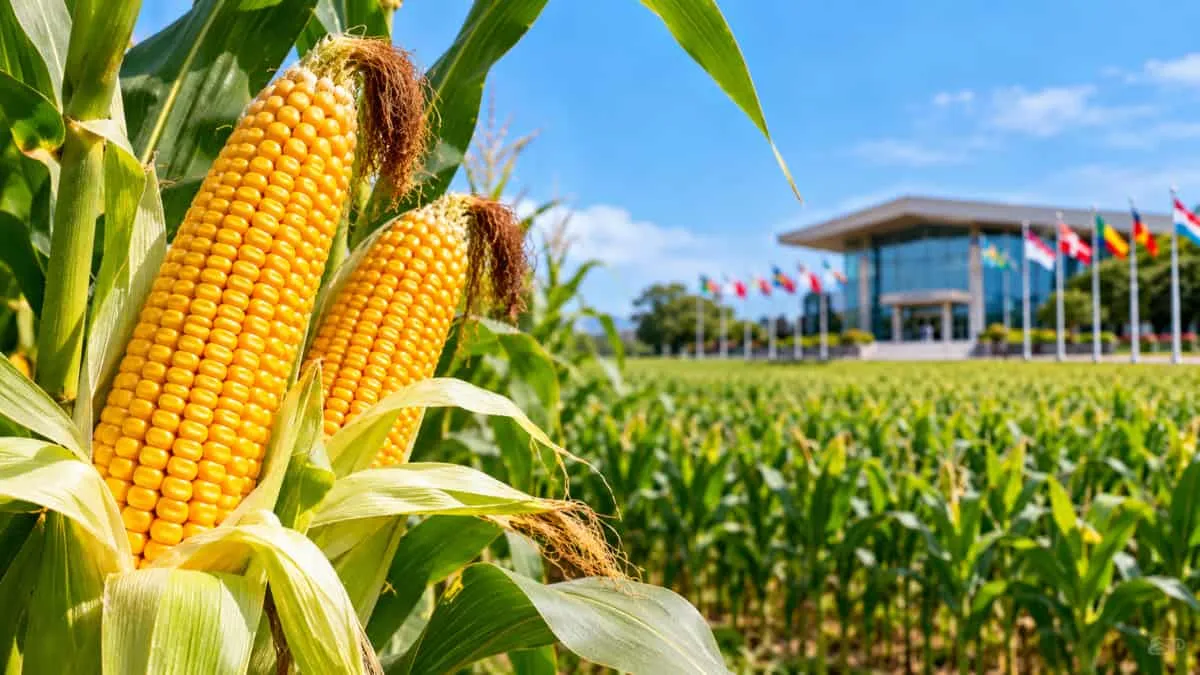
The 1st International Maize Conference 2026 was held in Hyderabad from November 2 to 4, bringing together agricultural scientists, policymakers, research institutions and industry experts to discuss ways to improve maize production, develop high-yielding varieties and strengthen farmers' income.
India aims to increase its maize production from approximately 55 million tonnes to 75 million tonnes over the next decade. The target was highlighted by Dr. M. L. Jat, Secretary of the Department of Agricultural Research and Education (DARE) and Director General of the Indian Council of Agricultural Research (ICAR), during the conference.
The three-day international conference focused on the theme "Maize Revolution for Food, Feed, Fodder, Fuel and Sustainability in the Changing World" (M4FS). It discussed the role of modern breeding techniques, improved seed systems, mechanisation and sustainable farming practices in transforming India's maize sector.
1st International Maize Conference 2026: Key Highlights
The conference focused on increasing maize productivity, improving crop quality and making agricultural research more beneficial for farmers.
Here are the major highlights:
Related Stories
-
India's maize production target: India aims to increase maize production to 75 million tonnes over the next decade.
Current production: India's maize production has reached approximately 55 million tonnes.
Productivity improvement: A further 1.5-fold increase in productivity has been targeted through technological innovation and better crop management.
New maize hybrids: Scientists highlighted the development of 329 maize hybrids over the past five years.
Farmer-centric research: Experts stressed that agricultural research should improve farmers' income and livelihoods.
Sustainable farming: The conference highlighted efficient use of natural resources, mechanisation and climate-resilient maize varieties.
What is the 1st International Maize Conference 2026?
The 1st International Maize Conference 2026 was an international platform for discussing the future of maize research, production and agricultural development.
It was organised under the theme "Maize Revolution for Food, Feed, Fodder, Fuel and Sustainability in the Changing World" (M4FS).
The conference took place at the JD Convention Centre in Hyderabad, Telangana, from November 2 to 4, 2026.
It brought together agricultural scientists, policymakers, researchers, agricultural universities and industry representatives from India and other countries.
The main objective was to explore innovative ways to increase maize production, improve the quality of seeds, develop better crop varieties and strengthen the maize value chain.
India Targets 75 Million Tonnes of Maize Production
One of the major announcements at the conference was India's target of producing 75 million tonnes of maize over the next decade.
Addressing the gathering, Dr. M. L. Jat highlighted that India's maize production had reached approximately 55 million tonnes, supported by significant improvements in productivity over the previous decade.
He emphasised that the country must focus on technological innovation, improved crop management and efficient resource utilisation to achieve the next production target.
Dr. Jat also called for increasing maize productivity by another 1.5 times.
He highlighted the importance of adopting a systems-science approach to bridge the gap between the potential yield of maize crops and their actual production in farmers' fields.
According to him, research should not remain limited to laboratories. It must reach farmers and help them improve their agricultural income.
Dr. M. L. Jat Highlights the Importance of a Farmer-Centric Approach
Dr. M. L. Jat highlighted the need to expand the traditional 4F vision of maize to a 5F approach.
The traditional 4F approach focuses on four major uses of maize:
-
Food: Maize is used for human consumption and food products.
-
Feed: It is an important ingredient in animal and poultry feed.
-
Fodder: Maize plants are used as fodder for livestock.
-
Fuel: Maize is used as a raw material for producing ethanol and bioenergy.
The expanded 5F approach places Farmers at the centre of agricultural development.
Dr. Jat explained that agricultural research and extension services should directly contribute to higher farm profitability and better livelihoods.
He also stressed the importance of providing affordable and quality seeds, particularly public-sector hybrids, to farmers.
Additionally, he called for strategically expanding maize cultivation across different seasons and agroecological zones without affecting the cultivation of important crops such as oilseeds and pulses.
ICAR Highlights Development of 329 Maize Hybrids
Dr. D. K. Yadav, Deputy Director General (Crop Science), ICAR, highlighted the importance of maize in ensuring food, nutritional and energy security.
He acknowledged the progress made in maize research and extension during the previous five years, including the development of 329 maize hybrids.
He also emphasised strengthening the All India Coordinated Research Project on Maize (AICRP on Maize).
According to him, future maize research should focus on:
-
Developing high-yielding maize varieties and hybrids.
-
Improving the nutritional quality of maize.
-
Developing resistance against pests, diseases and environmental stresses.
-
Improving the efficiency of water, fertilisers and other agricultural inputs.
-
Promoting agricultural mechanisation.
-
Strengthening public-sector hybrid seed production.
-
Improving the skills and technical knowledge of farmers.
He also highlighted the importance of collaboration between research institutions, universities and industries to increase the use of maize as an ethanol feedstock.
Experts Call for Innovative Maize Breeding and Research
Several prominent agricultural scientists and experts shared their views on improving India's maize sector during the conference.
Padma Shri Dr. S. Vasal, an eminent maize scientist and World Food Laureate associated with the International Maize and Wheat Improvement Center (CIMMYT), advocated simple and cost-effective breeding methods.
He highlighted the need to develop improved maize varieties and hybrids that meet farmers' practical requirements.
Padma Bhushan Dr. R. S. Paroda, former Secretary of DARE and former Director General of ICAR, emphasised aligning agricultural research with the changing needs of farmers and the agriculture sector.
He highlighted several important priorities, including:
-
Greater use of advanced breeding techniques.
-
Conservation and utilisation of maize germplasm.
-
Strengthening maize value chains.
-
Better management of aflatoxins to improve food and feed safety.
-
Improving the quality and safety of maize products.
Dr. H. S. Jat, President of the Maize Technologists Association of India (MTAI), also highlighted the strategic importance of maize in India's agricultural transformation.
He called for stronger cooperation between research institutions, agricultural universities, policymakers and industries.
Why is Maize Important for India?
Maize is one of the major cereal crops grown in India. It is important not only for human consumption but also for animal feed, industrial applications and energy production.
Its importance can be understood through the following points:
-
Food security: Maize is used to prepare various food products and provides essential nutrients.
-
Animal feed: It is widely used in poultry and livestock feed industries.
-
Ethanol production: Maize can be used as a feedstock for producing ethanol, which is blended with petrol.
-
Industrial applications: It is used in starch production and several food-processing industries.
-
Farmers' income: Improved maize varieties and better market opportunities can help increase farmers' earnings.
-
Agricultural sustainability: Improved crop management and resource-efficient farming can support sustainable agricultural production.
Conclusion
The 1st International Maize Conference 2026 highlighted India's ambition to strengthen its maize sector through scientific research, modern breeding techniques and farmer-focused agricultural policies.
With a production target of 75 million tonnes over the next decade, India aims to improve both maize production and productivity.
The conference also emphasised that better seeds, improved crop management, technological innovation and stronger cooperation between scientists and farmers will be essential to achieving this target.
By expanding the traditional 4F approach to include Farmers as the fifth priority, the conference placed farmers' profitability and livelihoods at the centre of India's maize development strategy.