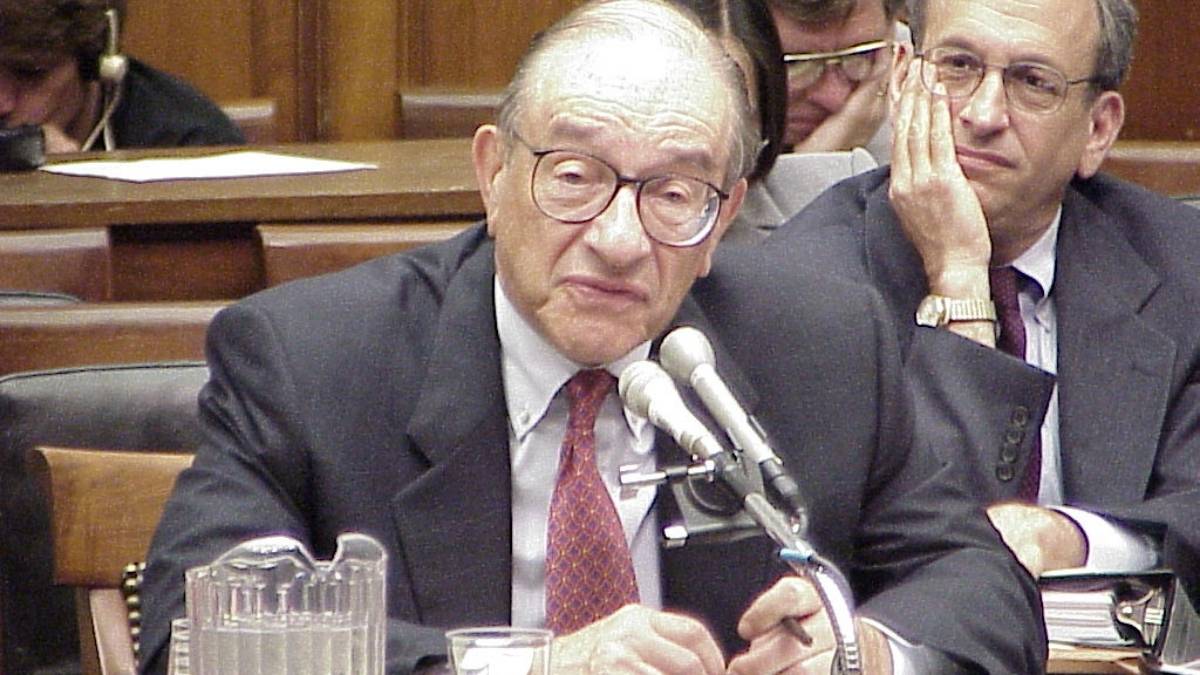
Alan Greenspan, legendary American economist and 13th Chairman of the Federal Reserve, has died aged 100. The maestro of monetary policy, often misspelled by casual followers as Allen Greenspan, died peacefully, leaving a profound legacy.
Greenspan’s historic tenure from 1987 to 2006 shaped the global financial landscape, directly impacting markets from Wall Street to Dalal Street in India. He was appointed by four US Presidents, and he navigated the economy through the 1987 stock market crash, the dot-com bubble, and the aftermath of 9/11.
Survived by his wife, veteran NBC correspondent Andrea Mitchell, Greenspan remains one of the most influential and widely discussed central bankers in modern history.
Who was Alan Greenspan?
Greenspan was born in New York City on March 6, 1926, with an early fascination for music and numbers. He went to the elite Juilliard School before becoming the face of American capitalism, and played the saxophone in a touring jazz band. But economics was his true vocation.
He later earned a Ph.D. from New York University and founded the consulting firm Townsend-Greenspan & Co. Washington politicians recognized his analytical brilliance. In elite financial circles, he is known simply as "Greenspan". This eventually led to his appointment as head of the Council of Economic Advisers under President Gerald Ford, kicking off his long career in government.
Major Milestones in Alan Greenspan's Career
Greenspan was famous for his data-driven style and complicated way of speaking, dubbed “Fedspeak,” that always kept global markets guessing during his tenure at the US Central Bank. His career has had many inflection points:
-
1987 Appointment: Nominated by President Ronald Reagan to lead the Federal Reserve.
Black Monday: Managed the 1987 stock market crash just months into his term, actively preventing a massive financial collapse.
The Dot-Com Boom: Navigated the rapid rise and subsequent burst of internet and technology stocks in the late 1990s.
Post-9/11 Recovery: Slashed interest rates to stabilize the global economy following the 2001 terrorist attacks.
Who is Alan Greenspan’s Wife?
Greenspan’s private life, when not consumed by economic issues, was often of public interest, given that he was married to Andrea Mitchell.
Mitchell is a leading journalist and NBC News’ chief foreign affairs correspondent. They married in 1997, a lovely combination of high-level government finance and broadcast journalism.
Throughout their nearly three decades of marriage, Mitchell remained a steadfast partner, often seen alongside him at high-profile Washington events.
How did Alan Greenspan impact the Indian and Global Economy?
Greenspan had control over the US dollar, but his policy decisions created huge ripples in emerging markets such as India. In the 1990s, when India opened its economy, the Bombay Stock Exchange was heavily influenced by the Federal Reserve’s interest rate policies in terms of foreign institutional investor (FII) inflows.
Greenspan supplied global liquidity indirectly by keeping borrowing costs low. This environment helped developing countries such as India to attract much-needed foreign capital in their critical years of growth and liberalization.
Alan Greenspan leaves behind an unmatched footprint on global monetary policy. In the depths of a financial crisis or in decades of economic growth, his policies will be debated by economists for years to come. The world has lost a giant of modern finance indeed.