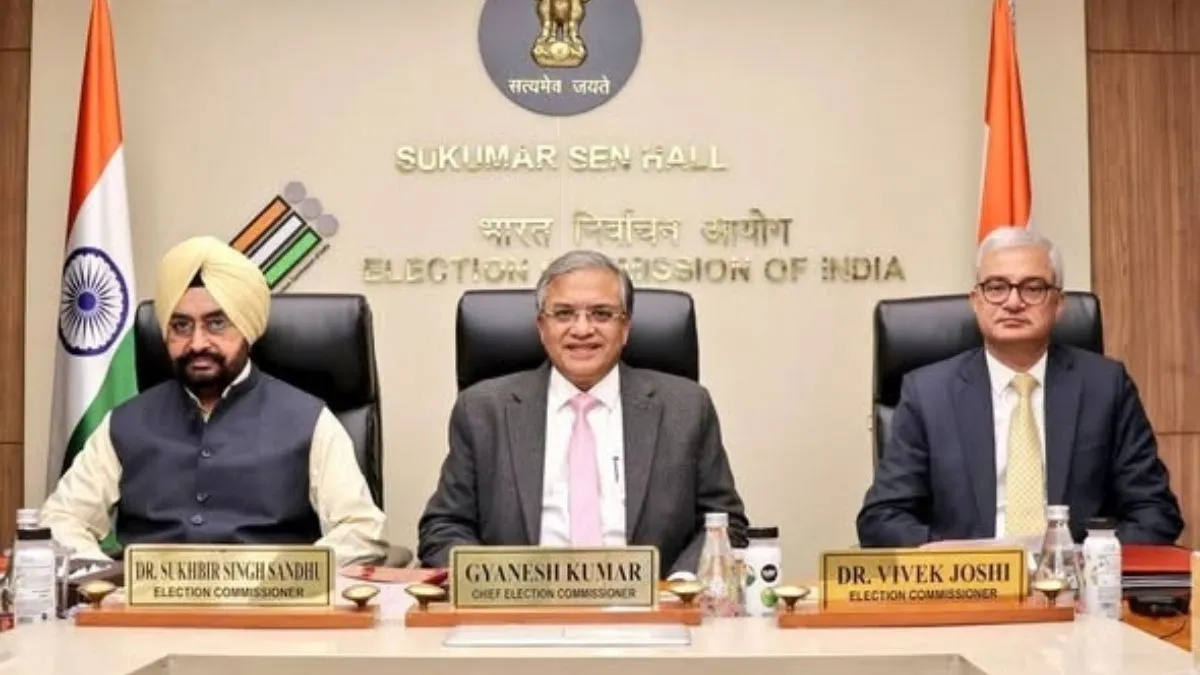
Election Commission of India (ECI) has made news lately due to the demonstrations against SIR (Special Intensive Revision) drive conducted by ECI all across India.
The political parties and voter groups have raised voices against the deletion of voters' names from the electoral list without any prior notice and field verification of those citizens.
The matter was filed in the Supreme Court of India wherein the judges have given notice in regard to the manner in which the application and revision of voters have taken place.
This article henceforth will guide you about the role of ECI and the current news surrounding it. This analysis will be very useful if you are preparing for UPSC, State PSC, SSC, and banking examinations.
What is ECI Special Intensive Revision (SIR) Row?
The SIR is a common procedure followed by the Election Commission with the objective of updating the voting lists.
This involves adding the names of newly eligible voters and deleting the names of those deceased or who have either relocated or registered themselves more than once.
The current debate centers on three practical issues:
-
Missing Names from SIR Form: Petitioners argue that legitimate voters lost their voting rights because door-to-door verification by local officials was incomplete.
Strict ID Documents: Voters were asked to produce legacy identification or birth documents to prove continuous residence. Many families found it hard to locate decades-old paperwork.
Changes to Form 6: Objections were raised in court alleging that the standard Form 6 (used to add new voters to the list) was modified mid-way through the drive without clear public notice.
How has the Election Commission of India Responded?
The ECI stated that all steps follow the rules laid down in the Representation of the People Act 1950. The Commission maintained that:
-
Revisions are necessary to ensure election integrity and stop fake entries.
-
Decisions are made by the full commission and not by any individual alone.
-
Anyone whose name was deleted can re-apply or submit an appeal to get restored before the final list is published.
What has the Supreme Court Said about SIR Row?
The courts have stepped in to balance administrative checks with voter rights:
-
The Supreme Court affirmed that the ECI has the basic constitutional duty under Article 324 to maintain accurate voter rolls.
-
The apex court issued notices asking the ECI and the Union Government to present records showing how changes to application procedures and Form 6 were introduced.
-
High Courts and Supreme Court benches have emphasised that local tribunals must resolve pending voter appeals quickly so no genuine citizen loses the right to vote.
GK Facts about the Election Commission of India (ECI)
Take a look at the following table about ECI. You can also use this quick summary table to review basic polity facts frequently tested in competitive exams:
|
Parameter
|
Key Constitutional Details about ECI
|
|
Status
|
Permanent and independent constitutional body
|
|
Part and Articles
|
Part XV
(Articles 324 to 329)
|
|
Established On
|
January 25th 1950
(Celebrated as National Voters' Day)
|
|
Current Structure
|
1 Chief Election Commissioner (CEC) and
2 Election Commissioners (ECs)
|
|
Headquarters
|
Nirvachan Sadan, New Delhi
|
|
Term Length
|
6 years or until reaching 65 years of age
(whichever comes first)
|
|
Removal of CEC
|
Removed only through parliamentary impeachment, just like a Supreme Court Judge
|
Important Articles related to ECI to Remember for Exams
-
Article 324: Gives the ECI complete authority to supervise, direct, and control elections for Parliament, State Assemblies, President, and Vice-President.
-
Article 325: States that no citizen can be excluded from voter lists on grounds of religion, race, caste, or sex.
-
Article 326: Guarantees universal adult franchise (it lowered the voting age from 21 to 18 through the 61st Amendment Act, 1988).
-
Article 327: Gives Parliament the power to pass laws regarding how elections are conducted.
-
Article 329: Restricts courts from interfering in routine election schedules, except through formal election petitions after results.