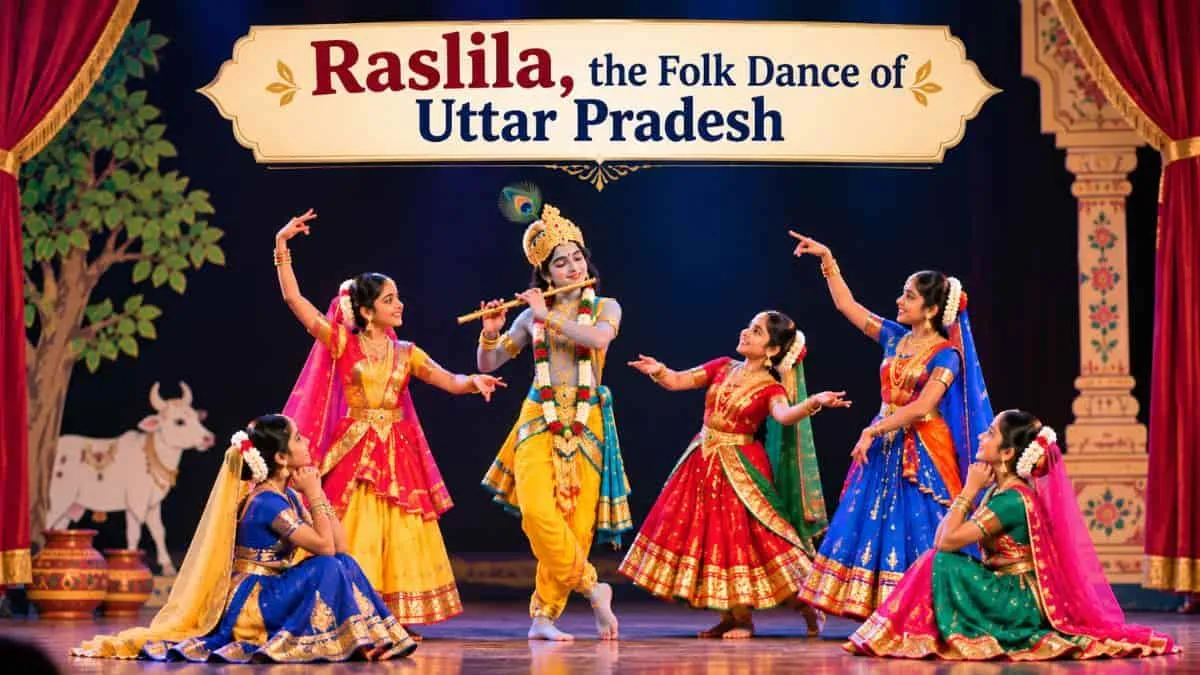
India is known for its numerous colourful folk dances and traditional dances. A beautiful tradition one such one is Raslila, which is very related to Lord Krishna's life and stories.
Raslila is predominantly associated with the Braj region of Uttar Pradesh in particular with Mathura and Vrindavan. It consists of dance, music, songs and acting in order to narrate the stories of Krishna's life. Raaslila is also included in the list of famous traditional dances and folk dances of Uttar Pradesh by the Government of Uttar Pradesh.
But do you know how Raslila started and why it became popular in Braj? Let us find out.
What Is Raslila?
Raslila is a traditional dance-drama featuring primarily the stories of Krishna, Radha and the Gopis.
The word Ras means joy, love and spiritual feelings, and Lila means a divine play or activity. In simple terms, Raslila is a drama/dance/music performance that tells the stories and plays of Krishna and his activities in a playful manner.
The tradition is closely associated with the region of Braj, which is around Mathura and Vrindavan. According to the Government of India publication India Perspectives, Raslila is a musical dance drama which was born and brought up in the region of Braj (Uttar Pradesh) in the 16th century.
Did You Know?Mathura-Vrindavan is not just known for its pilgrimage and temples. It is also a major hub of traditional culture of Braj such as the music, dance and even the performance of Krishna. Mathura, Vrindavan, Gokul, Barsana, Nandgaon, Govardhan are included in Uttar Pradesh's Krishna/Braj tourism circuit as part of the tourism policy.
|
What is the Origin of Raslila?
The origin of Raslila is related to the childhood and the youth of Lord Krishna in Braj.
The traditional tales indicate that the childhood of Krishna was an important period in his life, passing through Gokul and Vrindavan. The tales are about his life with his friends, the Gopis and Radha.
There is one popular story relating to the Ras dance, in which Krishna danced with the Gopis near the Yamuna. Later these stories played a significant role in the devotional practices of Braj.
The modern stage version of Raslila, however, came much later. The 16th century is thus a significant time in the evolution of the organised Raslila tradition in Braj. According to the Indira Gandhi National Centre for the Arts, it began in the 16th century and is related to some religious teachers and artists.
How Did It Become a Stage Performance?
During the Bhakti period, many saints and religious teachers helped spread devotion to Krishna through songs, poetry and performances.
Names associated with the development of the Braj Raslila tradition include:
-
Vallabhacharya
Swami Haridas
Hit Harivansh
Hariram Vyas
Narayan Bhatt
It is not agreed upon who started the first Raslila performance, exactly. There are various accounts in different traditions. It is generally accepted, however, that a big era was marked in the 16th century when the Braj form of Raslila gained shape and got more popular.
What Happens During a Raslila Performance?
A Raslila performance is not only a dance. It is a combination of several art forms.
|
Part
|
What happens?
|
|
Dance
|
Performers use traditional dance movements to show Krishna's stories.
|
|
Music
|
Songs and devotional music accompany the performance.
|
|
Drama
|
Different characters act out stories from Krishna's life.
|
|
Costumes
|
Performers wear colourful traditional clothes.
|
|
Characters
|
Krishna, Radha, Gopis and other characters are shown.
|
|
Stories
|
Episodes from Krishna's childhood and life in Braj are presented.
|
The performances traditionally use music, dance and storytelling to bring Krishna's stories before the audience.
Raslila and Janmashtami
Raslila is also performed around Krishna Janmashtami, the festival that celebrates the birth of Krishna.
The Uttar Pradesh government's cultural information notes that Rasa dance narrates stories from Krishna's early life and is organised on the occasion of Janmashtami.
During such performances, people gather to watch scenes from Krishna's childhood and his life in Braj.
Is Raslila Only a Dance?
No, it is not only a dance. Raslila is a traditional dance-drama or folk theatre rather than just a dance. It uses acting, singing, music, dialogue and dance together.
The Uttar Pradesh government describes Raaslila among the state's traditional performances in which stories are narrated along with dance.
Raslila: Quick GK Facts
|
Aspects
|
Details
|
|
What is Raslila?
|
A traditional dance-drama based on Krishna's stories
|
|
Which region is it mainly associated with?
|
Braj region
|
|
Which state is famous for it?
|
Uttar Pradesh
|
|
Important places
|
Mathura and Vrindavan
|
|
Main character
|
Lord Krishna
|
|
Other important characters
|
Radha and the Gopis
|
|
Important development period
|
16th century
|
|
Main art forms used
|
Dance, music, singing and drama
|
|
Festival associated with it
|
Krishna Janmashtami
|
|
Main theme
|
Stories and divine play of Krishna
|
Conclusion
One of the colourful traditional performance forms related to Braj state of Uttar Pradesh is Raslila. The stories are centered primarily on Lord Krishna, Radha and the Gopis.
The organized tradition of the Braj Raslila began to take a definite form in the 16th century, although the stories of Krishna's Ras dance are much older. The tradition was developed and spread by the music, poetry, dance and drama of saints, poets and religious teachers.
Raslila is still an integral part of the cultural heritage of Mathura, Vrindavan and the entire Braj region today.