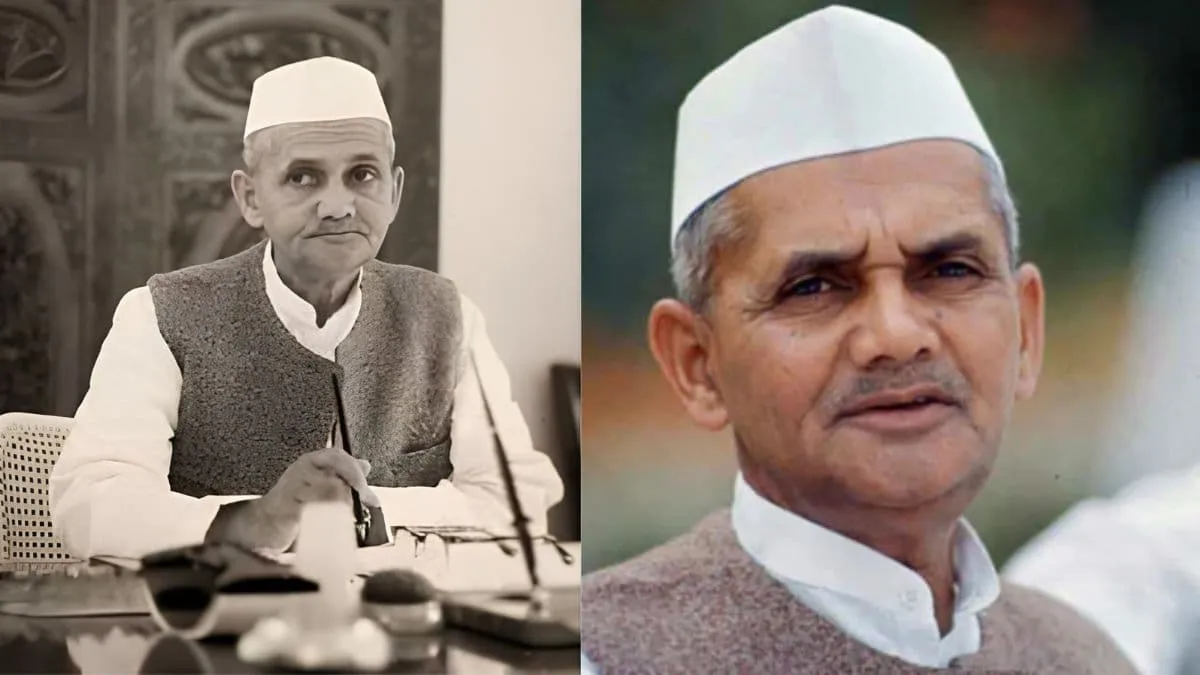
Lal Bahadur Shastri was the second Prime Minister of India, and he was popularly known for his slogan given by him, Jai Jawan Jai Kishan.
He was born on 2nd October, 1904, in Mughalsarai (now Pandit Deen Dayal Upadhyaya Nagar) in Varanasi, Uttar Pradesh.
He left his studies at sixteen and joined the Non-Cooperation Movement in India, but he joined the Kashi Vidya Peeth in Varanasi and completed his bachelor's degree.
|
Quick Fact
|
Detail
|
|
Born
|
2 October 1904
|
|
Birthplace
|
Mughalsarai, Uttar Pradesh
|
|
Political party
|
Indian National Congress
|
|
Prime Minister
|
9 June 1964 to 11 January 1966
|
|
Famous slogan
|
Jai Jawan Jai Kisan
|
|
Highest honour
|
Bharat Ratna (1966)
|
GK Quiz on Lal Bahadur Shastri: Test Your Knowledge!
Here, there are 10 MCQs on Lal Bahadur Shastri. So, without seeing the answers first, try to solve these MCQs and test your knowledge with this GK quiz.
1. When was Lal Bahadur Shastri born?
A) 2 October 1869
B) 2 October 1904
C) 14 November 1889
D) 31 October 1875
Answer: B) 2 October 1904
Explanation: Shastri ji was born on 2 October 1904. This is also the birth date of Mahatma Gandhi, so India remembers both leaders on the same day every year.
2. Where was Shastri ji born?
A) Varanasi
B) Allahabad
C) Mughalsarai
D) Mirzapur
Answer: C) Mughalsarai
Explanation: He was born in Mughalsarai, a small railway town about seven miles from Varanasi in Uttar Pradesh. He moved to Varanasi later to attend high school.
3. What was the job of Shastri ji's father?
A) Farmer
B) Railway clerk
C) School teacher
D) Lawyer
Answer: C) School teacher
Explanation: His father was a school teacher. He died when Lal Bahadur was only a year and a half old, so his mother raised the three children at her father's house.
4. What was Shastri ji's pet name at home when he was a child?
A) Lalu
B) Nanhe
C) Munna
D) Bahadur
Answer: B) Nanhe
Explanation: At home the family called him Nanhe, which means little one. As a child he walked many miles to school without shoes, even in the burning summer heat.
5. At what age did Shastri ji give up his studies to join the Non-Cooperation Movement?
A) Twelve
B) Sixteen
C) Twenty
D) Twenty-five
Answer: B) Sixteen
Explanation: Mahatma Gandhi called people to join the Non-Cooperation Movement when Shastri was sixteen. He gave up his studies at once, even though his family was upset about it.
6. Which institution in Varanasi did he join after leaving school?
A) Banaras Hindu University
B) Kashi Vidya Peeth
C) Aligarh Muslim University
D) Jamia Millia Islamia
Answer: B) Kashi Vidya Peeth
Explanation: He joined Kashi Vidya Peeth in Varanasi, one of the national institutions set up against British rule. There he learned from great thinkers and nationalists of that time.
7. What does the word "Shastri" in his name refer to?
A) A title given by a king
B) His family surname
C) A name given by Gandhiji
D) A bachelor's degree from Kashi Vidya Peeth
Answer: D) A bachelor's degree from Kashi Vidya Peeth
Explanation: Lal Bahadur Shastri was completed his bachelor's degree at Kashi Vidya Peeth, and in there at Kashi Vidya Peeth, this degree was called as “Shastri”. So, people used to call him "Shastri," and this word became a part of his name.
8. What was the only dowry Shastri ji accepted at his wedding?
A) Gold ornaments
B) A horse and a cart
C) A piece of land
D) A spinning wheel and a few yards of handspun cloth
Answer: D) A spinning wheel and a few yards of handspun cloth
Explanation: During his wedding, Shahstri ji only accepted a spinning wheel and a few yards of handspun cloth as a dowry.
9. How many years did Lal Bahadur Shastri ji spend in British jails during the freedom struggle?
A) Two years
B) Four years
C) Seven years
D) Twelve years
Answer: C) Seven years
Explanation: After Gandhi's Dandi March in 1930, Shastri joined the freedom struggle, and during this freedom fight toward British independence, he spent a total of 7 years in the British Jail.
10. Which post did Shastri ji reach in his home state, Uttar Pradesh, after 1946?
A) Chief Minister
B) Home Minister
C) Governor
D) Speaker
Answer: B) Home Minister
Explanation: He began as Parliamentary Secretary in Uttar Pradesh and soon became the state's Home Minister. His hard work and efficiency became well known across the state.