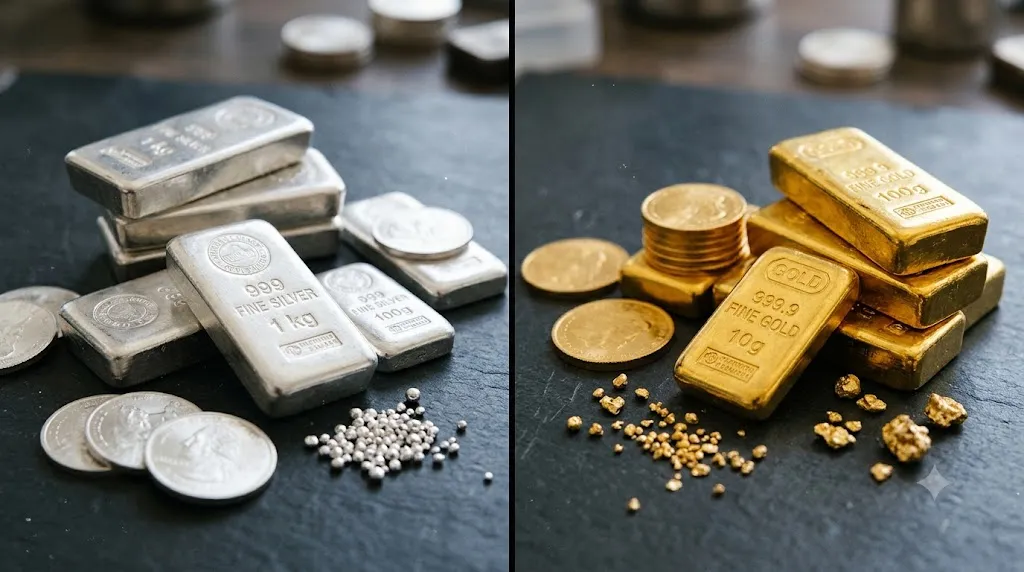
Gold and silver are two precious metals known for their distinctive appearance, durability and usefulness. While both belong to Group 11 of the periodic table, they have different physical and chemical properties that determine how they are used in science, technology, medicine and industry. Although gold is generally more expensive in the market, price is only one difference between these metals. Keep reading to know in detail.
Gold vs Silver: What Is the Scientific Difference?
Gold and silver are chemical elements with different atomic numbers, atomic masses and physical properties. Both are transition metals and are located in Group 11 of the periodic table.
Related Stories
| Scientific Property | Gold | Silver |
| Chemical name | Gold | Silver |
| Chemical symbol | Au | Ag |
| Atomic number | 79 | 47 |
| Relative atomic mass | Approximately 196.97 u | Approximately 107.87 u |
| Periodic table group | Group 11 | Group 11 |
| Period | 6 | 5 |
| Element category | Transition metal | Transition metal |
| Appearance | Naturally yellow and metallic | Shiny, silvery-white |
| State at room temperature | Solid | Solid |
| Density | Approximately 19.3 g/cm³ | Approximately 10.5 g/cm³ |
| Crystal structure | Face-centred cubic | Face-centred cubic |
| Main natural isotope | Gold-197 | Silver-107 and Silver-109 |
Gold vs Silver: Which Metal Is Denser?
Gold is considerably denser than silver. At room temperature, gold has a density of approximately 19.3 grams per cubic centimetre, while silver has a density of approximately 10.5 grams per cubic centimetre. This means that a solid piece of gold and a solid piece of silver with the same volume will not have the same mass. The gold piece will weigh considerably more.
Gold vs Silver: Melting Point and Boiling Point
Melting point refers to the temperature at which a solid becomes a liquid under a specified pressure. Gold has a higher melting point than silver, meaning it requires a higher temperature to melt.
Gold vs Silver: Chemical Reactivity and Corrosion
Gold is a relatively unreactive metal and resists oxidation and corrosion under ordinary environmental conditions. This is one reason gold objects can retain their appearance for long periods. Silver is also a noble metal but it reacts with sulfur-containing compounds in the environment. This can form a dark surface layer of silver sulfide, commonly called tarnish.
| Chemical Property | Gold | Silver |
| Resistance to oxidation | Very high | Generally good, but surface reactions occur |
| Tarnishing | Does not normally tarnish under ordinary conditions | Can tarnish due to sulfur compounds |
| Corrosion resistance | Excellent | Good, depending on the environment |
| Common surface change | Usually retains its metallic appearance | May develop a dark coating |
| Practical consequence | Useful for durable decorative and electronic contacts | May require cleaning to restore its appearance |
Gold vs Silver Price Comparison Table
| Metal | Purity | Price | Unit |
| Gold | 24 carat, 999 | ₹1,44,595 | 10 grams |
| Gold | 22 carat, 916 | ₹1,32,449 | 10 grams |
| Gold | 18 carat, 750 | ₹1,08,450 | approximately 10 grams |
| Silver | 999 purity | ₹1,96,757 | 1 kilogram |
| Silver | 999 purity | ₹19,676 | approximately 100 grams |
| Silver | 999 purity | ₹1,968 | approximately 10 grams |
| Silver | 999 purity | ₹197 | approximately 1 gram |
Price date: October 29, 2026, 11:28 AM IST.
Gold vs Silver Price in Delhi Today
For readers purchasing precious metals in Delhi, local reference rates offer a useful comparison. All India Bullion reported the following rates for Delhi on October 29, 2026.
| Metal | Purity | Price | Unit |
| Gold | 24 carat, 999 | ₹1,44,650 | 10 grams |
| Gold | 22 carat, 916 | ₹1,32,705 | approximately 10 grams |
| Silver | 999 purity | ₹1,96,832 | 1 kilogram |
| Silver | 999 purity | ₹19,683 | approximately 100 grams |
| Silver | 999 purity | ₹1,968 | approximately 10 grams |