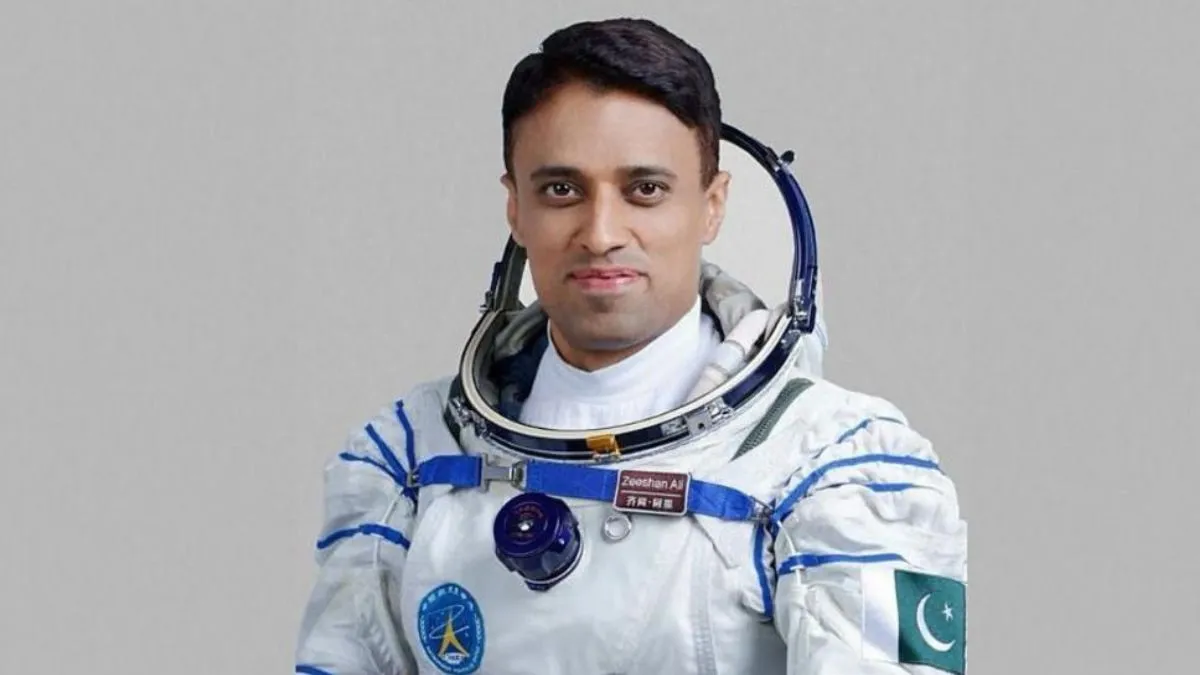
China’s Shenzhou-24 spacecraft launched on November 25, 2026, carried Pakistani astronaut Muhammad Zeeshan Ali alongside Chinese astronauts Tang Hongbo and Wu Yi. The mission marks the historic first time any Pakistani astronaut has entered orbit and the debutant foreign national to joined a crewed Chinese spaceflight and visited the Tiangong space station. Beyond its scientific importance, it underscores growing China-Pakistan space cooperation, a development attracting attention in India.
What Is China’s Shenzhou-24 Mission?
The spacecraft took off from Jiuquan Satellite Launch Centre aboard a Long March-2F rocket and later docked with Tiangong. Ali, a 40-year-old Pakistan Air Force pilot, is serving as a payload specialist. He is slated to stay in orbit for five to ten days before returning to Earth with members of the earlier crew.
The mission spans across around 90 scientific experiments and technology tests. Pakistan’s space agency has detected research involving microalgae and quinoa seeds among the areas of interest. Ali’s participation comes amid February 2025 cooperation agreement between Pakistan’s Space and Upper Atmosphere Research Commission and the China Manned Space Agency. He underwent seven months of training in China.
Related Stories
How Deep Are China-Pakistan Space Ties?
The collaboration dates back decades when China launched Pakistan’s maiden satellite, Badr-1, in 1990, and the countries have since worked together on satellite launches and research. Pakistan has joined China’s lunar exploration plans, with a Pakistani-designed rover likely to participate in a future Chinese Moon mission.
For Chian, inviting a foreign astronaut presents Tiangong as a global platform and bolsters its diplomatic influence. For Pakistan, it provides access to human-spaceflight experience and research scope that would be difficult to develop separately.
Why Does It Matter to India?
The concern in India encompasses beyond Ali’s flight. Reportedly, Pakistan has launched numerous satellites using Chinese launch vehicles since 2025. Indian defence officials have also ignited concerns that China may have provided Pakistan with satellite-based information during Operation Sindoor. These claims are allegations, not separately confirmed facts.
Satellite imagery, navigation and communications can have civilian and military uses. Closer China-Pakistan ties in these areas therefore has strategic consequences for India.
What Is India’s Position?
India is also establishing its human-spaceflight programme, Gaganyaan, and aims to establish an Indian space station by 2035. Shenzhou-24 underlines why space technology is linked not only to science, but also to diplomacy, security and regional influence for the region.