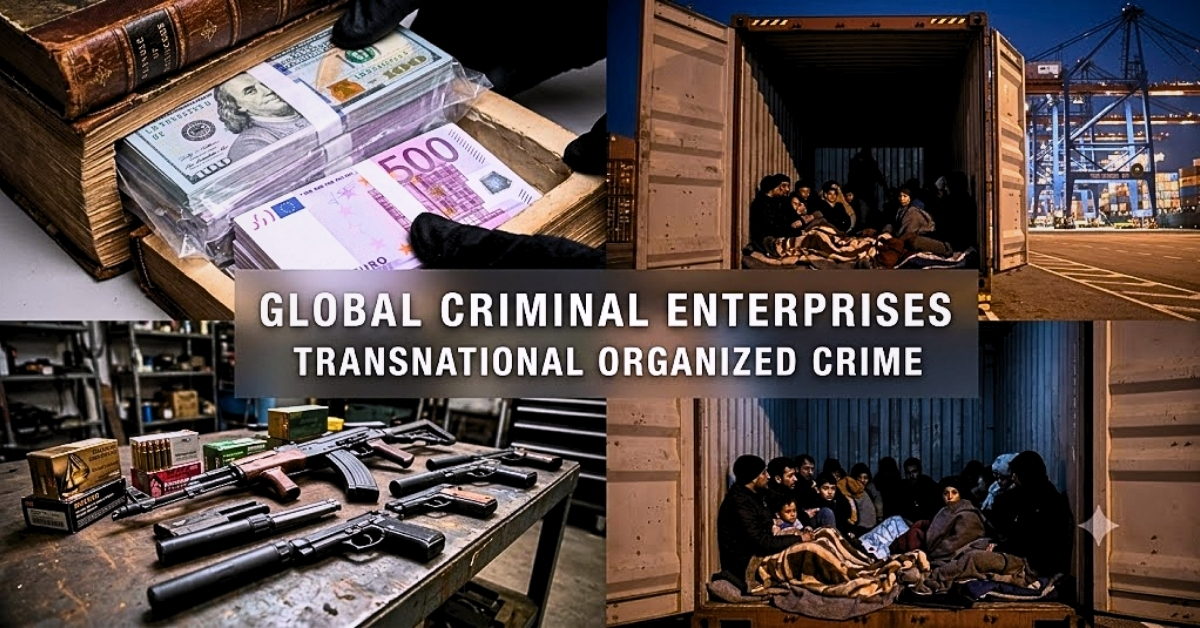
Globalisation facilitated international trade and communication but it also promoted rapid expansion of criminal networks. Transnational crime represents one of the most complex threats to international security, state sovereignty, human rights and economic stability.
Transnational organized crime operates across international borders, exploiting regulatory loopholes, weak border security and jurisdictional limitations.
According to reports by the United Nations Office on Drugs and Crime (UNODC) organised crime accounts for approximately 95,000 homicides annually worldwide. A scale of human loss comparable to active armed conflicts.
What is Transnational Crime?
Transnational crime refers to illegal activities conducted by organized criminal networks that cross international boundaries, involving planning, execution or impact across two or more nations.
UNTOC Definition
An organised criminal group is defined under UNTOC as a structured group of three or more persons existing for a period of time and acting in concert to commit one or more serious crimes to obtain financial or material benefit.
United Nations Convention against Transnational Organised Crime (UNTOC) framework on transnational crime also known as the Palermo Convention adopted in 2000.
According to Article 3 of UNTOC, an offense is considered transnational if
-
It is committed in more than one State
It is committed in one State but a substantial part of its preparation, planning, direction or control takes place in another State.
-
It is committed in one State but involves an organised criminal group that engages in criminal activities in more than one State.
-
It is committed in one State but has substantial effects in another State.
Types of Transnational Crime
Transnational organised crime is diverse form based on in technology and logistics such as
Drug trafficking
The illegal production, distribution and sale of prohibited substances like cocaine, heroin, synthetic drugs, etc remains the financial mainstay of most organised crime groups, generating hundreds of billions of dollars annually.
Human Trafficking
Trafficking of humans through the recruitment, transportation or harbouring of individuals through force, fraud, or coercion for exploitation (sexual exploitation, forced labor or organ harvesting). It is governed by the Palermo Protocol on Human Trafficking.
Smuggling of migrants is the procurement of the illegal entry of a person into a State Party of which the person is not a national or permanent resident, typically for financial gain.
Financial Crimes
Criminal organizations generate vast quantities of dirty money that must be integrated into legitimate financial systems. It include trade-based money laundering (TBML), shell companies and tax havens (Hiding ultimate beneficial ownership) and Cryptocurrency Exploitation( Using decentralized assets to obfuscate transaction trails)
Digital Fraud
Modern financial transnational groups rely on borderless digital tools to conduct large-scale operations like Ransomware attacks to target critical infrastructure and municipal governments.
Industrial scam hubs operate centralised online fraud farms to siphon off personal savings globally. Online exploitation networks operate illicit marketplaces on the dark web.
Environmental & Wildlife Crimes
This involves the illegal extraction and trafficking of natural resources including ivory, timber, protected fauna and rare minerals. These activities exacerbate biodiversity loss, deforestation and climate vulnerability.
Impact of Transnational Crime
The ramifications of transnational organized crime extend beyond regional law enforcement challenges, impacting economic systems, national security and democratic governance.
Transnational crime diverts billions of dollars in tax revenues, disturbs fair market competition and drives away legitimate foreign direct investment (FDI).
It creates a threat to economies that destabilizes national currencies and financial systems. It leads to criminal governance where crime syndicates capture state institutions, corrupt law enforcement and manipulate electoral processes through illicit funding and intimidation.
It causes severe loss of life, inflicts profound trauma on human trafficking victims and creates widespread violence associated with territorial disputes between criminal cartels.
International Frameworks to Transnational Crime
To address borderless criminal networks requires a coordinated global response involving multilateral treaties, law enforcement cooperation and financial tracking mechanisms.
-
UN Convention against Transnational Organised Crime (UNTOC) is a legally binding global instrument forcing member states to align national laws, criminalise participation in organised groups and assist in cross-border extraditions.
-
UN Office on Drugs and Crime provides technical assistance, legislative drafting aid and global data tracking. Acts as the custodian of UNTOC,
-
INTERPOL (International Criminal Police Organisation) facilitates real-time intelligence sharing among member countries using secure communication channels and specialised alerts like Red Notices (wanted persons) and Purple Notices (modus operandi).
Financial Action Task Force (FATF)
The global money laundering and terrorist financing watchdog. It sets international standards (FATF 40 Recommendations) and maintains "Black" and "Grey" lists to compel non-compliant nations to strengthen financial oversight.
Transnational crime poses an evolving challenge to global security. The criminal networks are increasingly adopting emerging technologies like artificial intelligence, encrypted communications and decentralized finance.
Combating transnational crime networks requires proactive international cooperation, robust financial oversight, institutional anti-corruption measures and dedicated capacity-building in vulnerable regions.